- Animals
- ›Arthropods
- ›Hexapods
- ›Insects
- ›Winged and Once-winged Insects
- ›Butterflies and Moths
- ›Owlet Moths and Allies
- ›Cutworm Moths and Allies
- ›Cutworms and Dart Moths
- ›Noctuini
- ›Agrotina
- ›Agrotis
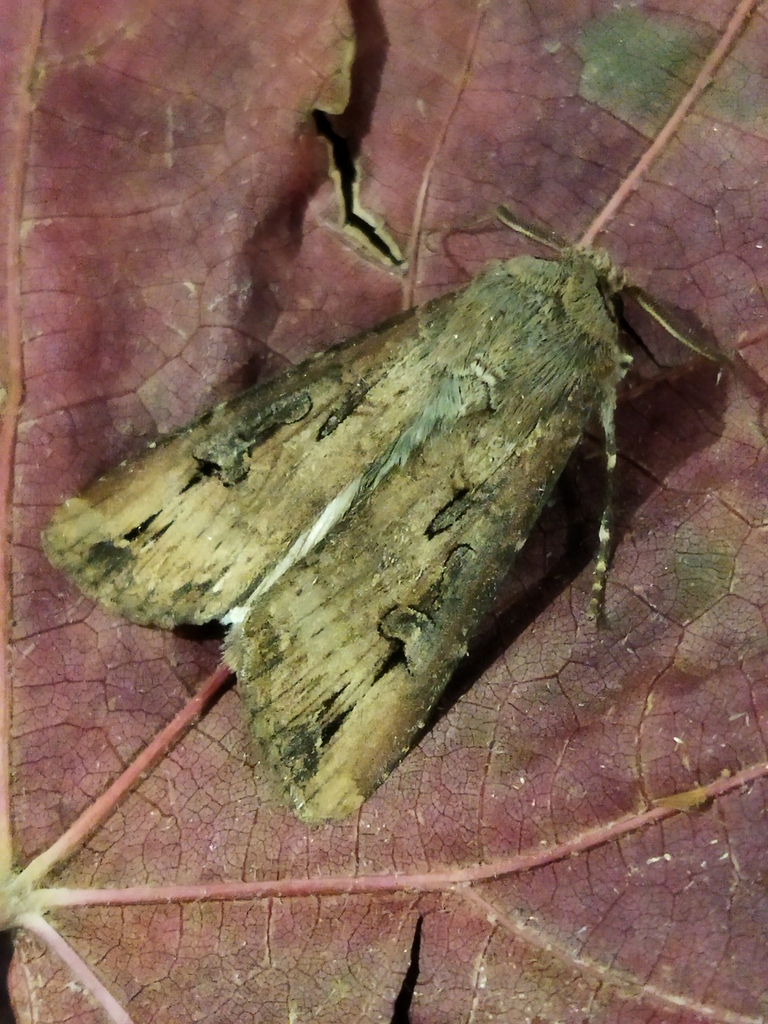
Ipsilon Dart Moth
Agrotis ipsilon
Agrotis ipsilon, the dark sword-grass, ipsilon dart, black cutworm, greasy cutworm or floodplain cutworm, is a small noctuid moth found worldwide. The moth gets its scientific name from black markings on its forewings shaped like the letter "Y" or the Greek letter upsilon. The larvae are known as "cutworms" because they cut plants and other crops. The larvae are serious agricultural pests and feed on nearly all varieties of vegetables and many important grains.
This species is a seasonal migrant that travels north in the spring and south in the fall to escape extreme temperatures in the summer and winter. The migration patterns reflect how reproduction occurs in the spring and ceases in the fall.
From the article Agrotis ipsilon on Wikipedia (CC BY-SA), quoted section by section
Description
38–48 millimetres (1.5–1.9 in). Antennae in male bipectinated. Forewings brown, reddish-tinged, mixed with pale greyish-ochreous, costa and sometimes median area suffused with dark fuscous; first and second lines edged with dark fuscous; spots outlined with black, reniform followed by a short black dash; subterminal line obscure, usually preceded in middle by two fine black marks. Hindwings whitish-grey or whitish, terminally suffused with fuscous. Larva ochreous brownish or bronzy-grey, sides sometimes greenish; dorsal, subdorsal, and spiracular lines faintly darker or lighter, usually darker-edged; head suffusedly brown-marked.
Range & habitat
Populations of this species have been found in southern Canada, 48 of the United States (and additionally Hawaii), Mexico, Central and South America, Australia, New Zealand, the Pacific Rim, North Africa, Europe, and Asia. However, they are absent from some tropical regions and colder areas and are more widespread in the Northern than Southern Hemisphere. This species is also known to migrate north in the spring and migrate south in the fall.
Wikipedia: “Geographic range”
What it does
In a given year, the number of generations differs based on location and weather conditions. In Canada, there are 1 or 2 generations, while in the United States, there are 2 to 4 per year. This species is abundant in warmer temperatures (such as Arkansas, US) during the late spring in May–June and early fall in September and October, while they are more abundant in cooler temperatures (such as New York, US) during the summer in June and July. One life cycle lasts between 35–60 days.
Egg. The egg stage lasts 3 to 6 days. Females oviposit eggs in clusters on low-lying leaves. If such host plants are not available, the females will oviposit on dead plant material. However, they will not lay eggs on bare soil. Females can deposit eggs singly, or in groups of up to 1200 to 1900 eggs.
The nearly spherical eggs are initially white but turn brown with age. The surface of the egg possesses 35–40 ribs that radiate from one apex.
Caterpillar. The larval stage lasts 20–40 days. Over the span of 5 to 9 instars, the caterpillar body grows from 3.5 mm to a maximum of 55 mm. Larval development is optimized at a temperature of 27 degrees Celsius, and instars 1–5 are most successful at higher humidities. By the 4th instar, the larva becomes light sensitive and spends most of the daylight underground. The larvae are considered pests because they damage the plant tissue under the soil. …
Wikipedia: “Life cycle”
How it is grown
Each larva can consume over 400 square centimetres of foliage during its development. They feed above ground until about the fourth instar. After that they do considerable damage to crops by severing young plants at ground level. In the midwestern US, the black cutworm is considered to be a serious pest of corn. Corn is very susceptible at the one-leaf stage, but by the four- or five-leaf stage, it is relatively unaffected. Damage to the underground parts of plants can also be harmful. Other crops where serious damage occurs include cotton, maize, tobacco, sunflower, tomatoes, sugar beet and potato.
Management. There are three options to manage cutworm population and the incurred damages. Soil insecticides can be applied as a pre-plant treatment, although this may be limited by the unpredictability of cutworm population density distribution. These insecticides can also be applied as a planting-time treatment, although the same limitations still hold. The third option would be a rescue treatment that is applied after the infestations have occurred; this is also called the wait-and-see system. This may also be preferable due to a recently lower occurrence of outbreaks.
Wikipedia: “Agricultural Pest”
Listen
Looking for field recordings…
Where it lives
Recorded sightings
—
geo-referenced records in GBIF, from museums, herbaria and field observers.
Drag the globe to turn it. Dots are where records exist, not a range map; darker means more records.
In the stacks
Searching the stacks…
Every page naming Agrotis ipsilon in the Biodiversity Heritage Library →
This page is assembled live from iNaturalist, GBIF, Wikipedia, the Source Library and the Internet Archive. It is not yet part of the hand-edited codex. iNaturalist taxon 126276.