- Animals
- ›Arthropods
- ›Hexapods
- ›Insects
- ›Winged and Once-winged Insects
- ›Butterflies and Moths
- ›Hawk, Sphinx, Silk, Emperor, and Allied Moths
- ›Sphinx Moths
- ›Macroglossine Sphinx Moths
- ›Dilophonotini
- ›Philampelina
- ›Amphion
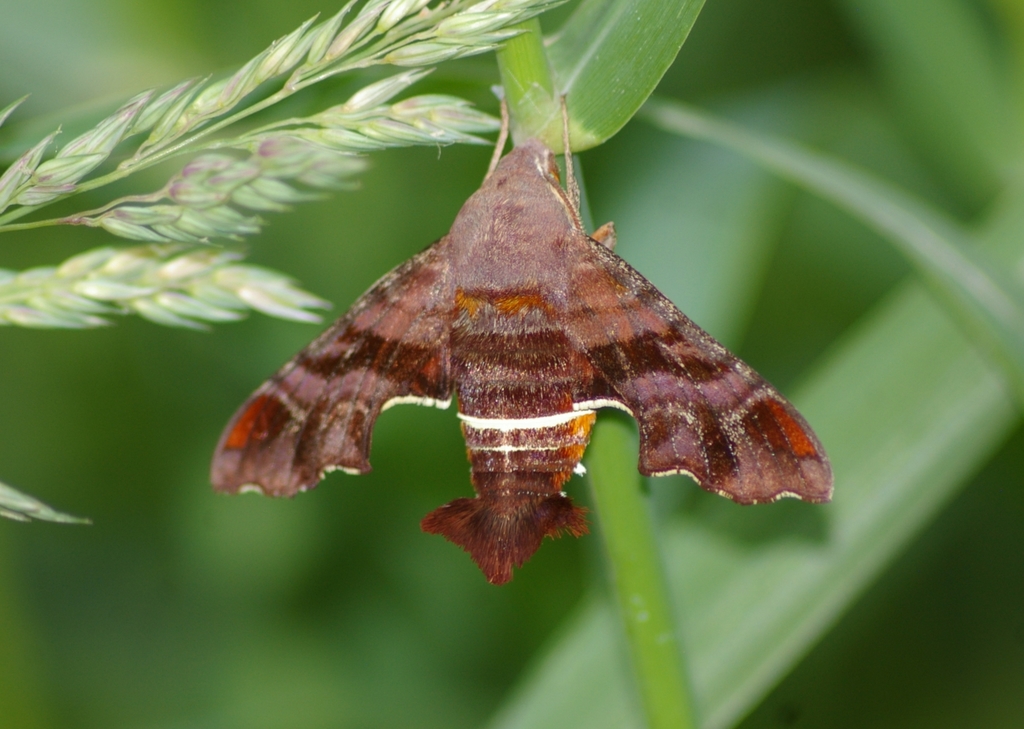
Nessus Sphinx
Amphion floridensis
Amphion floridensis, the Nessus sphinx, is a day-flying moth of the family Sphingidae. The species was described by Pieter Cramer in 1777, and renamed in 1920. It is the only member of the genus Amphion erected by Jacob Hübner in 1819. It lives throughout the eastern United States and Canada and occasionally south into Mexico, and is one of the more commonly encountered day-flying moths in the region, easily recognized by the two bright-yellow bands across the abdomen.
From the article Amphion floridensis on Wikipedia (CC BY-SA), quoted section by section
Description
The Nessus sphinx has reddish median bands on its hindwings and two prominent horizontal yellow stripes and a tail feather-like hair tuft on abdomen of both sexes. The wingspan is 37–55 mm. It has a stout body and reddish-brown upperside wings, and in some individuals the hindwings may have pale to absent median band or a yellow spot on the costal margin.
Range & habitat
Found in the Eastern United States from Maine to Florida and as far west as Colorado.. The Canadian range extends from the southeast corner of Manitoba to Nova Scotia.
Wikipedia: “Geographic range”
Listen
Looking for field recordings…
Where it lives
Recorded sightings
—
geo-referenced records in GBIF, from museums, herbaria and field observers.
Drag the globe to turn it. Dots are where records exist, not a range map; darker means more records.
In the stacks
Searching the stacks…
Every page naming Amphion floridensis in the Biodiversity Heritage Library →
This page is assembled live from iNaturalist, GBIF, Wikipedia, the Source Library and the Internet Archive. It is not yet part of the hand-edited codex. iNaturalist taxon 126153.