- Animals
- ›Arthropods
- ›Hexapods
- ›Insects
- ›Winged and Once-winged Insects
- ›Butterflies and Moths
- ›Gracillarioidea
- ›Leaf Blotch Miner Moths
- ›Lithocolletinae
- ›Cameraria
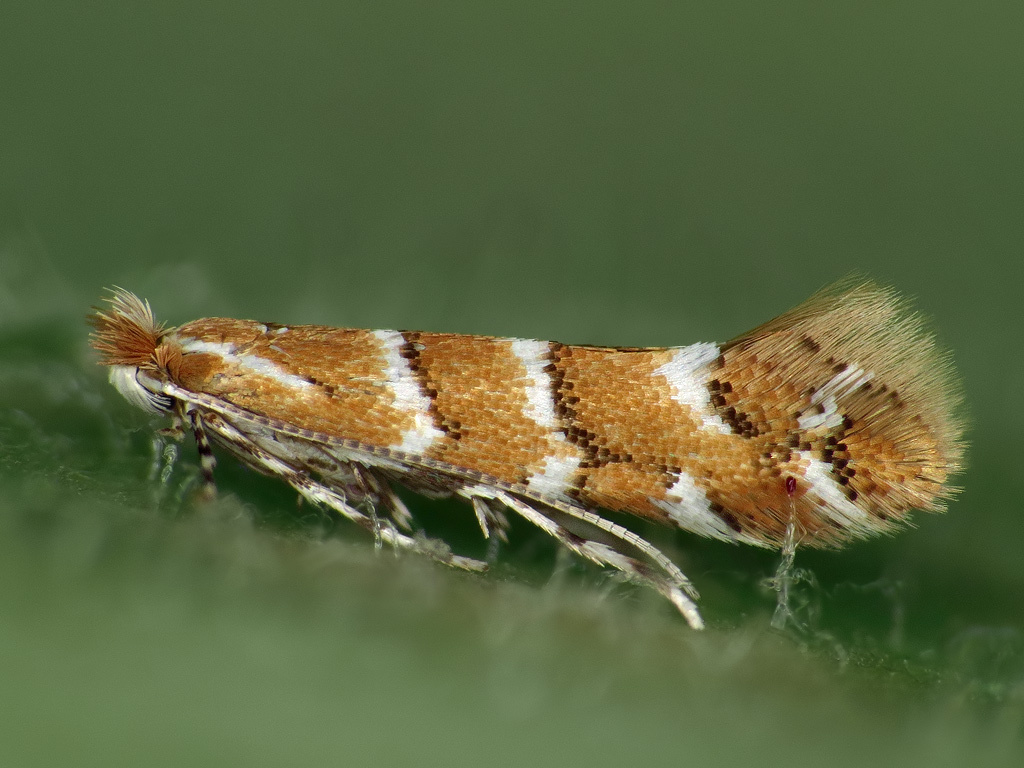
Horse-chestnut Leafminer
Cameraria ohridella
The horse-chestnut leaf miner (Cameraria ohridella) is a leaf-mining moth of the family Gracillariidae. The horse-chestnut leaf miner was first observed in North Macedonia in 1984, and was described as a new species in 1986. Its larvae are leaf miners on the common horse-chestnut (Aesculus hippocastanum). The horse-chestnut leafminer was first collected and inadvertently pressed in herbarium sheets by the botanist Theodor von Heldreich in central Greece in 1879.
From the article Horse-chestnut leaf miner on Wikipedia (CC BY-SA), quoted section by section
Description
The moth is up to 5 millimetres (3⁄16 inch) long, with shiny, bright brown forewings with thin, silvery white stripes. The hindwings are dark grey with long fringes. Each female moth lays between 20 and 40 eggs singly on the upper surface of leaves, and once these hatch 2–3 weeks later, the larvae develop through five feeding phases (or instars) and two prepupal (spinning) phases before the pupal phase. The first stage creates a small cavity (or mine) parallel to a vein in the leaf and is "sap-sipping" rather than "tissue-feeding". By the third instar, the larva creates a mine approximately 8mm in diameter; this is further expanded by later instars until one mine can cover several square centimeters. The larva starts to pupate around four weeks after the egg hatches and, except when hibernating as a pupa in the mine, the adult emerges around two weeks later. In severe infestations, the mines of individuals can merge and almost the entire leaf area may be utilised. When this occurs it may lead to high moth mortality as the larvae compete for space and food. The moth is able to go through up to five generations each year, if the weather is hot and dry; on average in western Europe, the moth goes through three generations each year. The last generation of the year pupates for over six months so as to survive the winter. …
Range & habitat
Cameraria ohridella has now been found in Albania, Austria, Belgium, Belarus, Bosnia and Herzegovina, Bulgaria, Croatia, the Czech Republic, Denmark, England and Wales, Estonia, Finland, France, Germany, Greece, Hungary, Ireland, Italy, Kosovo, Latvia, Liechtenstein, Lithuania, Luxembourg, Moldova, Montenegro, the Netherlands, North Macedonia, Poland, Serbia, Romania, Russia, Serbia, Slovakia, Slovenia, Spain, Sweden, Switzerland, Turkey and Ukraine. Although horse-chestnut occurs naturally mostly above the 700–1,000 m (2,300–3,300 ft) contours the moth does well in well-watered places such as parks in cities and at low elevation but not well in the hotter parts of Europe e.g. Spain. Probably aided greatly by vehicular transport, the moth has attained a very rapid dispersal rate across Europe of 60 kilometres (40 miles) per year.
Wikipedia: “Distribution and dispersal”
Listen
Looking for field recordings…
Where it lives
Recorded sightings
—
geo-referenced records in GBIF, from museums, herbaria and field observers.
Drag the globe to turn it. Dots are where records exist, not a range map; darker means more records.
In the stacks
Searching the stacks…
Every page naming Cameraria ohridella in the Biodiversity Heritage Library →
This page is assembled live from iNaturalist, GBIF, Wikipedia, the Source Library and the Internet Archive. It is not yet part of the hand-edited codex. iNaturalist taxon 126088.