On eBird ↗
Himalayan Quail
Live sightings near you, the range map, bar charts of when it is seen, and Macaulay Library photos and recordings.
Himalayan Quail
Ophrysia superciliosa
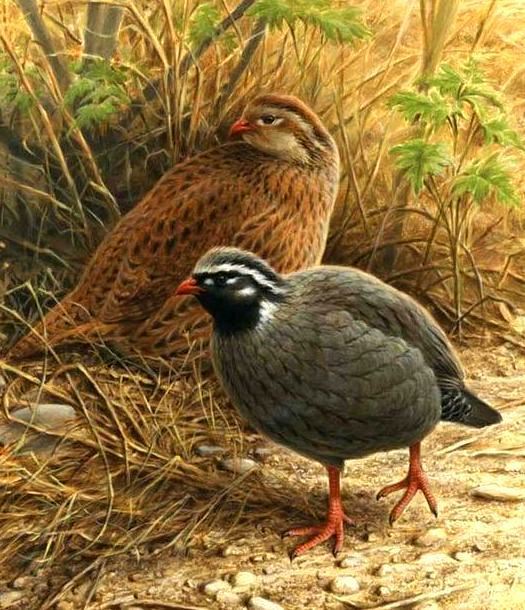
The Himalayan quail (Ophrysia superciliosa) or mountain quail, is a medium-sized quail belonging to the pheasant family. It was last reported in 1876 and is feared extinct. This species was known from only two locations (and 12 specimens) in the western Himalayas in Uttarakhand, north-west India. The last verifiable record was in 1876 near the hill station of Mussoorie.
From the article Himalayan quail on Wikipedia (CC BY-SA), quoted section by section
Description
The red bill and legs of this small dark quail and white spots before and after the eye make it distinctive. The male is dark grey with bleak streaks and a white forehead and supercilium. The female is brownish with dark streaks and greyish brow. Like the male it has a white spot in front of the eye and a larger one behind the eye. It is believed to fly only when flushed at close quarters and was found in coveys of five or six. The habitat was steep hillsides covered by long grass. The genus name is derived from ophrys, which refers to the brow. This quail has long tail coverts and the 10 feathered tail is longer, nearly as long as the wing, than in most quails. The feathers of the forehead are bristly and stiff. The species was described in 1846 by J.E. Gray from living specimens in the collection of the Earl of Derby at Knowsley Hall, and he gave the locality as "India" with a query. These are the two syntype specimens of Rollulus superciliosa J.E.Gray (Knowsley Menagerie, 1, 1846, p.8, pl.16) and are held in the collections of National Museums Liverpool at World Museum, with accession numbers D259 (male) and D259a (female). …
What it does
All records of the Himalayan quail are in the altitude range of 1,650 to 2,400 m. They were seen in patches of tall grass ("high jungle grass", "tall seed-grass", see Terai) and brushwood on steep hillsides, particularly on the crests of south- or east-facing slopes. It probably bred around September. The June specimen is a yearling male in moult.A. O. Hume (Stray Feathers 9 [1880 or 1881]: 467-471) suggested that it was similar in habit to the Manipur bush quails Perdicula manipurensis in that it was seen very rarely, except at dawn or dusk, keeping to tall grassland, relying on its legs rather than its wings for escape and only flying when closely approached. The fluffy, soft plumage suggests it was adapted for low temperatures; it has been suggested that the birds migrated north and uphill in the summer months to the higher mountains, but the shape and size of its wings do not suggest a bird capable of flying long distances. However, the sites where it was recorded are almost 200 km apart and separated by the much lower elevation of the Ganges valley near Rishikesh. …
Wikipedia: “Ecology”
Listen
Looking for field recordings…
Where it lives
Recorded sightings
—
geo-referenced records in GBIF, from museums, herbaria and field observers.
Drag the globe to turn it. Dots are where records exist, not a range map; darker means more records.
In the stacks
Searching the stacks…
Every page naming Ophrysia superciliosa in the Biodiversity Heritage Library →
This page is assembled live from iNaturalist, GBIF, Wikipedia, the Source Library and the Internet Archive. It is not yet part of the hand-edited codex. iNaturalist taxon 1251.