- Plants
- ›Vascular Plants
- ›flowering plants
- ›Dicots
- ›Sunflowers, Bellflowers, Fanflowers, and Allies
- ›Sunflowers, Daisies, Asters, and Allies
- ›Asteroideae
- ›Sunflowers and Allies
- ›Helianthinae
- ›Helianthus
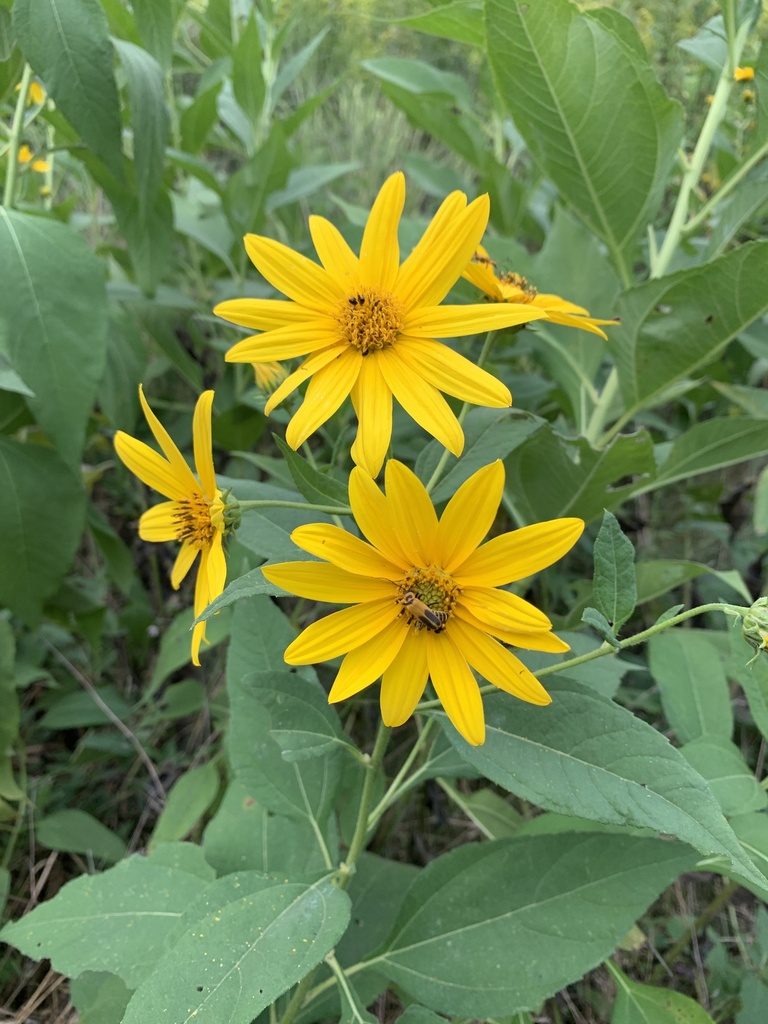
Jerusalem artichoke
Helianthus tuberosus
The Jerusalem artichoke (Helianthus tuberosus), also called sunroot, sunchoke, earth apple, or topinambour, is a species of sunflower native to eastern North America, and found from eastern Canada and Maine west to North Dakota, and south to northern Florida and Texas. It is also cultivated widely across the temperate zone for its tuber, which is used as a root vegetable.
From the article Jerusalem artichoke on Wikipedia (CC BY-SA), quoted section by section
Description
Helianthus tuberosus is a herbaceous perennial plant growing to 1.5–3 m (4 ft 11 in – 9 ft 10 in) tall with opposite leaves on the lower part of the stem but alternate towards the top. The leaves have a rough, hairy texture. Larger leaves on the lower stem are broad ovoid-acute and can be up to 30 cm (12 in) long. Leaves higher on the stem are smaller and narrower. The flowers are yellow and produced in capitate flowerheads, which are 5–10 cm (2–4 in) in diameter, with 10–20 ray florets and 60 or more small disc florets. The flowers are briefly fragrant, giving off a light, vanilla-chocolate scent. The tubers are often elongated and uneven, typically 7.5–10 cm (3–3+7⁄8 in) long and 3–5 cm (1–2 in) thick, and vaguely resembling a ginger root in appearance, with a crisp and crunchy texture when raw. They vary in color from pale brown to white, red, or purple.
Range & habitat
Originating in North America, the Jerusalem artichoke can now be found in several countries in North and South America, Europe, Asia, and Australia. In Central Europe it is one of the most expanding invasive plant species. It can grow in many geo-climatic regions and different types of soils. However, Jerusalem artichoke prefers moist habitats and seems to be less tolerant of dry conditions.
Wikipedia: “Origins and distribution”
At the table
The tubers can be eaten raw, cooked, or pickled. Before the arrival of Europeans, indigenous peoples cultivated H. tuberosus as a food source. The tubers persist for years after being planted, so the species expanded its range from central North America to the eastern and western regions. Early European colonists learned of this and sent tubers back to Europe, where they became a popular crop and naturalized there. It later gradually fell into obscurity in North America, but attempts to market it commercially were successful in the late 1900s and early 2000s. The tuber contains about 2% protein, no oil, and little starch. It is rich in the carbohydrate inulin (8 to 13%), which is a polymer of the monosaccharide fructose. Tubers stored for any length of time convert their inulin into its component, fructose. Jerusalem artichokes have an underlying sweet taste because of the fructose, which is about one and a half times as sweet as sucrose.
It has also been reported as a folk remedy for diabetes: since inulin is not assimilated in the intestine, it does not cause a glycemic spike as potatoes would. Temperature variances have been shown to affect the amount of inulin the Jerusalem artichoke can produce. It makes less inulin in a colder region than when it is in a warmer region.
Wikipedia: “Culinary use”
How it is grown
Unlike most tubers, but in common with many other members of the Asteraceae (including the artichoke), Jerusalem artichoke tubers store their carbohydrates as the polysaccharide inulin (not to be confused with the peptide insulin) rather than as starch. This has made them an important source of inulin used as a dietary fiber in food manufacturing. Jerusalem artichoke can propagate with seeds and tubers but the use of tubers leads to higher yields. For planting, the tubers are cut into pieces with three to five buds that are placed in 5–10 centimetres (2–4 in) depth in the soil. Jerusalem artichoke has low nutrient requirements and needs less nitrogen than other energy crops. The competitiveness against weeds is high, making weed control easier but also making it harder to grow a different culture afterward, since some small tubers usually remain in the ground after harvest. The plant's high competitiveness may be due to allelopathic effects, high plant size, and rapid growth rate. Crop yields are high, typically 16–20 tonnes per hectare (7–9 short ton/acre) for tubers, and 18–28 tonnes per hectare (8–12 short ton/acre) green weight for foliage. Tubers remaining in the ground lie dormant over winter and can handle temperatures as low as −30 °C (−22 °F). …
Wikipedia: “Cultivation and use”
In human culture
The Jerusalem artichoke has no relationship to Jerusalem, and it is not a type of artichoke, though the two are distantly related as members of the daisy family. The most probable explanation is that Italian settlers in the United States called the plant girasole, the Italian word for sunflower, because of its familial relationship to the garden sunflower (both plants are members of the genus Helianthus). Over time, the name girasole (pronounced closer to [dʒiraˈsuːlə] in Neapolitan) was corrupted by English-speakers to Jerusalem. Various other names have been applied to the plant, such as the French or Canada potato, topinambour, and lambchoke. Sunroot is a literal translation of the Virginia Algonquian term kaishucpenauk this naming is similarly reflected in Ojibwe as ᑮᓯᓲᒌᐱᒃ giizisoojiibik. Sunchoke, a marketing name by which it is still known today in the US, was invented in the 1960s by Frieda Caplan, a produce wholesaler trying to revive the plant's appeal. The artichoke part of the Jerusalem artichoke's name comes from the taste of the cooked tuber. …
Wikipedia: “Etymology”
Where it lives
Recorded sightings
—
geo-referenced records in GBIF, from museums, herbaria and field observers.
Drag the globe to turn it. Dots are where records exist, not a range map; darker means more records.
In the old herbals & bestiaries

In the stacks
Searching the stacks…
Every page naming Helianthus tuberosus in the Biodiversity Heritage Library →
This page is assembled live from iNaturalist, GBIF, Wikipedia, the Source Library and the Internet Archive. It is not yet part of the hand-edited codex. iNaturalist taxon 122970.