- Animals
- ›Arthropods
- ›Hexapods
- ›Insects
- ›Winged and Once-winged Insects
- ›Butterflies and Moths
- ›Flannel, Slug Caterpillar, Leaf Skeletonizer, and Allied Moths
- ›Slug Caterpillar Moths
- ›Limacodinae
- ›Eucleini
- ›Acharia
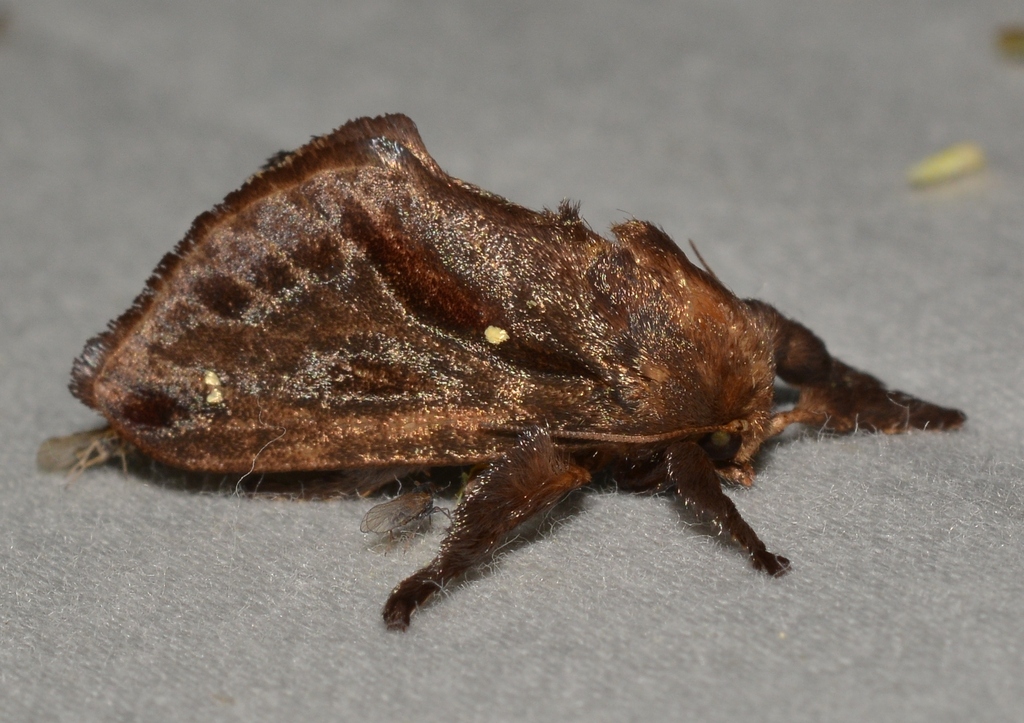
Saddleback Caterpillar Moth
Acharia stimulea
The saddleback caterpillar (Acharia stimulea, formerly Sibine stimulea) is the larva of a species of moth native to eastern North America. It is also found in Mexico. The species belongs to the family of slug caterpillars, Limacodidae.
The larva (caterpillar) is primarily green with brown at both ends and a prominent white-ringed brown dot in the center which resembles a saddle. It has a pair of fleshy horns at both ends. These and most of the rest of the body bear urticating hairs that secrete an irritating venom. Contact with the hairs causes a painful, swollen rash and sometimes nausea in humans. In some cases, more severe reactions to the venom can occur, including a systemic condition called erucism or acute urticaria, for which severe symptoms may include migraines, gastrointestinal symptoms, asthma complications, anaphylactic shock, rupturing of erythrocytes, and hemorrhaging. The hairs should be removed from the skin immediately to prevent more venom spread. The cocoon may also have irritating hairs, and hairs from the larva can fall on surrounding objects.
From the article Saddleback caterpillar on Wikipedia (CC BY-SA), quoted section by section
Description
Acharia stimulea (formally known as Sibine stimulea) is a moth of the family Limacodidae that is most widely known and recognizable for its larval phase. During the mid and late instar (a phase between two periods of molting in the development), Acharia stimulea exhibits its characteristic lime-green coloring along the top of the body that contains its most identifiable feature, a dark marking at the center that is inclosed in a white and black that resembles a saddle. The green of the body contrasts against its dark anterior (head) and posterior (rear) which, along with the skirt of the body, contain tubercles with hollow spines that, when broken, release an irritating toxin into predators. Like others in the family Limacodidae, they rely on their slug-like anatomy to move. Similar to a slug, Acharia stimulea uses suckers and mucus to help them roll and adhere to surfaces. After pupation, the adult Acharia stimulea loses all of its vibrant coloring, and develops velvety dark brown anterior wings and cream posterior wings.
Range & habitat
Acharia stimulea are native to North America and are most known for living in warmer climates like Yucatan, Mexico, but they can also survive the slightly cooler temperatures of the eastern United States. Adult moths fly during warm months, which can be year round in the south or between July and August in the U.S. Acharia stimulea are polyphagous and do not rely on a single plant species for survival, though they tend to favor palms. Below is a list of known host plants that the Acharia stimulea female moths are known to lay their egg on and where they live during their larvae phase:
Wikipedia: “Distribution and habitat”
What it does
Adult Acharia stimulea will mate as soon as two days after emerging from their cocoon and will copulate for up to 24 hours. In the wild, mating rituals occur during nights with warm temperatures, which can vary between February and July in the United States. After mating, the female will choose a host plant, and lay her eggs on the underside of the leaf where she will frequently visit until they have successfully hatched.
Wikipedia: “Reproduction”
Toxicity
Acharia stimulea is known for having one of the strongest stings and, because the saddleback caterpillar is commonly found in ornamental plants, gardeners are most at risk of accidental exposure. The spines along the caterpillar, when broken, will release an irritating toxin into its victims that is known to cause acute urticaria in humans. These spines are fragile and can become airborne and embedded into surfaces, therefore immediate action is required for removal if infected to prevent prolonged harm. Spines can be removed by using adhesive tape over the infected area to pull out the spines, with a new piece of tape used for each treatment. Symptoms can be mild or severe and typically last from a few hours to a few days, depending on the sensitivity of those affected, and are relieved through prescribed medication on a case-by-case basis. Some of the symptoms include headaches, conjunctivitis, difficulty breathing, gastrointestinal symptoms, asthma complications, anaphylactic shock and hemorrhaging. Ice packs, corticosteroids, topical and oral antihistamines have been reported to help relieve pain.
Wikipedia: “Dangers and treatments of stings”
Listen
Looking for field recordings…
Where it lives
Recorded sightings
—
geo-referenced records in GBIF, from museums, herbaria and field observers.
Drag the globe to turn it. Dots are where records exist, not a range map; darker means more records.
In the stacks
Searching the stacks…
Every page naming Acharia stimulea in the Biodiversity Heritage Library →
This page is assembled live from iNaturalist, GBIF, Wikipedia, the Source Library and the Internet Archive. It is not yet part of the hand-edited codex. iNaturalist taxon 122228.