- Animals
- ›Arthropods
- ›Hexapods
- ›Insects
- ›Winged and Once-winged Insects
- ›Butterflies and Moths
- ›Butterflies
- ›Gossamer-winged Butterflies
- ›Blues
- ›Typical Blues
- ›Lampidina
- ›Lampides
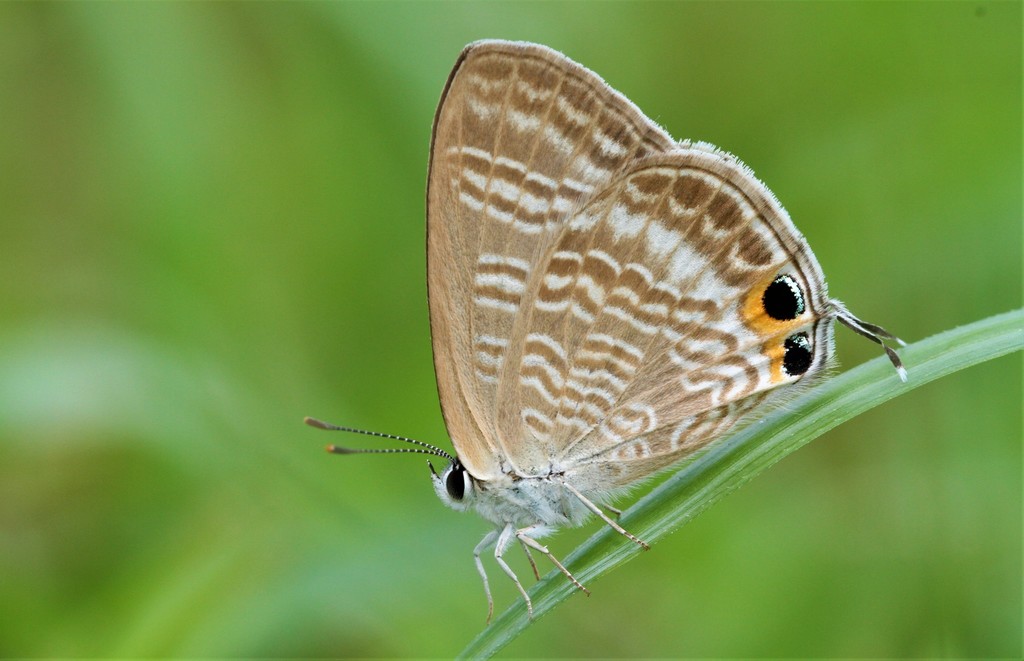
Pea Blue
Lampides boeticus
Lampides boeticus, the pea blue, or long-tailed blue, is a small butterfly that belongs to the lycaenids or gossamer-winged family.
From the article Lampides boeticus on Wikipedia (CC BY-SA), quoted section by section
Description
The wingspan is 24–32 mm for males and 24–34 mm for females. In these small butterflies (although unusually large for their family) the males have a mainly blue violet upper face of the wings with the brown edges, while the females have only a small amount of blue colour in the centre of the wings (sexual dimorphism). Both sexes have a thin, long tail in the hindwings and two black spots in the anal angle. The underface of the wings is ocher and adorned with white markings and with a larger white submarginal streak.
The underface of each hindwing shows a pair of small black eye-spots beside each tail, with an orange marginal spots at the anal angle. This species is rather similar and it can be confused with Leptotes pirithous and Cacyreus marshalli although the pea-blue is significantly larger than both species.
Male. Upperside violet-blue, with hair-like, whitish scales dispersed over the entire surface of both wings. Forewing with costal and outermarginal brown line, the latter often with a little inward brown suffusion, Hindwing with a similar marginal line, a rather large round black subterminal spot in interspace 2, a smaller spot in interspace 1, each spot ringed, sometimes with pale blue, sometimes with pale orange-ochreous. Cilia white, with a brown basal band; tail black, tipped with white. Underside grey with a slight ochreous tinge, markings brownish. …
Range & habitat
This species can be found in Europe, Africa, South and Southeast Asia, and Australia. It is also found in the Hawaiian islands. It is also found in the Maldives.In New Zealand this species is regarded as being self introduced as was first observed in November 1965.
Wikipedia: “Distribution”
What it does
This species may have three generations a year. Adults fly from February to early November and are strong migrants. Eggs are white with a greenish tinge and have a disc-shaped form. They can reach a diameter of 0.5 mm. They are laid singly on the flower buds of the host plants. Old caterpillars are green or reddish-brown, with dark dorsal stripe. They reach a length of 14–15 mm. Pupae reach a length of 9–10 mm. They are light grayish-brown with medium-sized dark spots and dark dorsal stripe. The larvae feed on flowers, seeds and pods of many Fabaceae species, including Medicago, Crotalaria, Polygala, Sutherlandia, Dolichos, Cytisus, Spartium and Lathyrus species. It has also been recorded on Crotolaria pallida. In Australia, the larvae are occasionally attended by ants in the genera Froggattella, Iridomyrmex or Camponotus.
Wikipedia: “Ecology”
In human culture
The Latin species name boeticus refers to Baetica, a province of the Roman Empire in the Iberian Peninsula . Its common name refers to the long streamers on its hind wings, the male's bright iridescent blue colour, and peas, which is the typical host plant of the butterfly.
Wikipedia: “Etymology”
Listen
Looking for field recordings…
Where it lives
Recorded sightings
—
geo-referenced records in GBIF, from museums, herbaria and field observers.
Drag the globe to turn it. Dots are where records exist, not a range map; darker means more records.
In the stacks
Searching the stacks…
Every page naming Lampides boeticus in the Biodiversity Heritage Library →
This page is assembled live from iNaturalist, GBIF, Wikipedia, the Source Library and the Internet Archive. It is not yet part of the hand-edited codex. iNaturalist taxon 121993.