- Animals
- ›Chordates
- ›Vertebrates
- ›Ray-finned Fishes
- ›Spiny-rayed fishes
- ›Cichlids and Allies
- ›Cichlids
- ›African Cichlids
- ›Oreochromis
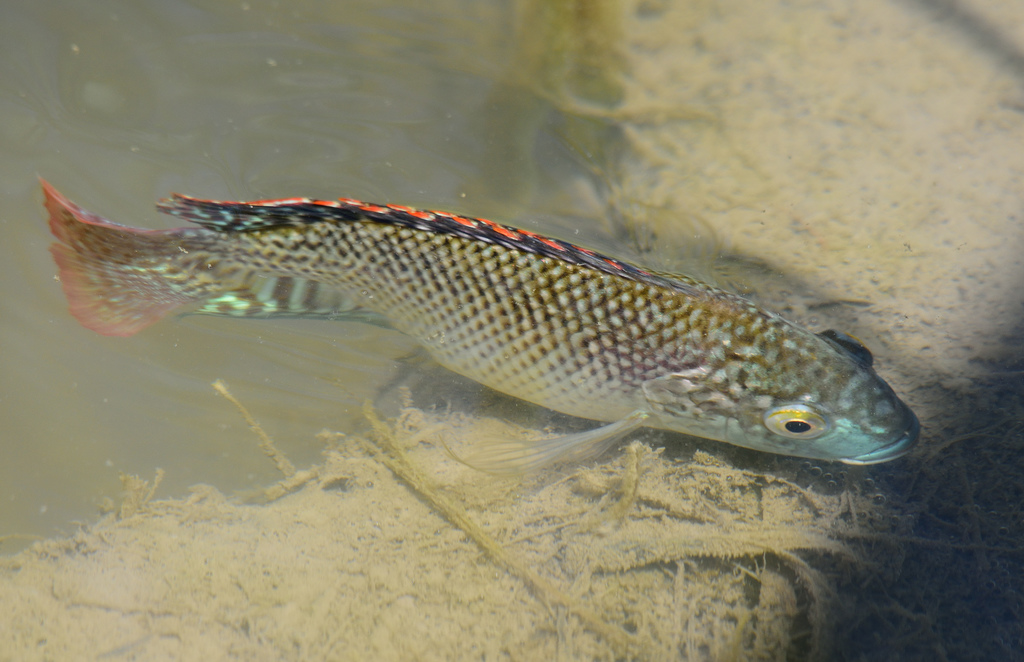
Blue Tilapia
Oreochromis aureus
The blue tilapia or Israeli tilapia, Oreochromis aureus, is a species of fish in the Cichlidae family. Native to Northern and Western Africa, and the Middle East, through introductions it is now also established elsewhere, including parts of the United States, where it has been declared an invasive species and has caused significant environmental damage. It is known as blue kurper in South Africa.
From the article Oreochromis aureus on Wikipedia (CC BY-SA), quoted section by section
Description
In their introduced US range, blue tilapia are usually 120 to 200 millimetres (4+3⁄4 to 7+3⁄4 in) in length, and reach weights up to 5 to 6 lb (2.3 to 2.7 kg). The largest recorded specimen was more than 21 in (53 cm) long and weighed more than 10 lb (4.5 kg). Blue tilapia are mouthbrooders, and broods range from 160 to 1600 eggs per female. O. aureus is primarily herbivorous, but occasionally consumes zooplankton; the young include small invertebrates in their diet.
Range & habitat
The blue tilapia is native to Northern and Western Africa, and the Middle East. In Africa, it is native to the Senegal, Niger, Benue and lower Nile Rivers. In the Middle East, it is native to the Jordan River. Through introductions, the fish can be found in the United States in Texas, Alabama, Florida, and Nevada. It has also been established in Central and South America, and Southeast Asia. The original stocks of O. aureus in the United States were from Israel. The blue tilapia is primarily a fresh and brackish water fish that occurs in a wide range of habitats such as streams, rivers, lakes and ponds, but it has a high tolerance for salt water and even hypersaline conditions at up to 4.5% salinity (seawater is about 3.5%). It primarily occurs in waters that range from 12 to 32 °C (54–90 °F), but tolerates between 8 and 40 °C (46–104 °F).
Israel. In Israel, Oreochromis aureus is also known as Jordan St. Peter's fish and was traditionally coming down the Jordan River from Lake Huleh to the Sea of Galilee. It is black and larger than the white "Common St. Peter's fish" or simply "St. Peter's fish", the redbelly tilapia (Arabic: مشط, romanized: musht, lit. 'comb', adopted into Modern Hebrew). Another "St. Peter's fish" is the "Galilee St. Peter's fish" (mango tilapia, Sarotherodon galileus; Arabic: مشط أبيض, romanized: musht abyaḍ), which is white and also larger than C. zillii.
Wikipedia: “Range and habitat”
Where it lives
Recorded sightings
—
geo-referenced records in GBIF, from museums, herbaria and field observers.
Drag the globe to turn it. Dots are where records exist, not a range map; darker means more records.
In the stacks
Searching the stacks…
Every page naming Oreochromis aureus in the Biodiversity Heritage Library →
This page is assembled live from iNaturalist, GBIF, Wikipedia, the Source Library and the Internet Archive. It is not yet part of the hand-edited codex. iNaturalist taxon 121302.