On eBird ↗
White-throated Grasswren
Live sightings near you, the range map, bar charts of when it is seen, and Macaulay Library photos and recordings.
White-throated Grasswren
Amytornis woodwardi
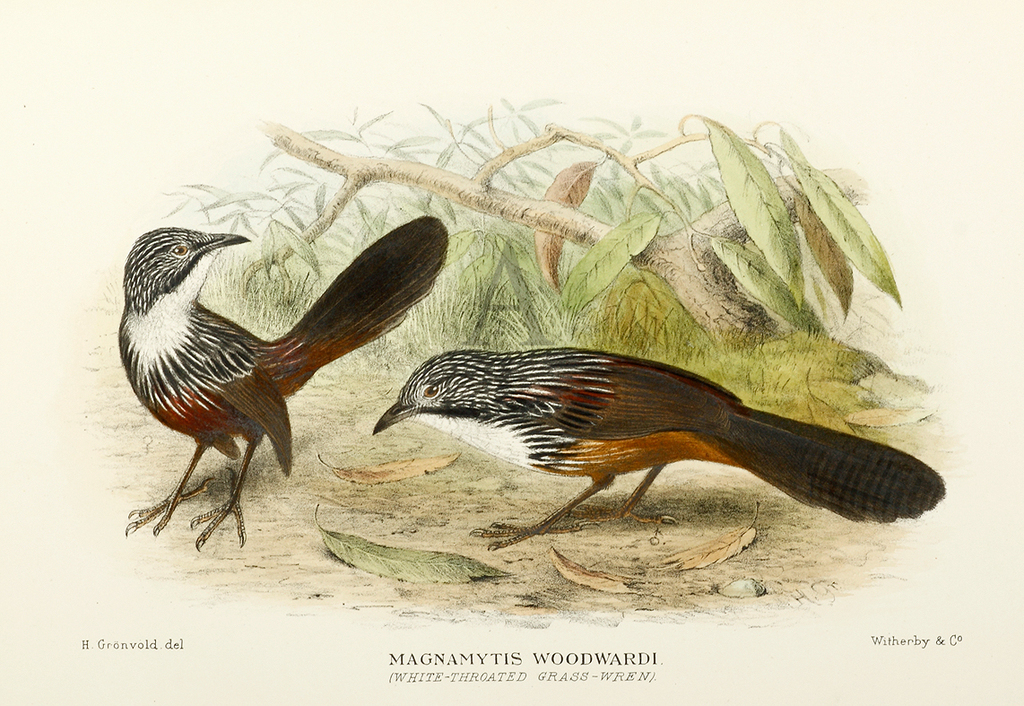
The white-throated grasswren (Amytornis woodwardi), also known as Yirlinkirrkirr in the local language, is a species of bird in the family Maluridae. It is endemic to northern Australia, found only in West Arnhem Land, in the Northern Territory (NT).
From the article White-throated grasswren on Wikipedia (CC BY-SA), quoted section by section
Description
The white-throated grasswren is the largest member of the Australian grasswrens (Amytornis spp.), with a wing length of 70–80 mm. It has a similar pattern of coloration to the smaller Carpentarian grasswren (A. dorytheae), which occurs on sandstones hundreds of kilometers to the east of the Arnhem Plateau. White-throated grasswrens have a typically dark plumage with a striking white 'bib' from below the chin to the middle of the belly. Females tend to have dark reddish brown flanks and lower belly, whereas males have lighter rufous brown belly and flanks. White-throated grasswrens have soft, high-pitched contact calls that sound very similar to the co-occurring purple-backed (lavender-flanked) fairywren (Malurus assimilis dulcis), but also produce a complex song of trills and warbles.
Range & habitat
The white-throated grasswren is only found on and around the Arnhem Land sandstone massif, between Katherine and Maningrida; representing an area of 6,200 km2 (2,400 sq mi). Like most grasswren species, the white-throated grasswren nests in large clumps of sharply pointed spinifex grass, which provides protection from predators. Its natural habitats are sandstone and conglomerate escarpment of the Arnhem Plateau. Ecological niche modelling has shown that white-throated grasswrens typically occupy habitat patches that are close to unburnt habitat, have a low proportion-of-area-burnt, have low vegetation cover, and high time-since-fire, particularly when compared to the average background values across the landscape. Using rough high and low thresholds of ecological niche modelling suitability scores, researchers predict that there is currently somewhere between 536 km2 and 2631 km2 of suitable habitat for the species. This is substantially less than previous estimates for the species. Local knowledge by Bininj Nawarddeken people has identified sightings of the white-throated grasswren near outstations in the Warddeken Indigenous Protected Area, including Manmoyi, Kamarrkawarn, and Kabulwarnmyo in place where 'karri kore kanjdjikandji, ankebkakebkali', translating to 'the river by the edge of the rocks where they meet the savanna'.
Wikipedia: “Habitat”
In human culture
The bird, known as Yirlinkirrkirr in the local Bininj Kunwok language, is of cultural significance to the Nawarddeken people.
Wikipedia: “Cultural importance”
Listen
Looking for field recordings…
Where it lives
Recorded sightings
—
geo-referenced records in GBIF, from museums, herbaria and field observers.
Drag the globe to turn it. Dots are where records exist, not a range map; darker means more records.
In the stacks
Searching the stacks…
Every page naming Amytornis woodwardi in the Biodiversity Heritage Library →
This page is assembled live from iNaturalist, GBIF, Wikipedia, the Source Library and the Internet Archive. It is not yet part of the hand-edited codex. iNaturalist taxon 12125.