- Plants
- ›Vascular Plants
- ›flowering plants
- ›Dicots
- ›Sunflowers, Bellflowers, Fanflowers, and Allies
- ›Sunflowers, Daisies, Asters, and Allies
- ›Asteroideae
- ›bonesets, blazingstars, and allies
- ›Ageratinae
- ›Ageratum
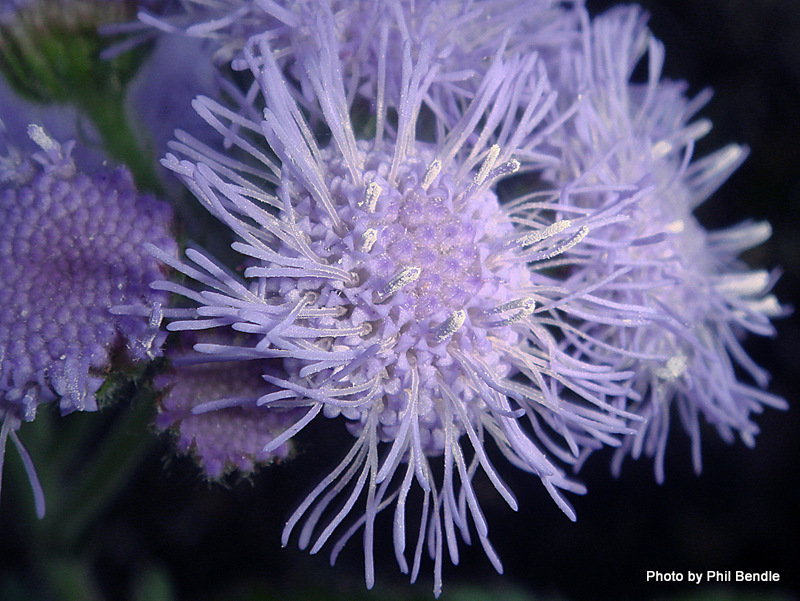
bluemink
Ageratum houstonianum
Ageratum houstonianum (flossflower, bluemink, blueweed, pussy foot, Mexican paintbrush) is a cool-season annual plant often grown as bedding in gardens. The plant grows to 0.3–1 m high, with ovate to triangular leaves 2–7 cm long, and blue flowerheads (sometimes white, pink, or purple). The flower heads are borne in dense corymbs. The ray flowers are threadlike, leading to the common name.
From the article Ageratum houstonianum on Wikipedia (CC BY-SA), quoted section by section
Description
This herbaceous annual or dwarf shrub grows to 0.3–1 m (1 ft 0 in – 3 ft 3 in) high, with ovate to triangular leaves 2–7 cm (0.79–2.76 in) long, and blue flowerheads (sometimes white, pink, or purple). The flower heads are borne in dense corymbs. The ray flowers are threadlike and fluff-haired, leading to the common name. The narrow lanceolate bracts are pointed, denticulate only at the top and glandular hairy. The flowering period is from May to November in the northern hemisphere. The plant attracts butterflies.
Range & habitat
The plant is native to Central America in Guatemala and Belize, and adjacent parts of Mexico, but has become an invasive weed in other areas. It was also naturalized in large parts of the tropics and in the southern United States. Its habitat is pastures, moist forest clearings and bushes up to altitudes of 1,000 metres (3,300 ft). Today, it is widely used as an ornamental plant for summer borders and balcony boxes, high varieties also as cut flowers. The species is cultivated once a year, having numerous varieties whose crowns may be dark blue, purple, pink and white. Preferring cool soils and exposure in full sun, high varieties reach stature heights up to 60 centimetres (24 in).
Wikipedia: “Range”
Toxicity
Ageratum houstonianum is toxic to grazing animals, causing liver lesions. It contains pyrrolizidine alkaloids.
Where it lives
Recorded sightings
—
geo-referenced records in GBIF, from museums, herbaria and field observers.
Drag the globe to turn it. Dots are where records exist, not a range map; darker means more records.
In the stacks
Searching the stacks…
Every page naming Ageratum houstonianum in the Biodiversity Heritage Library →
This page is assembled live from iNaturalist, GBIF, Wikipedia, the Source Library and the Internet Archive. It is not yet part of the hand-edited codex. iNaturalist taxon 120944.