On eBird ↗
White-winged Fairywren
Live sightings near you, the range map, bar charts of when it is seen, and Macaulay Library photos and recordings.
White-winged Fairywren
Malurus leucopterus
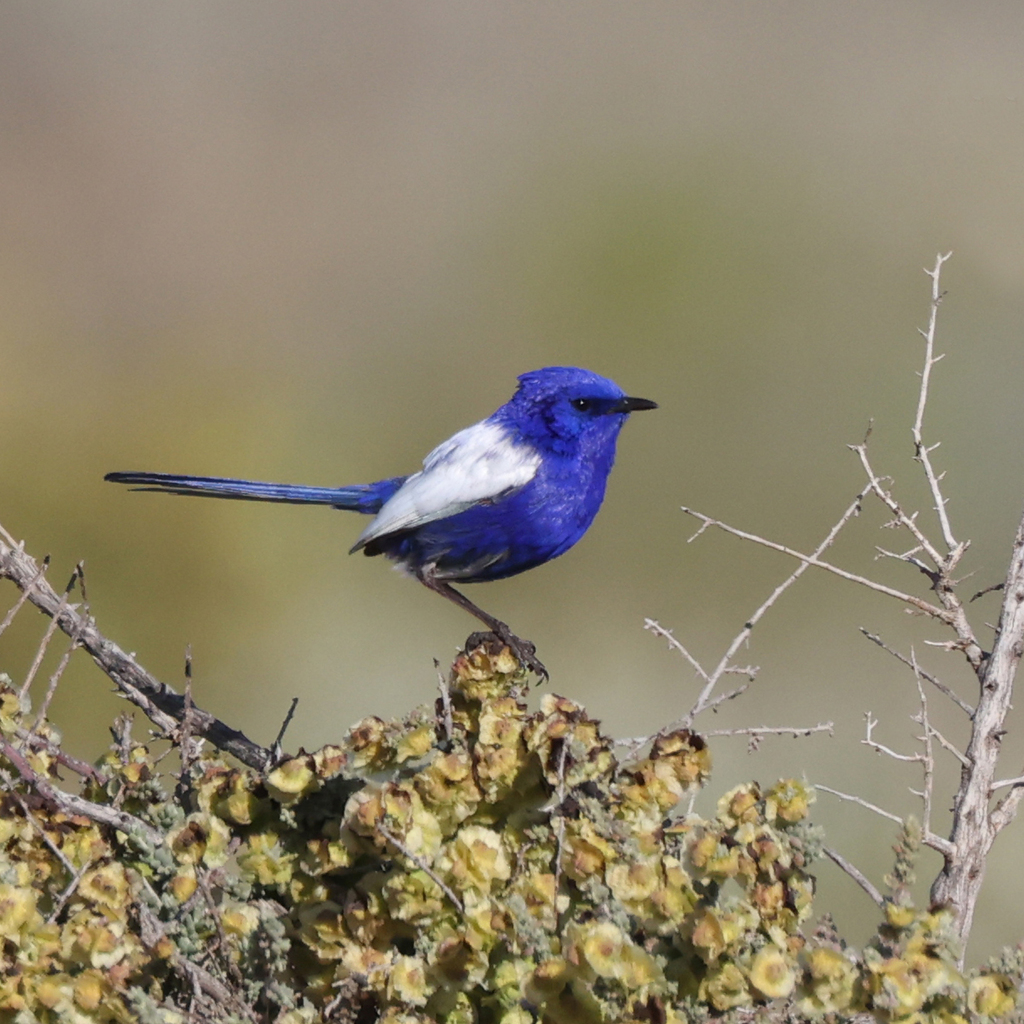
The white-winged fairywren (Malurus leucopterus) is a species of passerine bird in the Australasian wren family, Maluridae. It lives in the drier parts of Central Australia; from central Queensland and South Australia across to Western Australia. Like other fairywrens, this species displays marked sexual dimorphism and one or more males of a social group grow brightly coloured plumage during the breeding season. The female is sandy-brown with light-blue tail feathers; it is smaller than the male, which, in breeding plumage, has a bright-blue body, black bill, and white wings. Younger sexually mature males are almost indistinguishable from females and are often the breeding males. In spring and summer, a troop of white-winged fairywrens has a brightly coloured older male accompanied by small, inconspicuous brown birds, many of which are also male. Three subspecies are recognised. Apart from the mainland subspecies, one is found on Dirk Hartog Island, and another on Barrow Island off the coast of Western Australia. Males from these islands have black rather than blue breeding plumage.
The white-winged fairywren mainly eats insects, supplementing this with small fruits and leaf buds. It occurs in heathland and arid scrubland, where low shrubs provide cover. Like other fairywrens, it is a cooperative breeding species, and small groups of birds maintain and defend territories year-round. Groups consist of a socially monogamous pair with several helper birds who assist in raising the young.
From the article White-winged fairywren on Wikipedia (CC BY-SA), quoted section by section
Description
Measuring 11 to 13.5 centimetres (4.3 to 5.3 in) in length, white-winged fairywrens are one of the two smallest species of Malurus. Males typically weigh between 7.2 and 10.9 grams (0.25 and 0.38 oz) while females weigh between 6.8 and 11 grams (0.24 and 0.39 oz). Averaging 8.5 mm (0.3 in) in males and 8.4 mm (0.3 in) in females, the bill is relatively long, narrow and pointed and wider at the base. Wider than it is deep, the bill is similar in shape to those of other birds that feed by probing for or picking insects off their environs. It is finer and more pointed in this species than in other fairywrens. Fully mature adults are sexually dimorphic, with the male being larger and differing in colour from the female. The adult female is sandy-brown with a very light blue tail, and a pinkish buff bill. The male in breeding plumage has a black bill, white wings and shoulders, and a wholly cobalt blue or black body (depending on subspecies). These contrasting white feathers are especially highlighted in flight and ground displays in breeding season. The male in eclipse plumage resembles the female, though it may be distinguished by its darker bill. Both sexes have long, slender, distinct tails held at an upward angle from their bodies. …
Range & habitat
The white-winged fairywren is well adapted to dry environments, and M.l. leuconotus is found throughout arid and semi-arid environments between latitudes 19 and 32oS in mainland Australia. It occupies coastal Western Australia from around Port Hedland south to Perth, and stretches eastwards over to Mount Isa in Queensland, and along the western parts of the Great Dividing Range through central Queensland and central western New South Wales, into the northwestern corner of Victoria and the Eyre Peninsula and across the Nullarbor. It commonly cohabits with other species of fairywren, including the purple-backed fairy-wren (M. lamberti assimilis). White-winged fairywrens often inhabit heathlands or treeless shrublands dominated by saltbush (Atriplex) and small shrubs of the genus Maireana, or grasses such as tussock grass (Triodia) and cane-grass (Zygochloa), as well as floodplain areas vegetated with lignum (Muehlenbeckia florulenta). M. l. leucopterus inhabits similar habitats on Dirk Hartog Island and M. l. edouardi does the same on Barrow Island. The white-winged fairywren is replaced to the north of its range on mainland Australia by the red-backed fairywren.
Wikipedia: “Distribution and habitat”
What it does
The usual form of locomotion is hopping, with both feet leaving the ground and landing simultaneously. However, birds may run when performing the rodent-run display. Its balance is assisted by a proportionally large tail, which is usually held upright and rarely still. The short, rounded wings provide good initial lift and are useful for short flights, though not for extended jaunts. White-winged fairywrens live in complex social groups. Clans consist of 2–4 birds, typically one brown or partially blue male and a breeding female. Nest helpers are birds raised in previous years which remain with the family group after fledging and assist in raising young; they may be male that have retained their brown plumage, or female. Birds in a group roost side-by-side in dense cover and engage in mutual preening. Several subgroups live within one territory and make up a clan, which is presided over by one blue (or black) male who assumes breeding plumage. While the blue male is dominant to the rest of the brown and partially blue males within his clan, he nests with only one female and contributes to the raising of only her young. It is unclear whether or not he fathers young in any of the other nests within his territory. Each clan has a specified area of land that all members contribute to foraging from and defending. …
Wikipedia: “Behaviour and ecology”
In human culture
Both island subspecies are nearer in genetic distance to mainland populations of leuconotus than to each other; Dirk Hartog Island is 2 kilometres (1.2 mi) from the mainland while Barrow Island is 56 kilometres (35 mi) from the mainland. Gene flow between the populations existed at the beginning of the present interglacial period, some 8,000 to 10,000 years ago, at a time when sea levels were lower and both islands connected with the mainland. There are three theories as to how the three races of white-winged fairywren could have evolved. The first suggests that black-and-white plumage is an ancestral condition and, following separation of the three populations, blue-and-white plumage evolved in the mainland species. The second hypothesis suggests that black-and-white plumage evolved convergently on the two separate islands. The third suggests that black-and-white plumage evolved once from the blue-and-white ancestral condition, and later the mainland species re-evolved blue plumage. The distribution of the three bi-coloured fairywren species indicates their ancestors lived across New Guinea and northern Australia in a period when sea levels were lower and the two regions were joined by a land bridge. …
Wikipedia: “Evolutionary history”
Listen
Looking for field recordings…
Where it lives
Recorded sightings
—
geo-referenced records in GBIF, from museums, herbaria and field observers.
Drag the globe to turn it. Dots are where records exist, not a range map; darker means more records.
In the stacks
Searching the stacks…
Every page naming Malurus leucopterus in the Biodiversity Heritage Library →
This page is assembled live from iNaturalist, GBIF, Wikipedia, the Source Library and the Internet Archive. It is not yet part of the hand-edited codex. iNaturalist taxon 12093.