On eBird ↗
Emperor Fairywren
Live sightings near you, the range map, bar charts of when it is seen, and Macaulay Library photos and recordings.
Emperor Fairywren
Malurus cyanocephalus
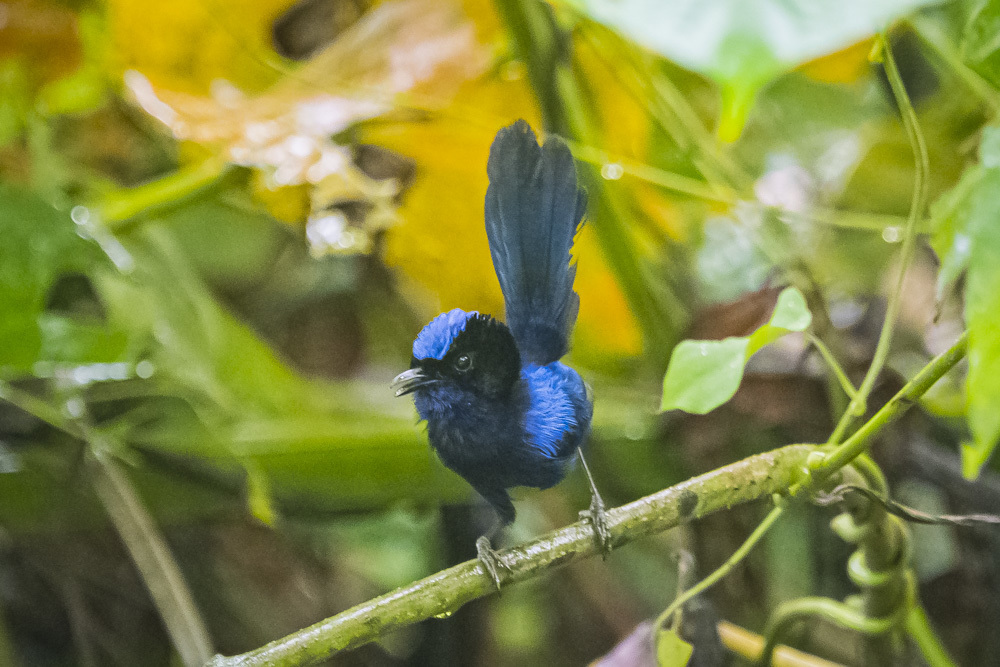
The emperor fairywren (Malurus cyanocephalus) is a species of bird in the Australasian wren family, Maluridae. It is found in New Guinea in its natural habitat of subtropical or tropical moist lowland forests. It is the largest species of fairywren. It is highly sexually dimorphic. Males have a blue and black plumage, with the females having blue and black plumage only on their heads, with the rest of the body being coloured a rusty brown and having a black tail tipped with white. There are 3 recognized subspecies of the emperor fairywren, one from north and northwestern New Guinea, one from Biak Island, and one from south New Guinea and the Aru Islands.
Like other fairywrens, the emperor fairywren is socially monogamous and sexually promiscuous, and is a cooperative breeder. Its nests are made of leaves, ferns, and moss, and laced in bushes at an elevation. Its diet is mostly composed of insects. Foraging occurs in family groups.
From the article Emperor fairywren on Wikipedia (CC BY-SA), quoted section by section
Description
It is the largest fairywren, being 13–16 cm (5.1–6.3 in) long and weighing 12–17 g (0.42–0.60 oz). Males of the nominate race have light royal blue crowns. The forehead, lores, and the side of the head up till the narrow collar is black. The upper back, along with the scapulars and uppertail-coverts is a deep turquoise-blue, with the lower back being blue-black. The upperwing and the tail are blackish-blue with tinges of blue, and the throats and underparts are a navy blue in color. It has dark brown eyes, black bill, and dark grey-brown legs. Females of the nominate race have a head that looks similar to the male, but have chestnut upperparts, white underparts, deep blue throats, and a black tail with whitish tips. They also have lighter and more mid-brown legs, along with duller crowns that are deeper in colour. Juveniles look like females, but have a dusky head, rusty brown upperparts, and entirely white underparts. M. c. mysorensis differs slightly in appearance with its crown being cobalt blue instead of royal blue, and M. c. bonapartii is slightly darker than the nominate race.
Vocalisations. Its songs are a reel that are preceded and followed by sets of 3 notes. This call is frequently given by groups of emperor fairywrens while they are foraging. The contact calls for the bird are "tst-tst-tst-tst", with the alarm call being "tschik".
Range & habitat
It is found on New Guinea and the Aru Islands. It is found in tropical lowland, forests, wetlands, and degraded former forests. They inhabit dense secondary growth that occurs at the edges of forest, along with forest openings, riversides, roadsides and overgrown gardens. They are not as affected by habitat disturbance and appear to like disturbed habitats like gardens and parks.
Wikipedia: “Distribution and habitat”
What it does
The emperor fairywren feeds mainly on arthropods. They eat beetles, bugs, moths, grasshoppers, and spiders. Foraging is conducted in noisy family groups, with the insects foraged from leaves, palm fronds and branches within 1 m (3.3 ft) of the ground.
Wikipedia: “Diet”
Listen
Looking for field recordings…
Where it lives
Recorded sightings
—
geo-referenced records in GBIF, from museums, herbaria and field observers.
Drag the globe to turn it. Dots are where records exist, not a range map; darker means more records.
In the stacks
Searching the stacks…
Every page naming Malurus cyanocephalus in the Biodiversity Heritage Library →
This page is assembled live from iNaturalist, GBIF, Wikipedia, the Source Library and the Internet Archive. It is not yet part of the hand-edited codex. iNaturalist taxon 12089.