On eBird ↗
Purple-crowned Fairywren
Live sightings near you, the range map, bar charts of when it is seen, and Macaulay Library photos and recordings.
Purple-crowned Fairywren
Malurus coronatus
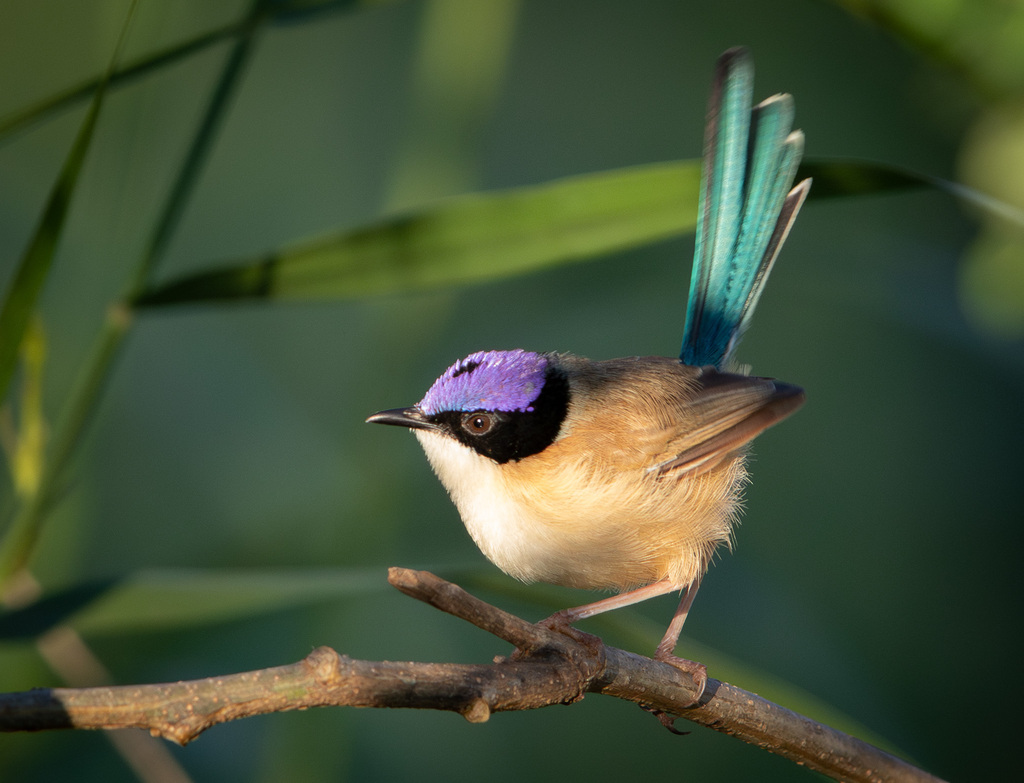
The purple-crowned fairywren (Malurus coronatus) is a species of bird in the Australasian wren family, Maluridae. It is the largest of the twelve species in the genus Malurus and is endemic to northern Australia. The species name is derived from the Latin word cǒrōna meaning "crown", owing to the distinctive purple circle of crown feathers sported by breeding males. Genetic evidence shows that the purple-crowned fairywren is most closely related to the superb fairywren and splendid fairywren. Purple-crowned fairywrens can be distinguished from other fairywrens in northern Australia by the presence of cheek patches (either black in males or reddish-chocolate in females) and the deep blue colour of their perky tails.
Like other fairywrens, the purple-crowned fairywren is socially monogamous. However, unlike other species in the genus, it is not sexually promiscuous and shows low rates of extra-pair paternity. However, females with related males as partners will mate with other individuals. This is thought to be an adaptation to avoid inbreeding depression. They build small dome-shaped nests in which 2–3 eggs are laid, with up to three clutches per year. It is mainly insectivorous, feeding on a wide variety of invertebrates, and supplements its diet with seeds.
From the article Purple-crowned fairywren on Wikipedia (CC BY-SA), quoted section by section
Description
The purple-crowned fairywren is a small, sexually dimorphic, bird measuring approximately 14 cm (5.5 in) in length, with a wing-span of approximately 16 cm (6.3 in) and weighing only 9–13 g (0.32–0.46 oz). It can be differentiated from other North Australian fairywrens by the presence of cheeks patches and the deep blue color of their tails. The plumage is brown overall, with the wings more greyish brown and the belly cream-buff. The blue tail is long and upright, and all except the central pair of feathers are broadly tipped with white. Their bill is black and the legs and feet are brownish grey. Although there is a slight geographical variation between the two subspecies, only the difference in colour of mantle is noticeable in the field. The crown and nape of M. c. macgillivrayi is slightly bluer, and its mantle and upper back has weak blue-grey shading, whereas the slightly larger M. c. coronatus has a browner back, as well as a buff-coloured, rather than white, breast and belly.
Crown. During the breeding season, adult males develop the spectacular bright purple feathers on their crown. This is bordered by a black face mask and capped with an oblong black spot on top of the head. During the non-breeding season, the male's colourful crown is replaced by grey/brown feathers and its black mask with black cheek patches and an off-white to pale grey orbital ring. …
Range & habitat
The species occurs across the wet-dry tropics of northern Australia, and is found in the Kimberley region of Western Australia, in the Victoria River region of the Northern Territory, and in the south-western sub-coastal region of the Gulf of Carpentaria in Queensland. Whilst the species' distribution spans more than 1,500 km (930 mi), it is constrained by the quality and extent of riparian vegetation along waterways. A natural geographic barrier of approximately 300 km (190 mi) of unsuitable habitat separates the two subspecies. The western subspecies M. c. coronatus occurs in the midsections of large river catchments that drain the Central Kimberley Plateau, and along sections of the Victoria River. The eastern subspecies M. c. macgillivrayi occurs along most rivers draining into south-western and southern Gulf of Carpentaria from Roper River in Northern Territory to Leichhardt and Flinders Rivers in Queensland. The purple-crowned fairywren is a riparian habitat specialist that occurs in patches of dense river-fringing vegetation in northern Australia. Its preferred habitat, which lines the permanent freshwater creeks and rivers, consists of a well-developed mid-storey that is composed of dense shrubs (i.e. …
Wikipedia: “Distribution and habitat”
What it does
Like all other species in the genus Malurus, the purple-crowned fairywren is a cooperative breeder and lives in sedentary groups that maintain their territories, often arranged linearly along creeks and rivers, year-round. However, unlike other species in the genus that are highly promiscuous, purple-crowned fairywrens display high levels of fidelity and low rates of extra-pair paternity. Groups generally consist of a breeding pair that is helped by one to six offspring from previous broods, and helpers may stay with their parents for several years before attempting to breed. Only the dominant pair in a group reproduces, and individuals can remain un-reproductive subordinates for several years. These subordinates help raise the offspring, improving productivity as well as the survival of the breeding pair.
Breeding and nesting. Group territories are maintained throughout the year, and usually the same site (or area) is used year after year. The spatial arrangement of purple-crowned fairywren territories differ depending on what plant species dominate the understory. Territories in Pandanus are usually arranged in a linear fashion, and generally occupy between 50–300 m (160–980 ft) of river length, whereas territories may be arranged in a mosaic pattern in areas where the understory consists of tall river-grasses such as C. …
Wikipedia: “Behaviour and ecology”
Listen
Looking for field recordings…
Where it lives
Recorded sightings
—
geo-referenced records in GBIF, from museums, herbaria and field observers.
Drag the globe to turn it. Dots are where records exist, not a range map; darker means more records.
In the stacks
Searching the stacks…
Every page naming Malurus coronatus in the Biodiversity Heritage Library →
This page is assembled live from iNaturalist, GBIF, Wikipedia, the Source Library and the Internet Archive. It is not yet part of the hand-edited codex. iNaturalist taxon 12073.