- Animals
- ›Chordates
- ›Vertebrates
- ›Ray-finned Fishes
- ›Spiny-rayed fishes
- ›Mackerels, Tunas, Butterfishes, and Allies
- ›Stromateoidei
- ›Butterfishes
- ›Stromateus
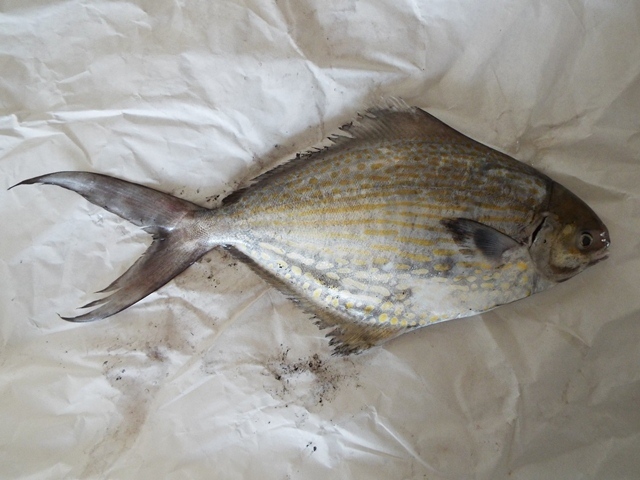
Blue Butterfish
Stromateus fiatola
The blue butterfish (Stromateus fiatola), is a species of pelagic fish in the genus Stromateus.
From the article Blue butterfish on Wikipedia (CC BY-SA), quoted section by section
Description
The blue butterfish usually grows about 40 cm (16 in), but the largest length of the blue butterfish that has been recorded was 50 cm (20 in). Dorsal soft rays (total): 42–50 cm; Anal soft rays: 33 – 38 cm. Blue to brownish in color and darker spots dorsally, silver to whitish ventrally; juveniles with vertical bars on body and small black pelvic fins.
Range & habitat
The blue butterfish is a pelagic fish, usually found in depths of 10–70 m (33–230 ft). It mainly lives in the Atlantic Ocean and is widely distributed in the eastern Atlantic Ocean, specifically in the Bay of Biscay, the Mediterranean, southward of the cape of good hope, and South Africa. This fish can also be found in the Red Sea.
Wikipedia: “Distribution and habitat”
What it does
The blue butterfish feeds on smaller fishes, jellyfish, and zooplankton. This fish is part of the trophic guild, planktotrophic, which means that they have a long pelagic larval stage and feed on their prey while suspended in the water column. The blue butterfish is also referred to as a pelagic mesopredator due to feeding on smaller animals within the pelagic zone.
Wikipedia: “Diet”
In human culture
Names of blue butterfish in other languages as follows: Bukla (Albanian), Ψευτολίτσα (Pseftolitsa) (Greek), Palometa fiatola (Spanish), Fieto (Italian), Blauer Butterfisch (German), Żuwak fiatola (Polish), Pampo-godinho (Portuguese), Фиатола (Fiatola) (Russian), Plotica morska (Serbian, Croatian), Figa (Slovenian), Yıldız balığı (Turkish), Fiatole (French).
Wikipedia: “Cultural”
Where it lives
Recorded sightings
—
geo-referenced records in GBIF, from museums, herbaria and field observers.
Drag the globe to turn it. Dots are where records exist, not a range map; darker means more records.
In the stacks
Searching the stacks…
Every page naming Stromateus fiatola in the Biodiversity Heritage Library →
This page is assembled live from iNaturalist, GBIF, Wikipedia, the Source Library and the Internet Archive. It is not yet part of the hand-edited codex. iNaturalist taxon 120681.