- Animals
- ›Chordates
- ›Vertebrates
- ›Ray-finned Fishes
- ›Spiny-rayed fishes
- ›Cichlids and Allies
- ›Cichlids
- ›South and Central American Cichlids
- ›Cichlasoma
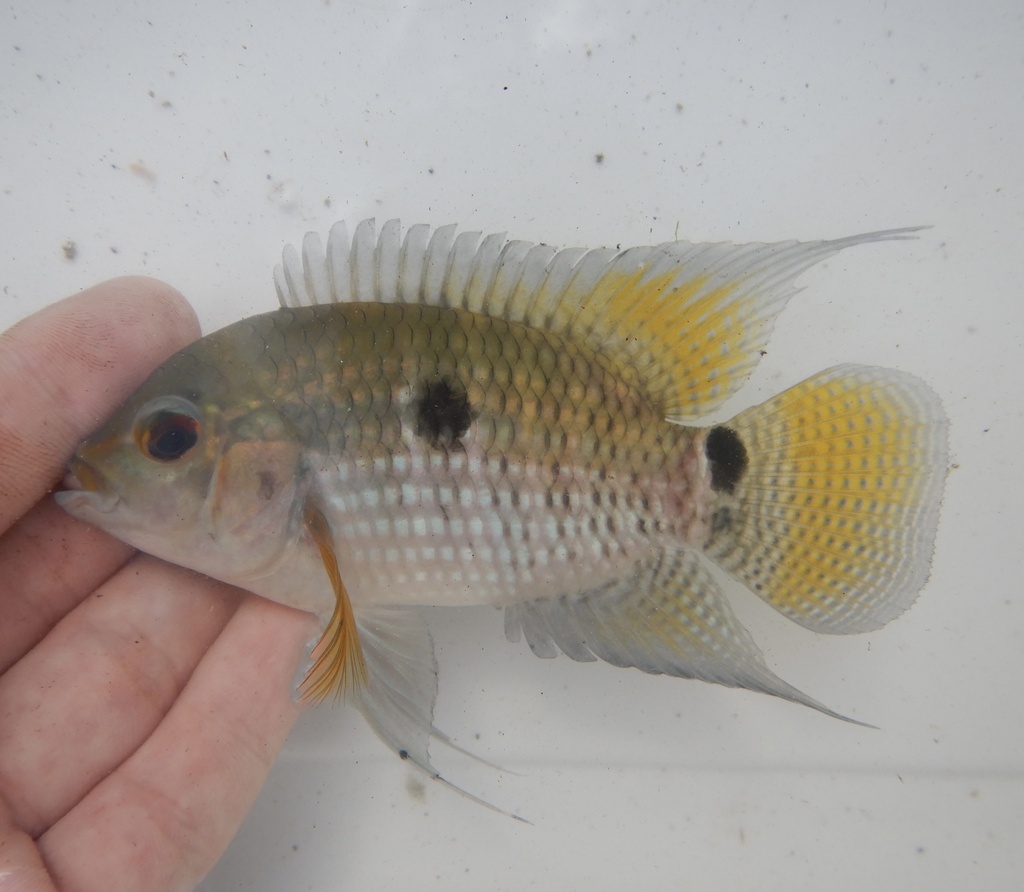
Black Acara
Cichlasoma bimaculatum
Cichlasoma bimaculatum is an omnivorous, freshwater, tropical fish commonly referred to as the Black Acara or two-spot cichlid. It was also identified as Aequidens portalegrensis in 1965 and 1970. It is most frequently classified in the Cichlidae (Cichlid) family and subfamily of Cichlasomatinae. It is found in freshwater canals and swamps, with a natural region spanning from the Amazon River to northeastern and northern South America. Since the 1960s it has been identified in the Gulf...
From the article Cichlasoma bimaculatum on Wikipedia (CC BY-SA), quoted section by section
Description
Cichlasoma bimaculatum has distinguishable characteristics. The black acara has a dark beige to gray back with a dirty white underbelly. It has a stout forebody, more compressed posterior body, and is oval to slightly rectangular in shape. The black body is beige to gray with an asymmetrically spotted caudal fin, and four anal spines. A black to green-gray strip extends from the eye through a mid-lateral spot, and then extends to a black spot at the upper caudal fin base. A dark blotch is present below the eye, and this species has a small and terminal mouth. Black rimming along the scale edges is narrow and even, although this feature may be absent in some individuals. The black acara only show bright coloring when living or held in optimal settings, such as the wild or proper aquariums. Fish of this species held in non-desirable conditions and experiencing traumatic situations will often present a very pale coloring. Though conflicting details exist regarding the sexual dimorphism of the black acara, females are more plump than males with a visible ovipositor. Another difference is that the males have more tapering, as well as a straight belly during the spawn. Black acara frequent shallow, stagnant, roadside ditches or similarly disturbed habitats that normally contain few other fishes. They are frequently present in larger canals and lakes. …
Wikipedia: “Characteristics and behavior”
Range & habitat
The first reported introduction of Cichlasoma bimaculatum to a new habitat was the introduction to Florida in 1965. Florida is the only state with a reported nonindigenous occurrence, including confirmed sightings in Big Cypress Swamp, the Everglades, and Lake Okeechobee. They are also found in creeks, lakes, canals, drainage ditches and wet prairies. Factors influential to black acara's successful establishment in Florida includes warm waters, and, in some areas slow water current. To avoid predation, the black acara desires habitats such as lakes and canals with rocky bottoms to blend in. The black acaras spread throughout the state are also successful because of its year-round breeding cycle and ability to withstand low oxygen levels as well as high fecundity. The tropical black acara fish is a resident of equatorial South America, unlike the chanchita. Even though the two species appear remarkably identical, the subtropical chanchita doesn't inhabit waters north of southern Brazil. Researchers suggest that since the chanchita is more cold-tolerant, it may have a more widespread effect in Florida than the black acara and could endanger native plants in habitats in North Central Florida. It lives in seven different counties and five other drainages of rivers in Florida, well beyond Tampa Bay's drainage, where it was first introduced.
Wikipedia: “Habitat and range”
What it does
Cichlasoma bimaculatum is a generalist omnivore with scavenger like qualities, consuming small crustaceans and insect larvae in addition to small fishes. The black acara provide more competition for the native sunfish within spawning areas and have the ability to impact both invertebrate and plant communities through predation. In the wild, the black acara is not typically finicky with the food it consumes. Often, the black acara will consume crustaceans, insects, and worms present in the same habitat.
Wikipedia: “Diet”
Where it lives
Recorded sightings
—
geo-referenced records in GBIF, from museums, herbaria and field observers.
Drag the globe to turn it. Dots are where records exist, not a range map; darker means more records.
In the stacks
Searching the stacks…
Every page naming Cichlasoma bimaculatum in the Biodiversity Heritage Library →
This page is assembled live from iNaturalist, GBIF, Wikipedia, the Source Library and the Internet Archive. It is not yet part of the hand-edited codex. iNaturalist taxon 120642.