- Animals
- ›Arthropods
- ›Hexapods
- ›Insects
- ›Winged and Once-winged Insects
- ›Grasshoppers, Crickets, and Katydids
- ›Katydids, Crickets, and Allies
- ›Crickets
- ›Mole and Ant Crickets
- ›Ant Crickets
- ›Myrmecophilinae
- ›Myrmecophilini
- ›Myrmecophilus
- ›Myrmecophilus
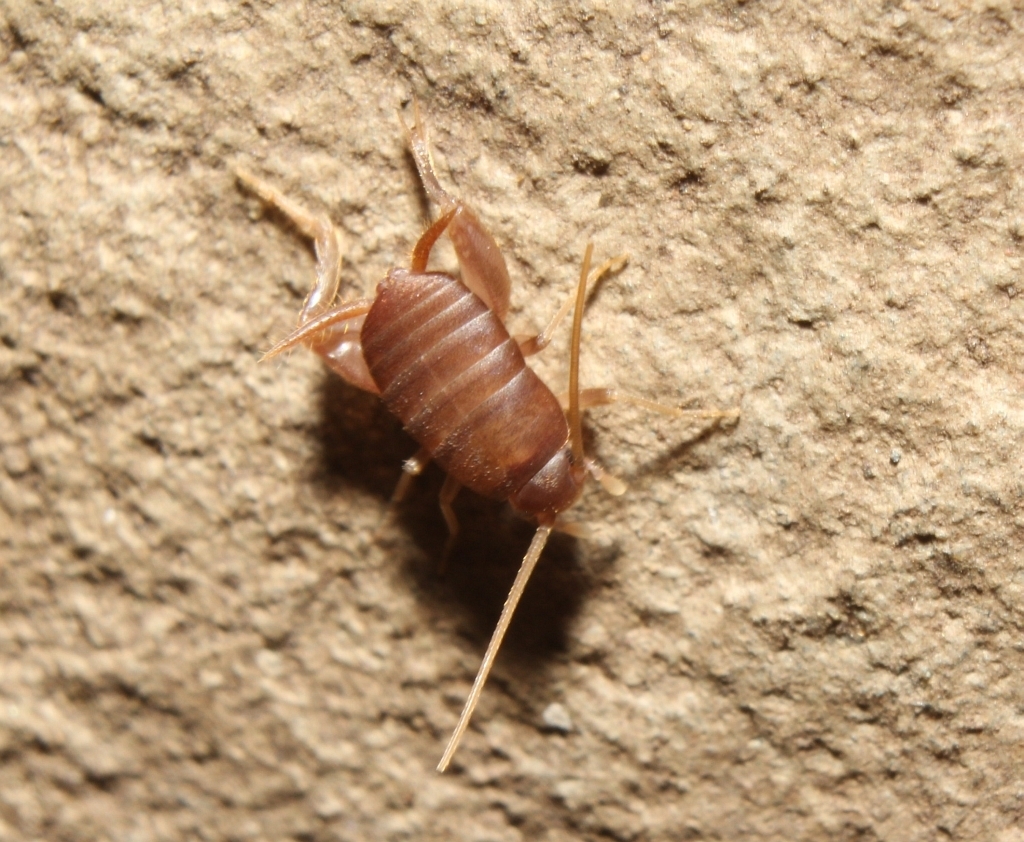
Eastern Ant Cricket
Myrmecophilus pergandei
Myrmecophilus pergandei, the eastern ant cricket, is a species of ant cricket in the family Myrmecophilidae. It is found in North America. It is a wingless cricket that is an obligate kleptoparasite of ants living in their nests. They lack both wings and tympanal organs on the front tibia.
From the article Myrmecophilus pergandei on Wikipedia (CC BY-SA), quoted section by section
Description
The general form of the insect, when looking at it from above, is oval, with the smallest part being at the head. The latter is depressed and deeply sunken into the front margin of the pronotum. The basal joint of the antennae is very large and globular, with a few short bristle-like hairs encircling the insertion of the second joint. The remaining joints gradually decrease in size toward the apex. The antennae are as long as the body, with the base being pale yellowish and the remaining portion rufous. The eyes are small and black, composed of a group of ocelli-like cells. They are situated immediately behind the base of the antenna, and in dried specimens, they are partly concealed by the front margin of the pronotum. The anterior legs are small and slightly compressed, and they are unarmed. The posterior femora are greatly enlarged, compressed, ovate incrassate, while the tibiae are stout, slightly compressed, shorter than the femora, and furnished with four movable spines on the inner and two on the outer edge. The apex has four long spurs, and the tarsi are plain. The cerci are stout, acuminate, slightly thickest in the middle, quite hairy, and as long as the abdomen. They are a trifle heaviest in the male. The ovipositor is slender and larger than usual, with the valves of equal lengths. The insect has a big and wide pronotum that is narrow in front and wide at the back. …
Range & habitat
They have been found in the United States, in the following states: Colorado, Georgia, Illinois, Louisiana, Maryland, Massachusetts, Mississippi, Nebraska, New Hampshire, New Jersey, New York, Oklahoma, Pennsylvania, and Virginia.
Wikipedia: “Distribution”
Listen
Looking for field recordings…
Where it lives
Recorded sightings
—
geo-referenced records in GBIF, from museums, herbaria and field observers.
Drag the globe to turn it. Dots are where records exist, not a range map; darker means more records.
In the stacks
Searching the stacks…
Every page naming Myrmecophilus pergandei in the Biodiversity Heritage Library →
This page is assembled live from iNaturalist, GBIF, Wikipedia, the Source Library and the Internet Archive. It is not yet part of the hand-edited codex. iNaturalist taxon 120150.