- Animals
- ›Arthropods
- ›Hexapods
- ›Insects
- ›Winged and Once-winged Insects
- ›Beetles
- ›Water, Rove, Scarab, Long-horned, Leaf, and Snout Beetles
- ›Bostrichiform Beetles
- ›Carpet, Powderpost, and Deathwatch Beetles
- ›Skin Beetles
- ›Megatominae
- ›Anthrenini
- ›Anthrenus
- ›Nathrenus
- ›Anthrenus verbasci
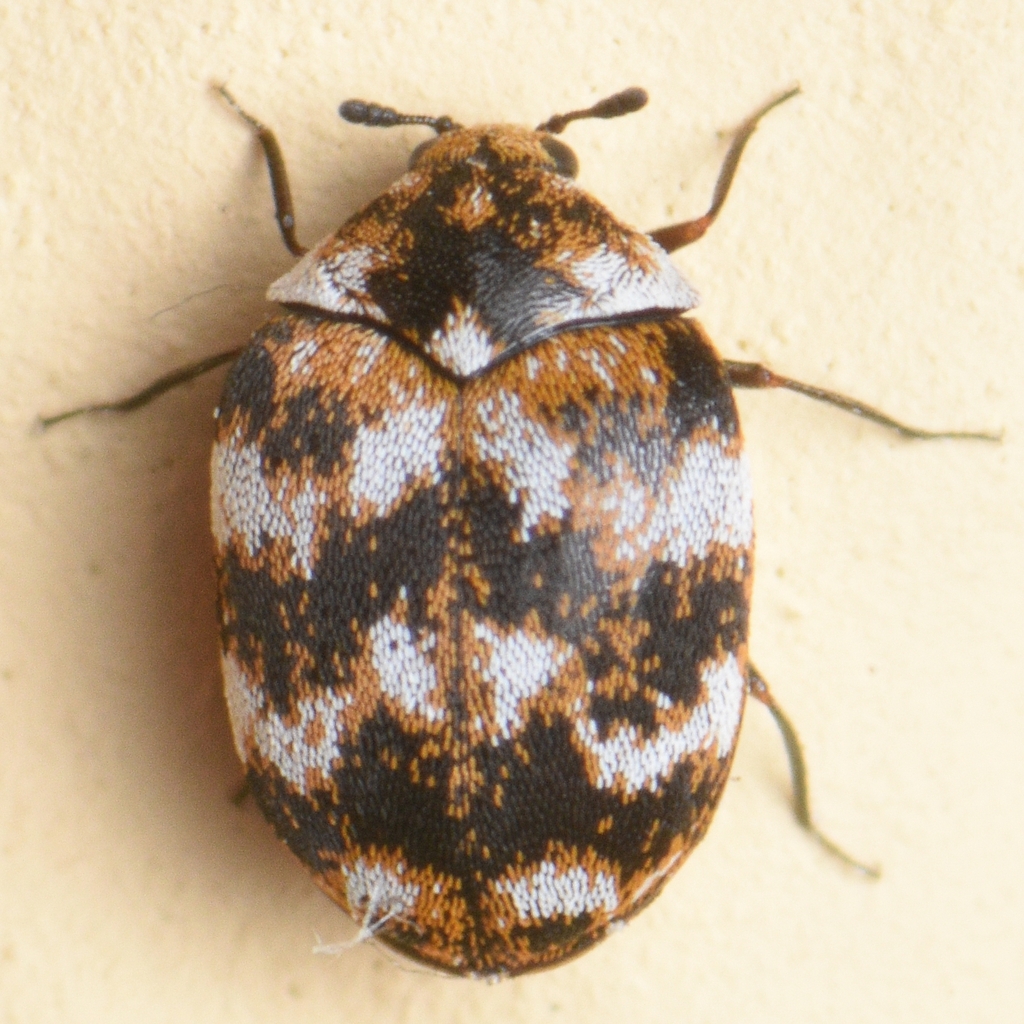
Varied Carpet Beetle
Anthrenus verbasci
The varied carpet beetle (Anthrenus verbasci) is a 3 mm-long beetle belonging to the family Dermestidae, positioned in subgenus Nathrenus. They are a common species, often considered a pest of domestic houses and, particularly, natural history museums, where the larvae may damage natural fibers and can damage carpets, furniture, clothing, and insect collections. A. verbasci was also the first insect to be shown to have an annual behavioral rhythm and remains a classic example of circannual cycles in animals.
From the article Varied carpet beetle on Wikipedia (CC BY-SA), quoted section by section
Description
Adult A. verbasci range in length from 1.7 to 3.5 mm (0.07 to 0.14 in). The body is rounded, almost spherical. The elytra and pronotum are covered in fine scales of different colours, creating an irregular pattern of white, brownish and yellowish patches on these features. The white scales are focussed along the lateral margins of the pronotum and on the elytra, where they form three bright, wavy transverse bands. In addition to these morphological features, their antennae are 11-segmented, with a club of 3 segments.
Range & habitat
This species is present in most of Europe, in the eastern Palearctic realm, in the Near East, in the Nearctic realm, in North Africa and in North Asia, also in the Neotropics.
Anthrenus verbasci does not have a strict habitat preferences and can be found in many places, but like many species in the genus, it can be found both indoors and outdoors. Its typical habitat is usually open areas with many flowers and trees, but it can also be found in houses, bird nests and other places.
Wikipedia: “Distribution and habitat”
What it does
Larvae feed on keratin and chitin of natural fibers (dead insects, animal hair and feathers) throughout their development, eventually experiencing a dormancy period (also known as diapause) prior to pupation into the adult stage. The length of the dormancy appears to depend on environmental factors, with the most likely zeitgeber, or trigger, being photoperiod. Adults feed on the pollen and nectar of flowering plants. They are reportedly particularly fond of flowers in the daisy family.
Wikipedia: “Diet and behaviour”
Listen
Looking for field recordings…
Where it lives
Recorded sightings
—
geo-referenced records in GBIF, from museums, herbaria and field observers.
Drag the globe to turn it. Dots are where records exist, not a range map; darker means more records.
In the stacks
Searching the stacks…
Every page naming Anthrenus verbasci in the Biodiversity Heritage Library →
This page is assembled live from iNaturalist, GBIF, Wikipedia, the Source Library and the Internet Archive. It is not yet part of the hand-edited codex. iNaturalist taxon 120113.