On eBird ↗
White-banded Swallow
Live sightings near you, the range map, bar charts of when it is seen, and Macaulay Library photos and recordings.
White-banded Swallow
Atticora fasciata
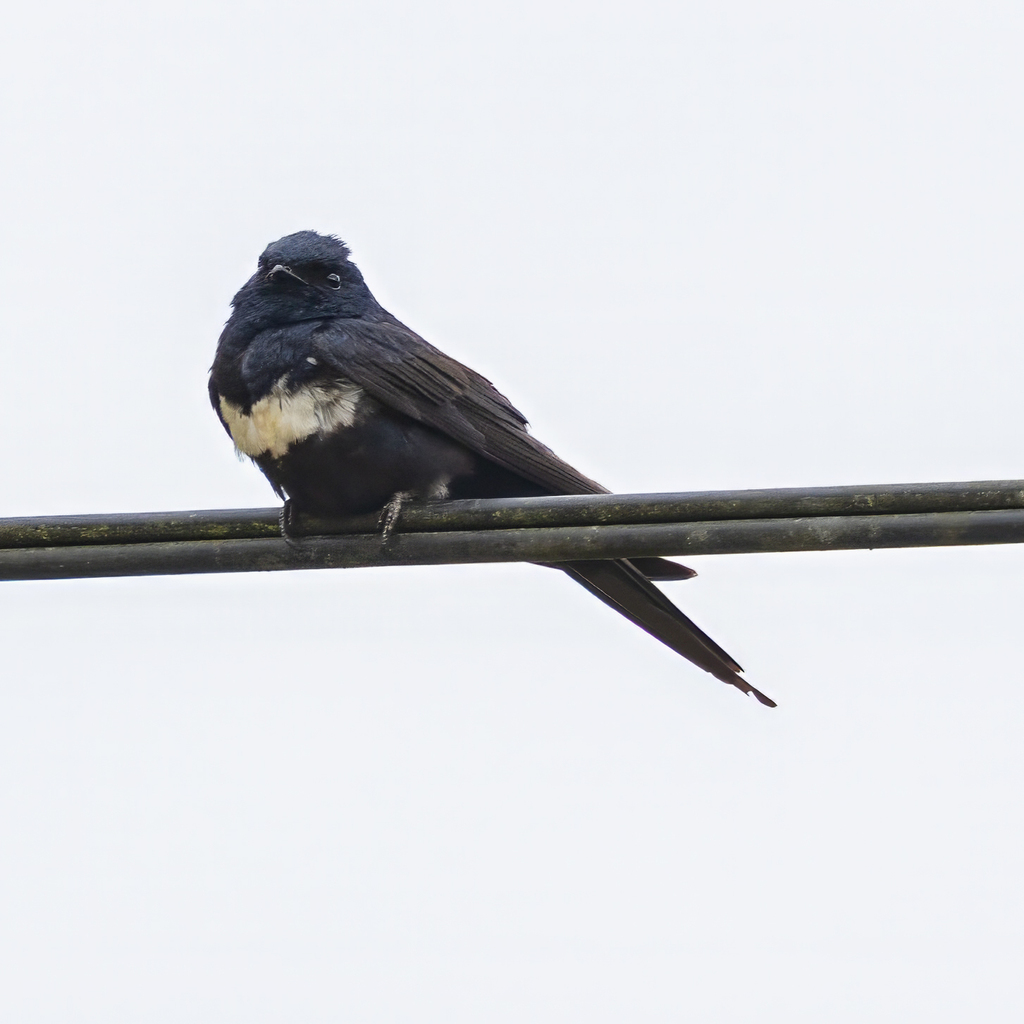
The white-banded swallow (Atticora fasciata) is a species of bird in the family Hirundinidae. It is black with white thighs, a white breast, and has white bars on the edges of its wings. It has a distinct, deeply forked tail.
It is found in Bolivia, Brazil, Colombia, Ecuador, French Guiana, Guyana, Peru, Suriname, and Venezuela, in tropical lowlands. It is non-migratory. Its natural habitats are rivers and forested areas. It nests in burrows and does not use artificial cavities.
From the article White-banded swallow on Wikipedia (CC BY-SA), quoted section by section
Description
The white-banded swallow is a medium-sized swallow, measuring, on average, 15 cm (5.9 in) and weighing 12–16 g (0.42–0.56 oz). They usually have a wingspan of 92–108 mm (3.6–4.3 in). They decline in size from north to south, but this is a gradual decline, which suggests that there is no geographical variation. It is black, except for the band on its breast, its thighs, and bars on the edge of its wings, which are all white. It also has blackish-brown underwing coverts. Their feathers have a blue-black luster. This swallow has a deeply forked tail. The sexes are similar, although the females weigh slightly more on average (12–14 g (0.42–0.49 oz) for the males, 12.8–15.8 g (0.45–0.56 oz) for the females). The juveniles are noted to be duller and browner, with shorter and paler feathers. It should not be confused with the black-collared swallow, which has white underparts and throat. The call of this swallow is described as a ti-ti-tur. These swallows also have a buzzy z-z-z-z-ee-eep call, which is usually given in flight.
Range & habitat
This bird is native to Bolivia, Brazil, Colombia, Ecuador, French Guiana, Guyana, Peru, Suriname, and Venezuela. It can be found to nest in tropical lowland evergreen forests near water and near both blackwater rivers and whitewater rivers, in forested areas. They are more frequently found near blackwater rivers in Columbia and Venezuela, nesting on rocky outcrops. Although they are found near water, they are rarely found over lakes. They are sometimes found over forested clearings. They usually do not occur above 800 m (2,600 ft), although they do occur up to 1,400 m (4,600 ft) in Columbia. These swallows are also non-migratory.
Wikipedia: “Distribution”
What it does
These birds are insectivores and feed in the air. When foraging, they fly rapidly in a zigzag path or circle above the water, skimming the water in some cases. They occasionally perch on boulders or small outcroppings above the water. They forage low over the water and occasionally near forests, clearings, or grassy areas with bushes. They usually forage alone or in small groups, occasionally with the black-collared swallow and the white-winged swallow. Although this does happen, they usually stay closer to rocks.
Wikipedia: “Diet”
Listen
Looking for field recordings…
Where it lives
Recorded sightings
—
geo-referenced records in GBIF, from museums, herbaria and field observers.
Drag the globe to turn it. Dots are where records exist, not a range map; darker means more records.
In the stacks
Searching the stacks…
Every page naming Atticora fasciata in the Biodiversity Heritage Library →
This page is assembled live from iNaturalist, GBIF, Wikipedia, the Source Library and the Internet Archive. It is not yet part of the hand-edited codex. iNaturalist taxon 11977.