- Plants
- ›Vascular Plants
- ›flowering plants
- ›Dicots
- ›Sunflowers, Bellflowers, Fanflowers, and Allies
- ›Sunflowers, Daisies, Asters, and Allies
- ›Vernonioideae
- ›Vernonieae
- ›Elephantopinae
- ›Elephantopus
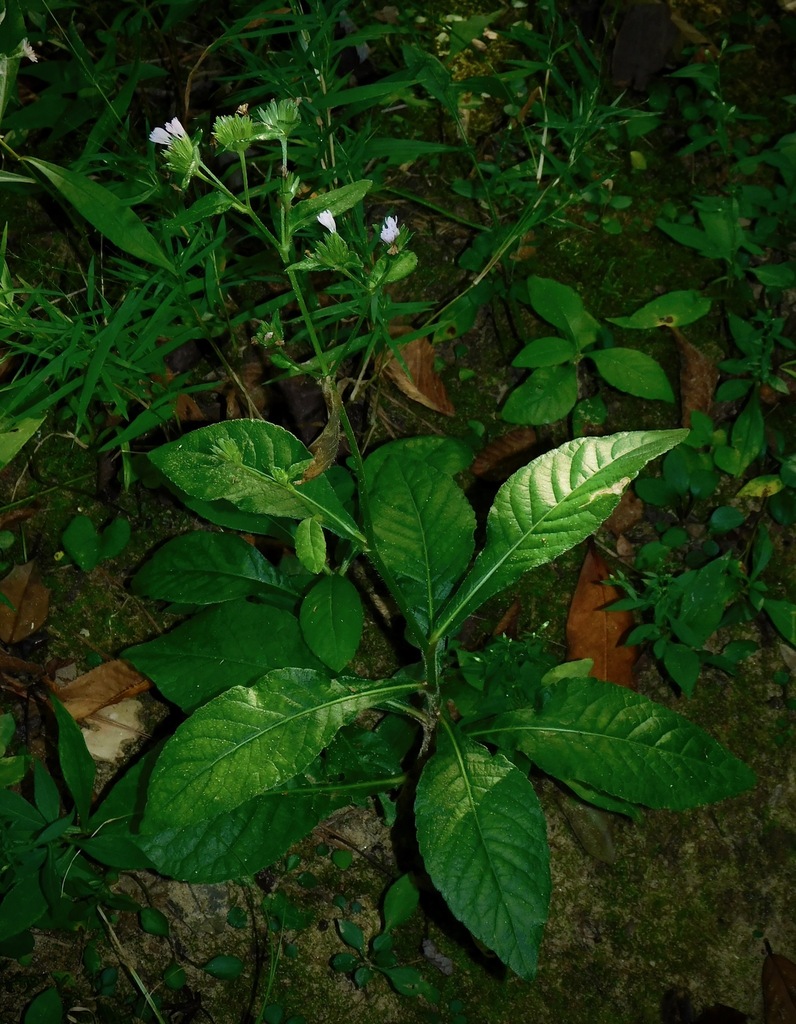
leafy elephant's-foot
Elephantopus carolinianus
Elephantopus carolinianus, common names Carolina elephantsfoot or leafy elephant's foot, is a species of flowering plant in the sunflower family. It is native to the United States from Florida north as far as Ohio, Illinois, and Pennsylvania, west to Texas, Oklahoma, and Kansas.
From the article Elephantopus carolinianus on Wikipedia (CC BY-SA), quoted section by section
Description
Elephantopus carolinianus is a perennial herb sometimes as much as 120 cm (4 feet) tall. Leaves are elliptic or ovate to lanceolate, up to 12 cm (5 inches) long, larger toward the base of the plant and decreasing in size moving up the stem. The leaves are darker on the upper side than they are on the lower side and are lightly hairy. They are alternate along the stem, becoming spaced further apart higher on the stem. At the plant's base, the leaves are very close together, as close as 0.6 centimetres (.25 in) apart. The plant produces numerous small flower heads in a tight cluster, each head generally containing only 4-5 florets. The cluster of flower heads is supported by 3 bracts that resemble leaves and are 1–3 centimetres (0–1 in) long. The lavender, or sometimes white, flowers bloom August to October. Flowers last for one day.
Range & habitat
The plant is native to the south-central and southeastern United States from Florida north as far as Ohio, Illinois, and Pennsylvania, west to Texas, Oklahoma, and Kansas. It grows in open or shaded pine forests and mixed forests, with generally damp to wet soil, often sandy.
Wikipedia: “Distribution and habitat”
In human culture
The genus name Elephantopus comes from the Greek words "elephantos" (elephant) and "pous" (foot). The term likely refers to the large basal leaves of some members of the genus.
Wikipedia: “Etymology”
Where it lives
Recorded sightings
—
geo-referenced records in GBIF, from museums, herbaria and field observers.
Drag the globe to turn it. Dots are where records exist, not a range map; darker means more records.
In the stacks
Searching the stacks…
Every page naming Elephantopus carolinianus in the Biodiversity Heritage Library →
This page is assembled live from iNaturalist, GBIF, Wikipedia, the Source Library and the Internet Archive. It is not yet part of the hand-edited codex. iNaturalist taxon 119609.