On eBird ↗
Bank Swallow
Live sightings near you, the range map, bar charts of when it is seen, and Macaulay Library photos and recordings.
Bank Swallow
Riparia riparia
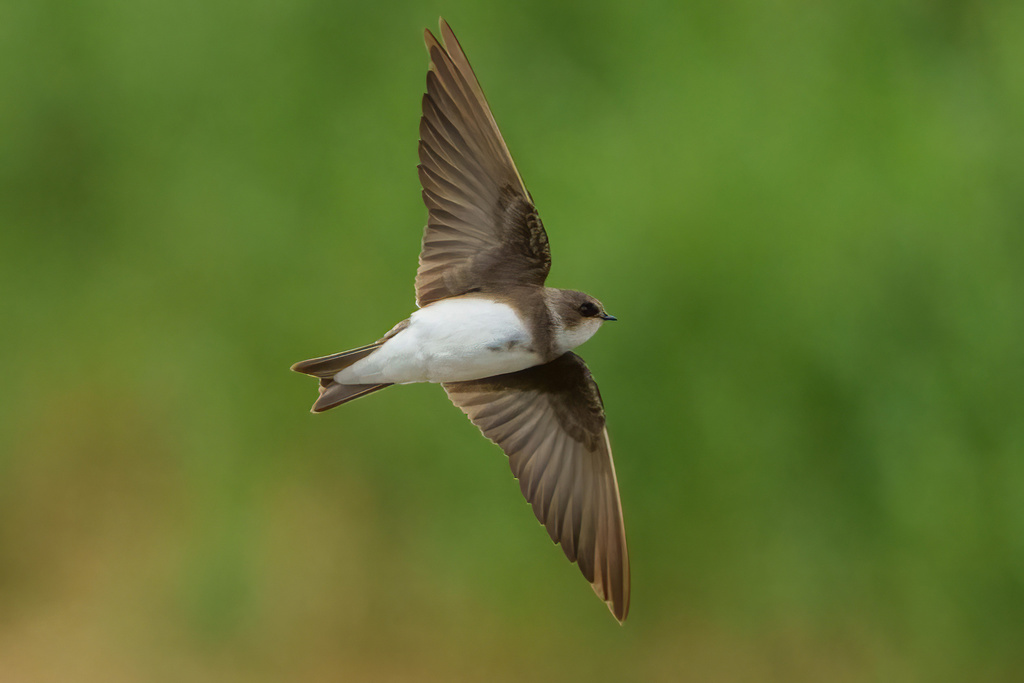
The sand martin (Riparia riparia), also known as the collared sand martin or common sand martin, and in the Americas as the bank swallow, is a migratory passerine bird in the swallow family Hirundinidae. It has a wide range in summer, embracing practically the whole Holarctic area, from Europe, across Asia to the Pacific Ocean, and throughout North America. It winters in eastern and southern Africa, southern Asia, and South America.
From the article Sand martin on Wikipedia (CC BY-SA), quoted section by section
Description
The sand martin is brown above, white below with a narrow brown band on the breast; the bill is black, the legs brown. The young have rufous tips to the coverts and margins to the secondaries. Its brown back and breast band, white throat, small size and quick jerky flight separate it from similar swallows, such as the common house martin (Delichon urbicum), the American cliff swallow (Petrochelidon pyrrhonota) and the tree swallow (Tachycineta bicolor). The other species of Riparia are more similar; the sand martin generally only occurs them in the wintering range, though there is breeding range overlap with pale martin in central Asia, with both species sharing mixed colonies without interbreeding. The banded martin (Neophedina cincta) of sub-Saharan Africa is very similar in plumage pattern, but is markedly larger, nearly double the weight. Measurements:
Length: 12–13 cm (4.7–5.1 in) Wingspan: 26.5–29 cm (10.4–11.4 in) Weight: 11–16 g (0.39–0.56 oz) (to 19.5 g (0.69 oz) before migration) The song is a continuous gravelly twittering when the birds are on the wing and becomes a conversational undertone after they have settled in the roost. The harsh alarm is heard when a passing falcon, crow or other suspected predator requires combined action to drive it away.
What it does
Linnaeus already remarked on this species' breeding habits: Habitat in Europae collibus arenosis abruptis, foramine serpentino ("it lives in Europe, in winding holes in sheer sandy hills"). It has been observed that sand martins favour loess as a particular type of ground to nest in. Sand martins are generally found near larger bodies of water, such as rivers, lakes or even the ocean, throughout the year. In Britain, the sand martin is the first of its family to appear on its breeding grounds, arriving from the middle of March, a week or two in advance of the barn swallow. In northern Ohio, they arrive in numbers by mid-April, about 10 days earlier than they did 100 years ago. At first, they flit over the larger bodies of water alone, in search of early flies. Later parties accompany other swallow species, but for a time, varying according to weather, the birds remain at these large waters and do not visit their nesting haunts. The sand martin departs early, at any rate from its more northerly haunts. In August, the gatherings at the nightly roost increase enormously, though the advent and departure of passage birds causes great irregularity in numbers. …
Wikipedia: “Ecology”
Listen
Looking for field recordings…
Where it lives
Recorded sightings
—
geo-referenced records in GBIF, from museums, herbaria and field observers.
Drag the globe to turn it. Dots are where records exist, not a range map; darker means more records.
In the old herbals & bestiaries

In the stacks
Searching the stacks…
Every page naming Riparia riparia in the Biodiversity Heritage Library →
This page is assembled live from iNaturalist, GBIF, Wikipedia, the Source Library and the Internet Archive. It is not yet part of the hand-edited codex. iNaturalist taxon 11941.