On eBird ↗
Violet-green Swallow
Live sightings near you, the range map, bar charts of when it is seen, and Macaulay Library photos and recordings.
Violet-green Swallow
Tachycineta thalassina
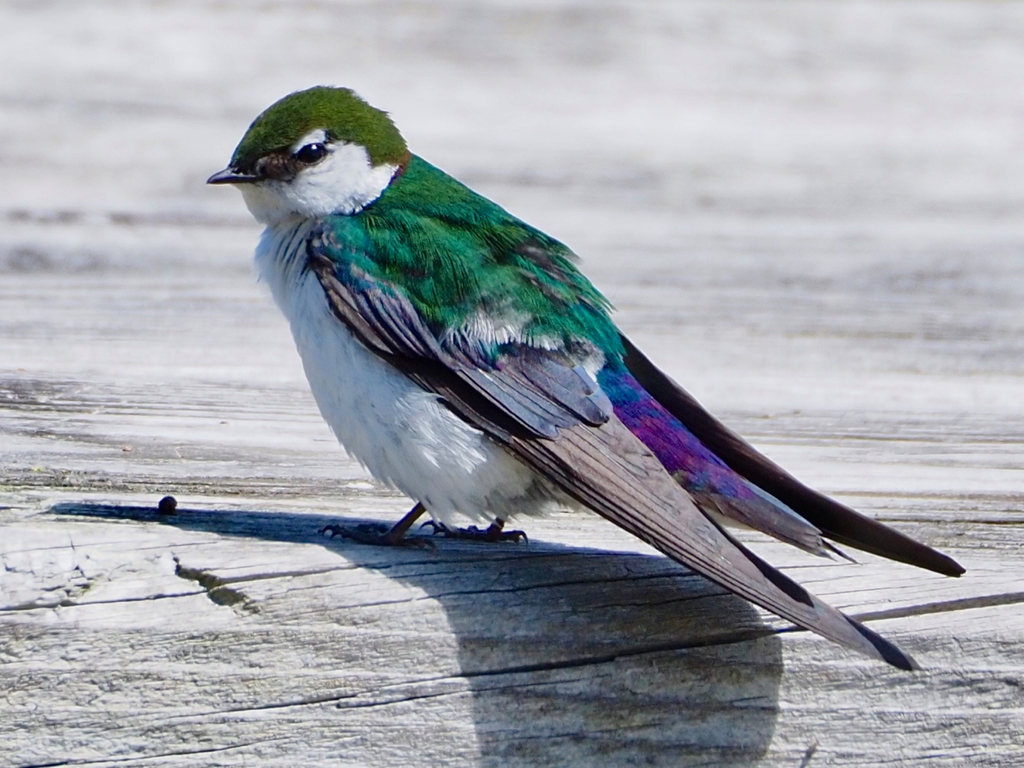
The violet-green swallow (Tachycineta thalassina) is a small North American passerine bird in the swallow family. These aerial insectivores are distributed along the west coast from Alaska to Mexico, extending as far east as Montana and Texas. With an appearance very similar to the tree swallow, these individuals can be identified by the white rump side-patches that appear to separate their green back and purple tail. Violet-green swallows are secondary cavity nesters, found in a number of habitats including deciduous and coniferous forest. In addition to nesting in tree holes within these habitats, they are also widely observed nesting in the cracks of large cliffs.
From the article Violet-green swallow on Wikipedia (CC BY-SA), quoted section by section
Description
The distinct body form of swallows distinguishes them from other passerine birds. Their long pointed wings and slim, streamlined body evolved to catch insects while in flight; the violet-green swallow is no exception. With an average body length of 12–13 cm (4.7–5.1 in), the violet-green swallow is slightly shorter and appears more compact in flight compared to some other members of the genus Tachycineta. The violet-green swallow most closely resembles the tree swallow T. bicolor, but can be distinguished by the more extensive white on the sides of the rump, and its green-and-violet glossed colour.
Colours. The violet-green swallow gets its name from the iridescent colours on its back and rump. The species is best identified by the glossy green on the top of the head and back as well as hints of purple on the nape, rump and upper tail. Below the green back, the remainder of the wing is a greyish-bronze. Similar to many other swallows, it is white below, but differs in that the white continues onto rump side-patches that almost meet at the base of the tail. These white rump side-patches sometimes look like one continuous stripe when in flight. White also extends onto the cheeks, partially surrounding the eye. …
Range & habitat
The type of habitat occupied by violet-green swallows varies depending on their geographical location and elevation. Across their range, these birds can be found in deciduous, coniferous and mixed forests, as well as within canyons and in close proximity to large cliffs. Breeding and non-breeding habitats do not differ much except that breeding habitat is usually at lower elevations. Violet-green swallows have also been observed nesting around buildings in more settled areas.
Wikipedia: “Habitat”
What it does
Similar to other swallows, violet-green swallows are specialized aerial insectivores, catching and eating their prey while in flight. However, they have been known to feed higher in the sky than most other swallows. The examination of the stomach contents of multiple individuals has presented a wide range of diet items, including insects like ants, beetles and flies as well as other arthropods such as spiders. On rare occurrences these birds have been observed foraging along the ground, but such events represent exceptions to their typical feeding habits.
Wikipedia: “Diet”
Listen
Looking for field recordings…
Where it lives
Recorded sightings
—
geo-referenced records in GBIF, from museums, herbaria and field observers.
Drag the globe to turn it. Dots are where records exist, not a range map; darker means more records.
In the stacks
Searching the stacks…
Every page naming Tachycineta thalassina in the Biodiversity Heritage Library →
This page is assembled live from iNaturalist, GBIF, Wikipedia, the Source Library and the Internet Archive. It is not yet part of the hand-edited codex. iNaturalist taxon 11931.