- Animals
- ›Arthropods
- ›Hexapods
- ›Insects
- ›Winged and Once-winged Insects
- ›Ants, Bees, Wasps, and Sawflies
- ›Narrow-waisted Wasps, Ants, and Bees
- ›Ants, Bees, and Stinging Wasps
- ›Formicoidea
- ›Ants
- ›Myrmicine Ants
- ›Myrmicini
- ›Myrmica
- ›Myrmica rubra
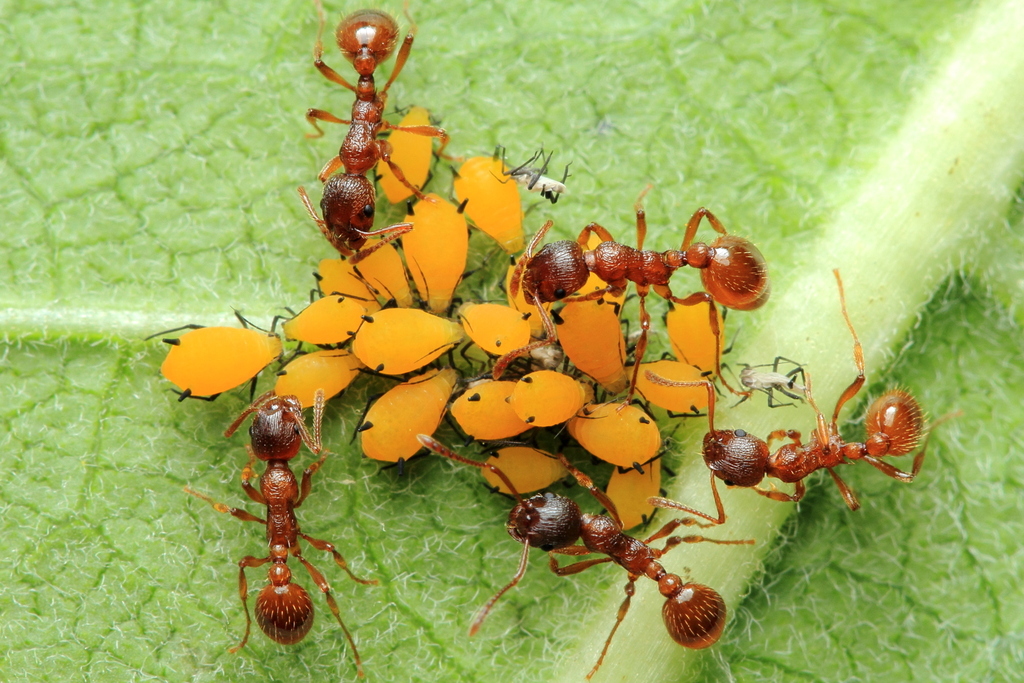
European fire ant
Myrmica rubra
Myrmica rubra, also known in the UK as the common red ant or in the USA as the European fire ant, is a species of ant of the genus Myrmica. It is found across Europe and is now invasive in some parts of North America and Asia. It is mainly red in colour, with slightly darker pigmentation on the head. These ants live under stones and fallen trees, and in soil. They are aggressive, often attacking rather than running away, and are equipped with a stinger, though they lack the ability to spray formic acid like the genus Formica.
This species is very similar to M. ruginodis, M. rubra is common in Southern England and becomes rarer further north whereas M. ruginodis is common all over the UK including Northern Scotland.
From the article Myrmica rubra on Wikipedia (CC BY-SA), quoted section by section
Range & habitat
This is one of the most common and widespread Myrmica species of the Palaearctic. It occurs in the region stretching from Portugal to East Siberia (as far as Transbaikalia), and from northern Greece to the forest-tundra zone in the North. It has also been introduced to North America in northwestern and northeastern United States and in western Canada, where it is considered an invasive species. These ants are very common in Europe and the UK and live in meadows and gardens. They live on a diet of honeydew excreted by aphids and feed on many types of insect and other invertebrates. They will attack any creature that disturbs their nest, but are not as aggressive as the red imported fire ant. They also consume pollen, a phenomenon rarely documented in ants of the temperate zone.
Wikipedia: “Distribution and habitat”
What it does
This ant's colonies have a polygyne form and can include up to one hundred queens per nest. These queens will have gathered together after their nuptial flight, formed a nest and laid their eggs in it. The species is also polydomous, with many nest sites per individual colony. The queens can live up to fifteen years. Nuptial flights take place normally in late July to mid-August in Europe. Hundreds of young queens and males take to the air to mate together. Afterwards, the males die and the queens shed their wings to make a new colony. No nuptial flights have been witnessed yet from this species where it is living in North America, however male-only mating swarms have been recorded in Newfoundland, Canada. In addition to the regular queens (macrogynes), M. rubra also have a microgyne caste. These queens are smaller in size compared to the macrogyne and were previously believed to be a different species of social parasite (M. microrubra). More recent DNA analysis suggest that they share a gene pool with the macrogyne and are therefor not a different species. While the roles of these microgynes are not yet fully understood, they are often found in nests with regular queens and this is believed to be a form of intraspecific parasitism where the microgyne are a social parasite of the larger macrogyne. …
Wikipedia: “Behaviour”
Listen
Looking for field recordings…
Where it lives
Recorded sightings
—
geo-referenced records in GBIF, from museums, herbaria and field observers.
Drag the globe to turn it. Dots are where records exist, not a range map; darker means more records.
In the stacks
Searching the stacks…
Every page naming Myrmica rubra in the Biodiversity Heritage Library →
This page is assembled live from iNaturalist, GBIF, Wikipedia, the Source Library and the Internet Archive. It is not yet part of the hand-edited codex. iNaturalist taxon 119172.