- Animals
- ›Arthropods
- ›Hexapods
- ›Insects
- ›Winged and Once-winged Insects
- ›Ants, Bees, Wasps, and Sawflies
- ›Narrow-waisted Wasps, Ants, and Bees
- ›Ants, Bees, and Stinging Wasps
- ›Vespoid Wasps
- ›Hornets, Paper Wasps, Potter Wasps, and Allies
- ›Hornets and Yellowjackets
- ›Vespa
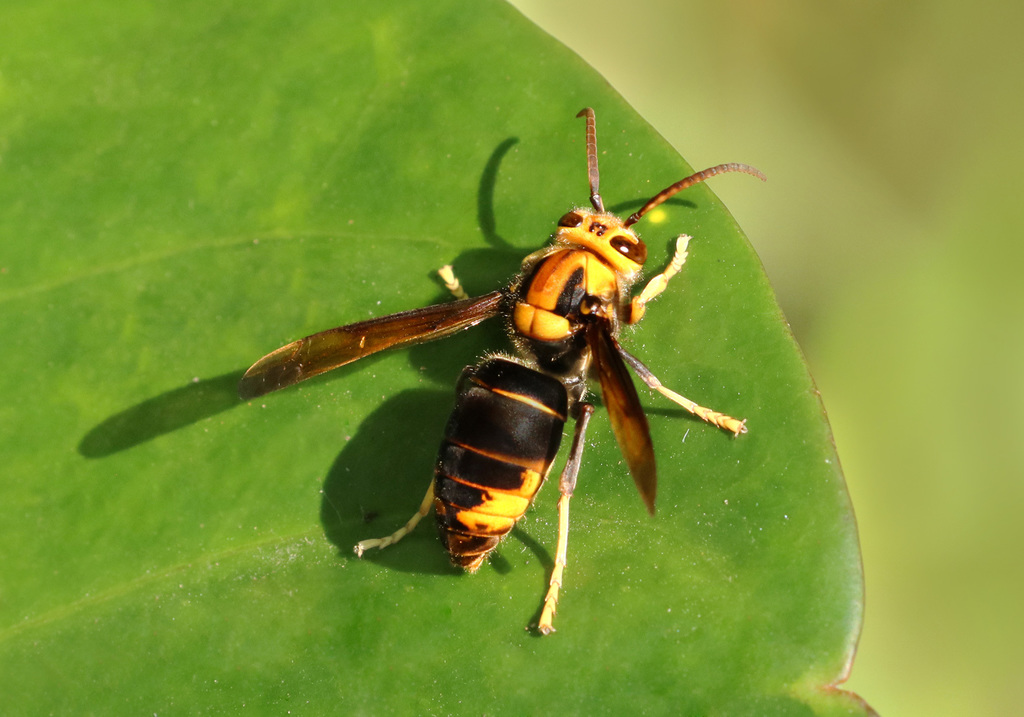
Yellow-legged Hornet
Vespa velutina
The Asian hornet (Vespa velutina), also known as the yellow-legged hornet or Asian predatory wasp, is a species of hornet indigenous to Southeast Asia.
It is of concern as an invasive species in some other countries, including most of Europe.
From the article Asian hornet on Wikipedia (CC BY-SA), quoted section by section
Description
Vespa velutina is significantly smaller than the European hornet. Typically, queens are 30 mm (1.2 in) long, and males about 24 mm (0.94 in). Workers are about 20 mm (0.79 in) long. The species has distinctive yellow tarsi (legs). The thorax is a velvety brown or black with a brown abdomen. Each abdominal segment has a narrow posterior yellow border, except for the fourth segment, which is orange. The head is black and the face yellow. Regional forms vary sufficiently in colour to cause difficulties in classification, and several subspecies have been variously identified and ultimately rejected; while there is a history of recognising subspecies within many of the Vespa species, including V. velutina, the most recent taxonomic revision of the genus treats all subspecific names in the genus Vespa as synonyms, effectively relegating them to no more than informal names for regional colour forms. The colour form causing concern about its invasiveness in Europe has been referred to as V. v. nigrithorax, though this name no longer has any taxonomic standing.
Wikipedia: “Appearance”
Range & habitat
V. velutina originates from Southeast Asia, particularly the tropical regions of northern India, Pakistan, Afghanistan, Bhutan, China, Taiwan, Burma, Thailand, Laos, Vietnam, Malaysia, the Indo-Chinese peninsula, and surrounding archipelagoes.
Pest status and invasiveness. As an invasive species, the Asian hornet appeared earliest in France, Spain, Portugal, South Korea, and Japan. Further invasions are ongoing in various countries, including much of Europe. Humans have been attacked after disturbing hornets; although the species is not aggressive, it "charges in a group as soon as it feels its nest is threatened". People have been hospitalised in France after suffering anaphylactic shock as a result of multiple stings. Because of Asian hornets' larger size, their stings are more serious than those of western honeybees. In November 2017, a man was killed in Galicia, Spain, after being stung over 20 times while pruning an apple tree. Several people have died in south west France near the original introduction site, including a resident of Chaillevette, Charente-Maritime, a 60-year-old woman in Gironde, Nouvelle-Aquitaine in 2019, and a farmer in Orival, Charente in 2020. …
Wikipedia: “Distribution”
At the table
According to a 2020 study in Korea, the larvae of V. velutina could be a potential food source, similar to the larvae of the Asian giant hornet (V. mandarinia), which are a Japanese delicacy.
Wikipedia: “Larvae as human food”
Listen
Looking for field recordings…
Where it lives
Recorded sightings
—
geo-referenced records in GBIF, from museums, herbaria and field observers.
Drag the globe to turn it. Dots are where records exist, not a range map; darker means more records.
In the stacks
Searching the stacks…
Every page naming Vespa velutina in the Biodiversity Heritage Library →
This page is assembled live from iNaturalist, GBIF, Wikipedia, the Source Library and the Internet Archive. It is not yet part of the hand-edited codex. iNaturalist taxon 119019.