- Animals
- ›Arthropods
- ›Hexapods
- ›Insects
- ›Winged and Once-winged Insects
- ›Butterflies and Moths
- ›Owlet Moths and Allies
- ›Underwing, Tiger, Tussock, and Allied Moths
- ›Tiger Moths and Allies
- ›Tiger Moths
- ›Handmaidens
- ›Ctenucha
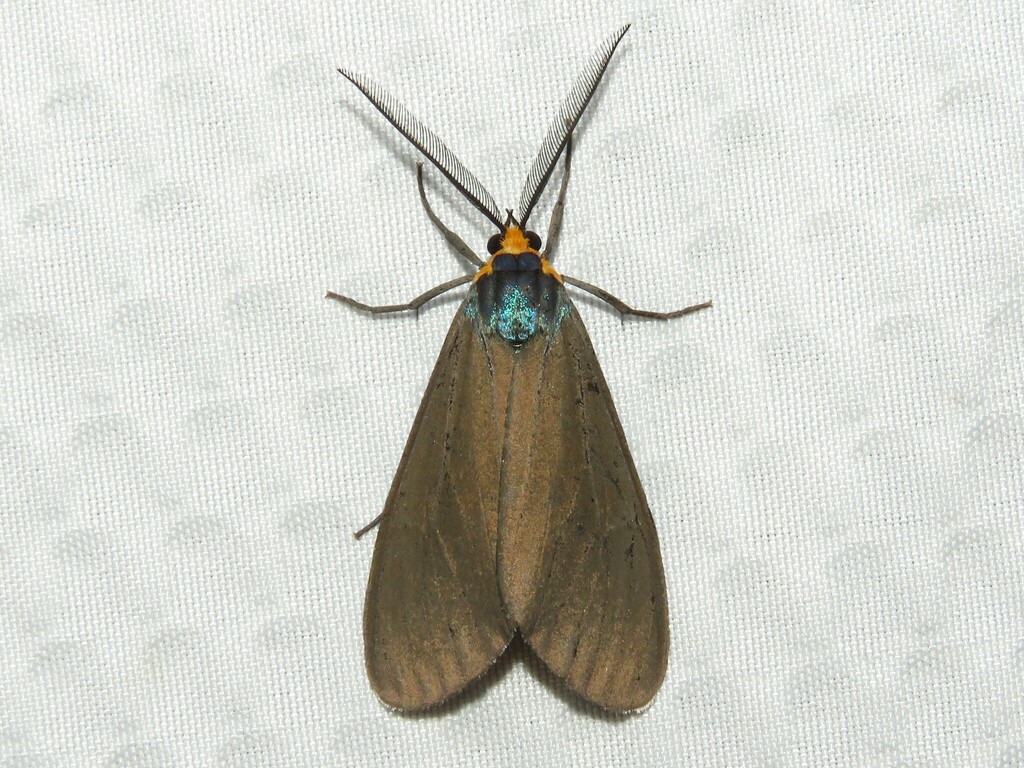
Virginia Ctenucha Moth
Ctenucha virginica
Ctenucha virginica, the Virginia ctenucha, is a moth of the family Erebidae. The wingspan ranges from 40–50 millimetres (1.6–2.0 in). The wing color varies from black to olive-brown. The body is a metallic blue-green. The head is yellow-orange, with feathery antennae. The caterpillar (about 20–25 mm) has multiple tufts of white and yellow hair. It undergoes metamorphosis in May–August.
From the article Ctenucha virginica on Wikipedia (CC BY-SA), quoted section by section
Description
The wingspan ranges from 40–50 millimetres (1.6–2.0 in). The wing color varies from black to olive brown. The body is a metallic blue green. The head is yellow orange, with feathery antennae. The caterpillar (about 20–25 mm) has multiple tufts of white and yellow hair. It undergoes metamorphosis in May–August.
Wikipedia: “Morphology”
Range & habitat
It is endemic to eastern North America, from Newfoundland south to Virginia. According to the University of Alberta, there has been a westward expansion in the last 60 years as it has reached the Canadian Rockies and is now found in all Canadian provinces.
Wikipedia: “Range”
At the table
Larvae feed on a variety of host plants including various grasses, irises, and sedges. Adults drink nectar from flowers including goldenrod.
Wikipedia: “Food plants”
Listen
Looking for field recordings…
Where it lives
Recorded sightings
—
geo-referenced records in GBIF, from museums, herbaria and field observers.
Drag the globe to turn it. Dots are where records exist, not a range map; darker means more records.
In the stacks
Searching the stacks…
Every page naming Ctenucha virginica in the Biodiversity Heritage Library →
This page is assembled live from iNaturalist, GBIF, Wikipedia, the Source Library and the Internet Archive. It is not yet part of the hand-edited codex. iNaturalist taxon 119013.