On eBird ↗
Welcome Swallow
Live sightings near you, the range map, bar charts of when it is seen, and Macaulay Library photos and recordings.
Welcome Swallow
Hirundo neoxena
The welcome swallow (Hirundo neoxena) is a small passerine bird in the swallow family Hirundinidae that is native to Australia and nearby islands. It has self-introduced into New Zealand in the middle of the twentieth century. It is very similar to the Pacific swallow with which it is often considered conspecific.
This species breeds in southern and eastern Australia in a variety of habitats, mostly in open areas, man-made clearings or urban environments, but not desert or dense forest. Eastern populations are largely migratory, wintering in northern Australia. Western birds and those in New Zealand are mainly sedentary.
From the article Welcome swallow on Wikipedia (CC BY-SA), quoted section by section
Description
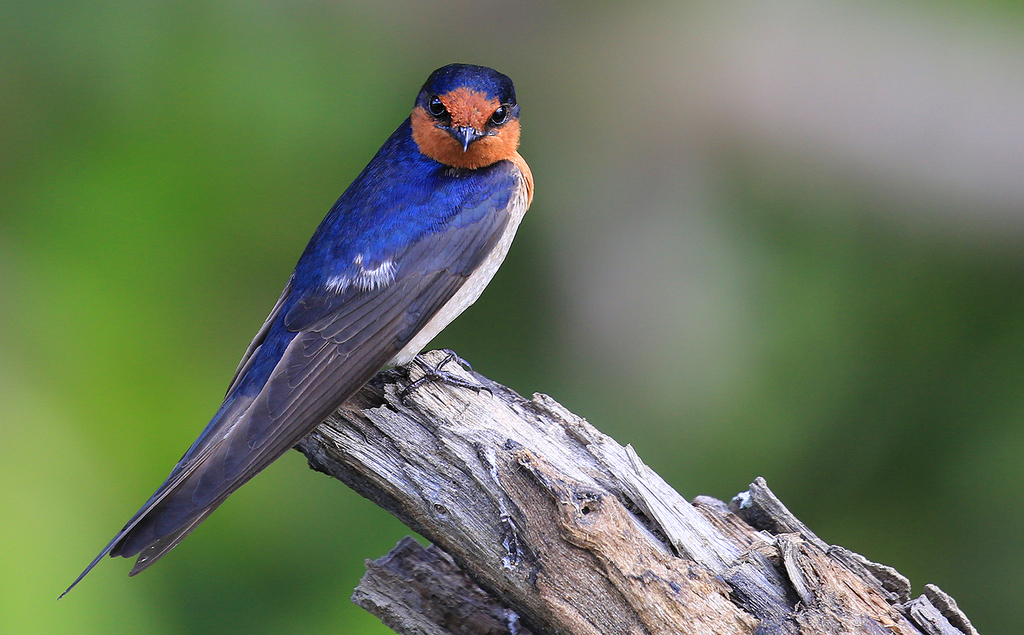
The welcome swallow is a small fast-flying bird. Its flying style is circular in pattern with swift darting motions. It has graceful shape and flight, moreover it often flies singly, in couples or in clusters. The welcome swallow is metallic blue-black above, light grey below on the breast and belly, and rusty on the forehead, throat and upper breast. It has a long forked tail, with a row of white spots on the individual feathers. These birds are about 15 cm (5.9 in) long, including the outer tail feathers which are slightly shorter in the female. The welcome swallow's weight is about 9-20g. From the Gould collection in Tasmania a "natural size" male had a wing size of 11.1 cm (4.4 in), tail size of 7.4 cm (2.9 in), and a culmen of 0.7 cm (0.28 in). While the female has 10.9 cm (4.3 in) wings, a 6.25 cm (2.46 in) tail, and a culmen of 0.7 cm (0.28 in). The call is a mixture of twittering and soft warbling notes, and a sharp whistle in alarm. However, their call is normally quiet and does not travel very far. Young welcome swallows are buffy white, instead of rufous, on the forehead and throat, and have shorter tail streamers.
Range & habitat
The winter range in northern Australia overlaps with that of wintering barn swallow (Hirundo rustica), but the latter is readily separable by its blue breast band. Welcome swallows readily breed close to human habitation. Welcome swallows are commonly found on wires, posts and other perches.
Natural global range. Welcome swallows have a very large distributional range because they are a cross-regional species. Welcome swallows live mostly in eastern, western, southern and central Australia. The welcome swallows that live in eastern Australia move to northern Australia in winter. The welcome swallows that live in Western Australia and others that live in New Zealand are mostly not migratory. This swallow species has been observed nesting in the majority of New Zealand and its surrounding islands, Australia and some parts of Tasmania. Currently, this species has been recorded in New Guinea, New Caledonia and other surrounding islands. The distribution of the welcome swallow also depends on seasonal change. During the winter, the welcome swallow in Australia will move towards the north which places it closer to the equator and warm weather. For the following spring, they will return to southern Australia to breed.
New Zealand range. The welcome swallow is a self-introduced species from Australia that is believed to have flown over to New Zealand in the early 1900s. …
Wikipedia: “Distribution and habitat”
What it does
These birds are extremely agile fliers, which feed on insects while in flight. They often fly fast and low to the ground on open fields in large circles or figure eight patterns. They will often swoop around animals or people in the open. Males and females tend to forage together during breeding season even with fledglings within the nest. Welcome swallows do show a habit of drinking water while flying, they do this by scooping water within their bills from lake and pond surfaces. This is because welcome swallows need to drink water frequently, which allows them to catch insects in the water as well. Welcome swallows can also cooperate with other birds or companions to drive the insects together. They can remember the insects' activity routines to make foraging more efficient. It has been found welcome swallows have slow growing wings that are not affected by food intake unless they are starving. This suggests that the welcome swallow prioritizes wing growth even when fasting for up to six hours at a time. It is also believed that the swallow accumulates fat in order to survive time periods when food is scarce or conditions are bad. This method allows rapid growth when conditions are good and stable growth when conditions are bad.
Wikipedia: “Food and feeding”
Listen
Looking for field recordings…
Where it lives
Recorded sightings
—
geo-referenced records in GBIF, from museums, herbaria and field observers.
Drag the globe to turn it. Dots are where records exist, not a range map; darker means more records.
In the stacks
Searching the stacks…
Every page naming Hirundo neoxena in the Biodiversity Heritage Library →
This page is assembled live from iNaturalist, GBIF, Wikipedia, the Source Library and the Internet Archive. It is not yet part of the hand-edited codex. iNaturalist taxon 11882.