- Plants
- ›Vascular Plants
- ›flowering plants
- ›Dicots
- ›Sunflowers, Bellflowers, Fanflowers, and Allies
- ›Sunflowers, Daisies, Asters, and Allies
- ›Asteroideae
- ›asters and allies
- ›Symphyotrichinae
- ›Symphyotrichum
- ›Symphyotrichum
- ›Symphyotrichum
- ›Porteriani
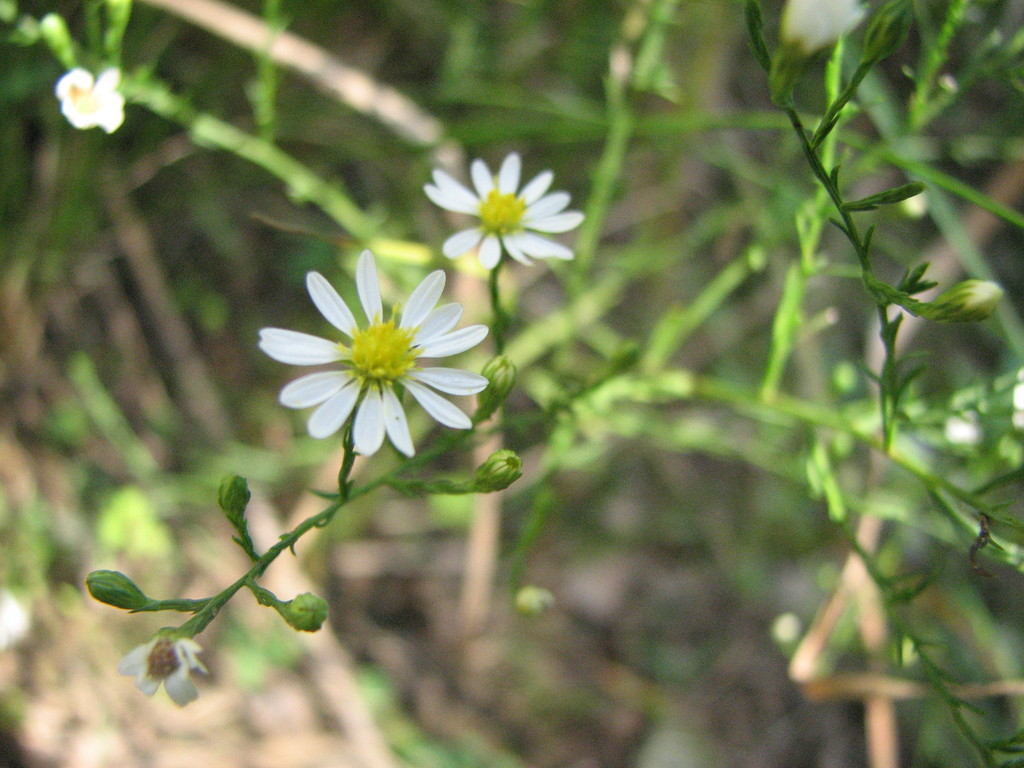
serpentine aster
Symphyotrichum depauperatum
Symphyotrichum depauperatum (formerly Aster depauperatus), commonly known as serpentine aster or starved aster, is a rare species in the family Asteraceae adapted to serpentine barrens, an ecosystem with a high concentration of toxic metals in the soil. It has been found in Pennsylvania, Maryland, and on some diabase glades in North Carolina. It grows to 50 centimeters (1+3⁄4 feet) and has white ray florets surrounding a center of yellow disk florets.
From the article Symphyotrichum depauperatum on Wikipedia (CC BY-SA), quoted section by section
Description
Symphyotrichum depauperatum is a perennial, herbaceous plant that may reach up to 50 centimeters (1+3⁄4 feet) tall, with 1–3 stems. The leaves are narrow and generally 2–4 centimeters (3⁄4–1+1⁄2 inches) long. The plant produces numerous flower heads in branched arrays, each head with 7–14 white or, rarely, pink ray florets surrounding 7–17 yellow disk florets.
Range & habitat
S. depauperatum is adapted to serpentine barrens, an ecosystem with a high concentration of toxic metals in the soil. It has been found in Baltimore and Cecil Counties, Maryland; Granville County, North Carolina; and, Chester, Delaware, and Lancaster Counties, Pennsylvania. Serpentine aster has been called a "flagship species" of the unique serpentine ecosystem and was once thought to be endemic to these barrens, but it also has been found to occur in a disjoint population on diabase glades in Granville County, North Carolina.
Wikipedia: “Distribution and habitat”
Where it lives
Recorded sightings
—
geo-referenced records in GBIF, from museums, herbaria and field observers.
Drag the globe to turn it. Dots are where records exist, not a range map; darker means more records.
In the stacks
Searching the stacks…
Every page naming Symphyotrichum depauperatum in the Biodiversity Heritage Library →
This page is assembled live from iNaturalist, GBIF, Wikipedia, the Source Library and the Internet Archive. It is not yet part of the hand-edited codex. iNaturalist taxon 118740.