On eBird ↗
Caribbean Martin
Live sightings near you, the range map, bar charts of when it is seen, and Macaulay Library photos and recordings.
Caribbean Martin
Progne dominicensis
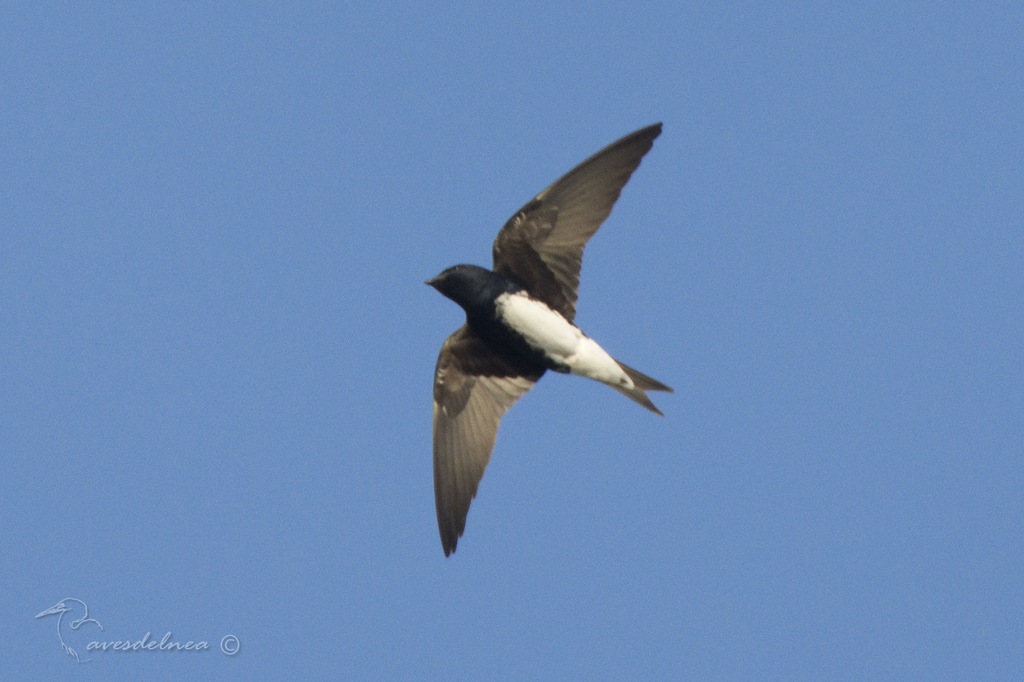
The Caribbean martin or white-bellied martin (Progne dominicensis) is a large swallow.
It has at various times been considered alternatively as a race of the purple martin, Progne subis.
From the article Caribbean martin on Wikipedia (CC BY-SA), quoted section by section
Description
Adult Caribbean martins are 18.5 cm in length, with a forked tail and relatively broad wings, and weigh 40 g. Adult males are a glossy blue-black with contrasting white lower underparts. Females and juveniles are duller than the male, with grey-brown breast and flanks and white lower underparts.
Range & habitat
It breeds throughout the Caribbean, except on Cuba and Isla de la Juventud, where it is replaced by the related Cuban martin (P. cryptoleuca). It is closely related to the aforementioned species, as well as the Sinaloa martin (P. sinaloae) to which it used to be considered conspecific. There are sight records from mainland Central and South America, and most birds appear to migrate to the South American mainland. A single bird was recorded in Key West, Florida, on May 9, 1895 (AOU 2000).
Wikipedia: “Distribution”
What it does
The Caribbean martin nests in cavities in banks and buildings, or old woodpecker holes. 3–6 eggs are laid in the lined nest, and incubated for 15 days, with another 26–27 to fledging. Just as the purple martin, this species may compete with other passerines for nesting cavities. In particular, the main foe is the house sparrow [1] in urban areas, where they mostly use man-made structures, whereas in more rural locations Picidae holes in coconut trees are favored, and there is less competition with the sparrows. Caribbean martins are gregarious birds which hunt for insects in flight. Their call is a gurgly chew-chew.
Wikipedia: “Behaviour”
Listen
Looking for field recordings…
Where it lives
Recorded sightings
—
geo-referenced records in GBIF, from museums, herbaria and field observers.
Drag the globe to turn it. Dots are where records exist, not a range map; darker means more records.
In the stacks
Searching the stacks…
Every page naming Progne dominicensis in the Biodiversity Heritage Library →
This page is assembled live from iNaturalist, GBIF, Wikipedia, the Source Library and the Internet Archive. It is not yet part of the hand-edited codex. iNaturalist taxon 11874.