- Animals
- ›Chordates
- ›Vertebrates
- ›Ray-finned Fishes
- ›Spiny-rayed fishes
- ›Perches, Scorpionfishes, Sticklebacks, and Allies
- ›Perches, groupers and allies
- ›Sea Basses
- ›Serranus
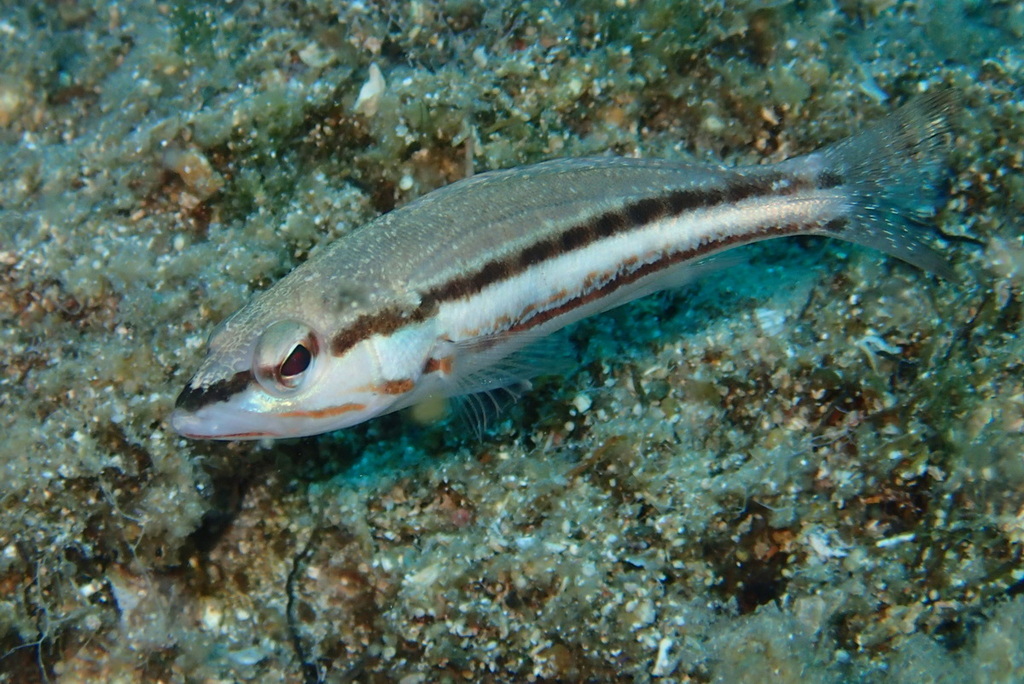
Comber
Serranus cabrilla
The comber (; Serranus cabrilla) is a species of marine ray-finned fish from the family Serranidae, the sea basses. It is widely distributed in the eastern North and South Atlantic Oceans and into the southwestern Indian Ocean. It is caught for food and fishmeal in some parts of its range.
From the article Comber (fish) on Wikipedia (CC BY-SA), quoted section by section
Description
The comber has a relatively stout body with a large head and a prominent jaw. It has two dorsal fins, the first has 11 thin spines and is joined to the second, which has 13–15 branched rays. The anal fin has 3 spines and 7–8 soft rays. The caudal fin is slightly truncate in shape. The colouration of the comber varies from light brown to dark brown to an intense reddish brown. It is marked with 7 to 9 darker transverse bands along its flanks, these are broken by a longitudinal white to yellowish stripe, running from the head to the tail. There are a few yellow or orange longitudinal lines on the sides of the head. The first dorsal fin is normally folded flat against the back when the fish is in the water. The comber can reach a standard length of 40 centimetres (16 in) but 25 centimetres (9.8 in) fish are more common.
Range & habitat
The comber has an extensive distribution in the eastern Atlantic where it is found in the warmer waters in the south and southwest of England and off western Wales, south along the European coast, to the Straits of Gibraltar and into the Mediterranean and Black Seas. It also occur along the west coast of Africa from Morocco southwards to Angola. Combers are found around the islands of Macaronesia and São Tomé and Príncipe in the Gulf of Guinea. It also occurs off the coasts of South Africa where it is found from the Cape of Good Hope to KwaZulu-Natal. Records from the Red Sea were thought to be a result of Anti-Lessepsian migration from the Mediterranean via the Suez Canal. However, genetic analysis demonstrated that the Red Sea population must have existed before the opening of the Suez Canal.
Wikipedia: “Distribution”
Where it lives
Recorded sightings
—
geo-referenced records in GBIF, from museums, herbaria and field observers.
Drag the globe to turn it. Dots are where records exist, not a range map; darker means more records.
In the old herbals & bestiaries


In the stacks
Searching the stacks…
Every page naming Serranus cabrilla in the Biodiversity Heritage Library →
This page is assembled live from iNaturalist, GBIF, Wikipedia, the Source Library and the Internet Archive. It is not yet part of the hand-edited codex. iNaturalist taxon 118675.