- Plants
- ›Vascular Plants
- ›flowering plants
- ›Dicots
- ›Legumes, Milkworts, and Allies
- ›Legumes
- ›Faboideae
- ›milkvetches, locoweeds, and allies
- ›Oxytropis
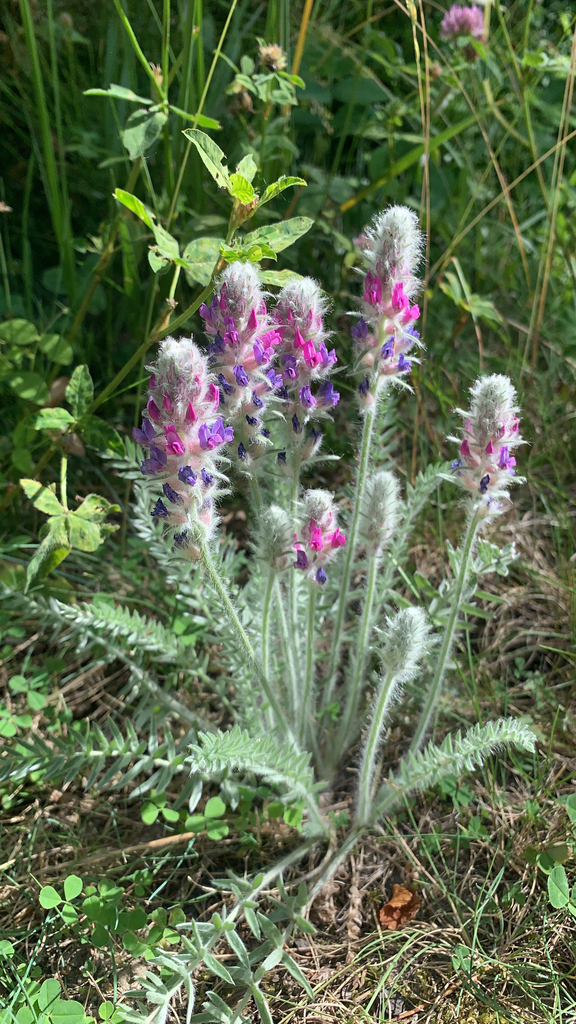
Showy Locoweed
Oxytropis splendens
Oxytropis splendens, commonly known as showy locoweed, is a flowering perennial in the legume family endemic to the east slope of the Rocky Mountains. Growing in Canada, Alaska, several Great Plains states, and parts of the Mountain West, O. splendens grows well in harsh alpine ecosystems, allowing it to quickly colonize gravel and coal spoils.
From the article Oxytropis splendens on Wikipedia (CC BY-SA), quoted section by section
Description
This plant is tufted with silvery, silky-hairy, leafless stems. When in bloom, it grows dense spikes of rich lavender flowers, rising from among pinnately compound basal leaves. It has a lifespan of 3-5 years, blooming every year from late-June to mid-August. It produces small brown seeds. The plant's flowers are favored by many varieties of bumblebees.
Range & habitat
Widely distributed in the mountains and foothills in Alberta. Alaska, Yukon, District of Mackenzie, to Lake Superior, south to southeastern British Columbia, New Mexico, North Dakota, northern Minnesota, and Colorado. It favors grassy slopes, open woods, clearings, gravelly river flats, banks, and roadsides. O. splendens is an early colonizer of disturbed gravel areas and unamended coal spoils. Its nitrogen fixing properties and quick colonizing of poor soils make it a favorable plant for revegetation.
Wikipedia: “Distribution and habitat”
Toxicity
It is potentially toxic, as it contains toxic alkaloids and takes up selenium.
== References ==
Where it lives
Recorded sightings
—
geo-referenced records in GBIF, from museums, herbaria and field observers.
Drag the globe to turn it. Dots are where records exist, not a range map; darker means more records.
In the stacks
Searching the stacks…
Every page naming Oxytropis splendens in the Biodiversity Heritage Library →
This page is assembled live from iNaturalist, GBIF, Wikipedia, the Source Library and the Internet Archive. It is not yet part of the hand-edited codex. iNaturalist taxon 118530.