- Animals
- ›Arthropods
- ›Hexapods
- ›Insects
- ›Winged and Once-winged Insects
- ›Ants, Bees, Wasps, and Sawflies
- ›Narrow-waisted Wasps, Ants, and Bees
- ›Ants, Bees, and Stinging Wasps
- ›Formicoidea
- ›Ants
- ›Myrmicine Ants
- ›Stenammini
- ›Messor
- ›Messor barbarus
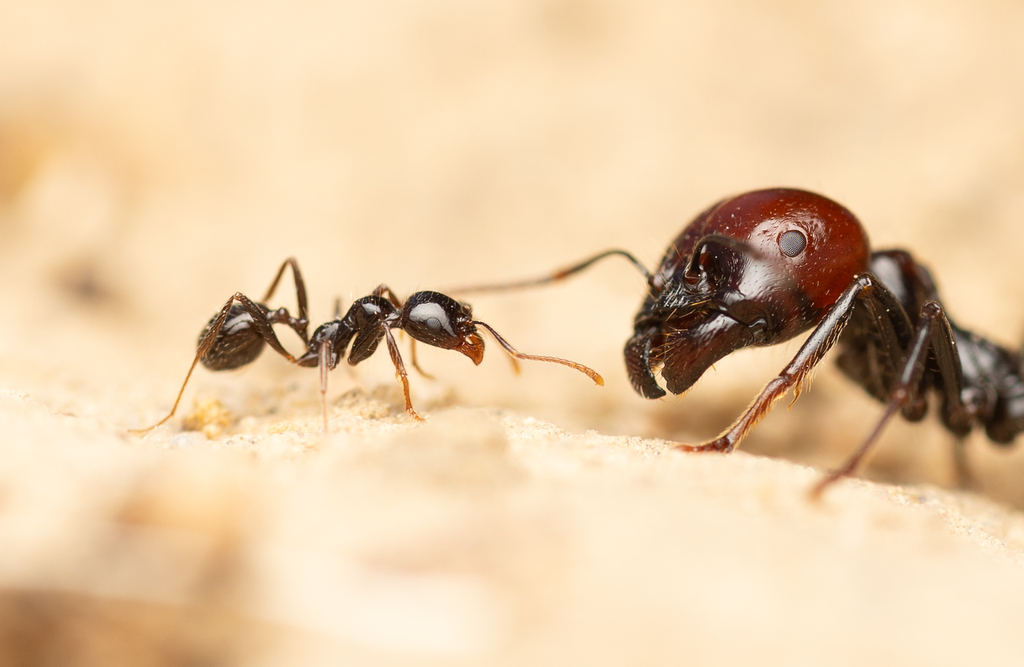
Barbary Harvester Ant
Messor barbarus
Messor barbarus is a species of harvester ant in the subfamily Myrmicinae. It is found In Southern Europe and Northern Africa.
From the article Messor barbarus on Wikipedia (CC BY-SA), quoted section by section
What it does
Messor barbarus is found to act in accordance with the optimal foraging theory, which predicts that selectivity in ants increases with increasing richness of resources in an area, as well as with increasing distance from starting location. Trails were likewise differentially favored according to the relative abundance of resources provided to the ant populations. Highly frequented trails had a higher mean rate per worker, meaning the harvesters returned higher rates of resources more efficiently along these trails. These trails drew more foraging ants to retrieve seeds on the whole, and the foraging ants returned seeds at a higher rate per capita. This foraging pattern indicates that relative food abundance along varying trails impacted the patterns of trail foraging behavior in Messor barbarus. For trails spanning long distances, ants exhibit behavior of strong chemical marking on preferred seeds to allow for the creation and maintenance of the route.
Wikipedia: “Trail foraging behavior”
Listen
Looking for field recordings…
Where it lives
Recorded sightings
—
geo-referenced records in GBIF, from museums, herbaria and field observers.
Drag the globe to turn it. Dots are where records exist, not a range map; darker means more records.
In the stacks
Searching the stacks…
Every page naming Messor barbarus in the Biodiversity Heritage Library →
This page is assembled live from iNaturalist, GBIF, Wikipedia, the Source Library and the Internet Archive. It is not yet part of the hand-edited codex. iNaturalist taxon 118487.