- Animals
- ›Chordates
- ›Vertebrates
- ›Birds
- ›Perching Birds
- ›Ovenbirds and Woodcreepers
- ›Typical Ovenbirds
- ›Clibanornis
On eBird ↗
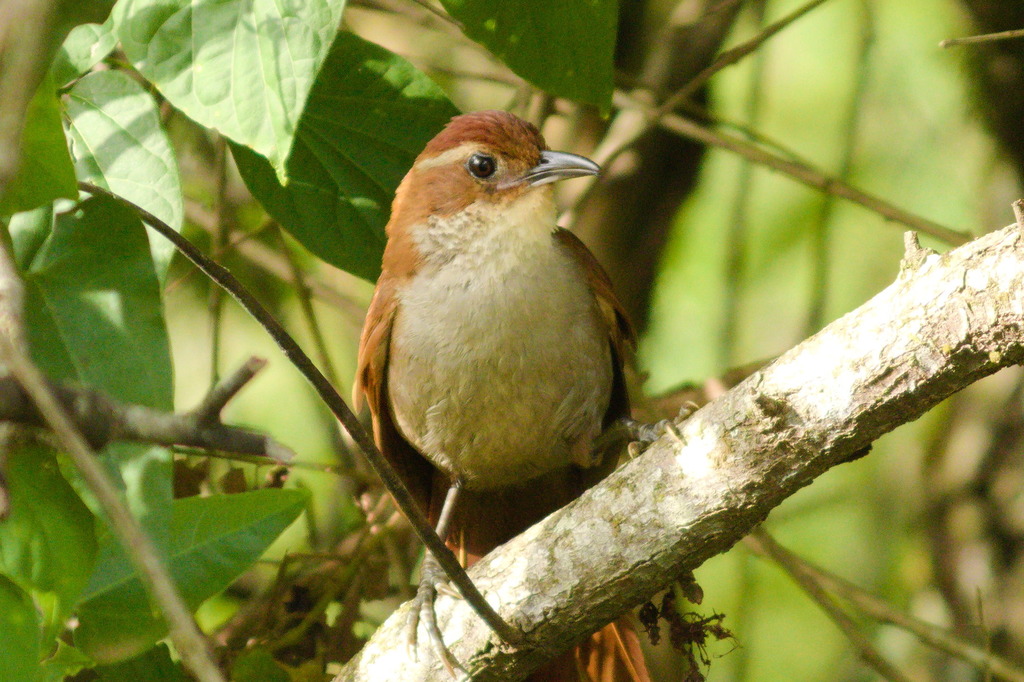
Canebrake Groundcreeper
Live sightings near you, the range map, bar charts of when it is seen, and Macaulay Library photos and recordings.
Canebrake Groundcreeper
Clibanornis dendrocolaptoides
The canebrake groundcreeper (Clibanornis dendrocolaptoides) is a species of bird in the Furnariinae subfamily of the ovenbird family Furnariidae. It is found in Argentina, Brazil, and Paraguay.
From the article Canebrake groundcreeper on Wikipedia (CC BY-SA), quoted section by section
Description
The canebrake groundcreeper is 20 to 22 cm (7.9 to 8.7 in) long and weighs 52 to 54 g (1.8 to 1.9 oz). It is a largish furnariid with an almost straight bill. The sexes have the same plumage. Adults have a narrow grayish or buff-gray supercilium that widens to the rear and dark brown lores on an otherwise dull reddish brown face. Their crown is dark chestnut-brown, their back and rump rufescent brown, and their uppertail coverts rufous-brown. Their wing coverts and flight feathers are also rufous-brown. Their tail's central pair of feathers are dull rufous-brown and the rest rufous-chestnut. Their throat is white with blackish speckles on the sides, their breast and belly dull grayish, their sides rufous-brown, and their flanks and undertail coverts ochraceous brown.Their iris is brown, their bill black, and their legs and feet olive-green to greenish gray. Juveniles have a plain buff-washed white throat, faint buff mottling on the breast, and a grayer belly than the nominate.
Range & habitat
The canebrake groundcreeper is found in southeastern Brazil from São Paulo state south into Rio Grande do Sul and in northeastern Argentina's Misiones Province. There are also fairly old records and reports of single birds in eastern Paraguay but apparently no permanent residents. It inhabits montane and tropical lowland evergreen forest, where it favors hilly terrain and the forest edge and secondary forest. It tends to be near watercourses and frequents bamboo thickets and dense understory along them. In elevation it ranges from near sea level to 1,200 m (3,900 ft).
Wikipedia: “Distribution and habitat”
What it does
The canebrake groundcreeper's diet and foraging technique are largely unknown. It is usually seen in pairs in dense undergrowth, and is assumed to glean arthropod prey on or near the ground.
Wikipedia: “Feeding”
Listen
Looking for field recordings…
Where it lives
Recorded sightings
—
geo-referenced records in GBIF, from museums, herbaria and field observers.
Drag the globe to turn it. Dots are where records exist, not a range map; darker means more records.
In the stacks
This page is assembled live from iNaturalist, GBIF, Wikipedia, the Source Library and the Internet Archive. It is not yet part of the hand-edited codex. iNaturalist taxon 11833.