On eBird ↗
Palawan Peacock-Pheasant
Live sightings near you, the range map, bar charts of when it is seen, and Macaulay Library photos and recordings.
Palawan Peacock-Pheasant
Polyplectron napoleonis
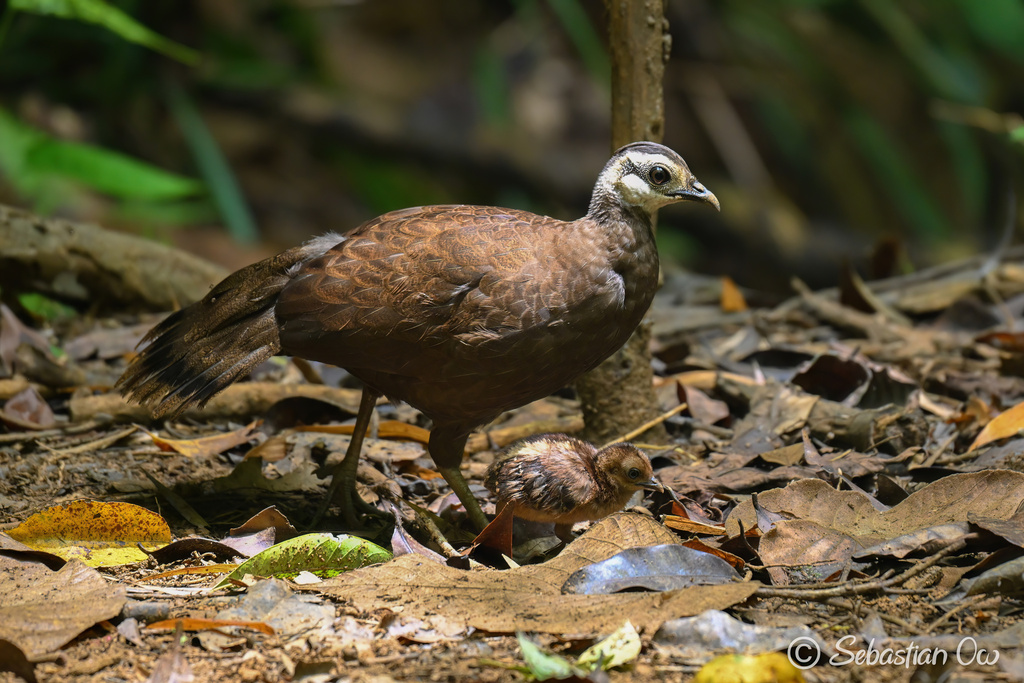
The Palawan peacock-pheasant (Polyplectron napoleonis) is a medium-sized (up to 50cm long) bird in the family Phasianidae endemic to the island of Palawan in the Philippines. The spectacular male has a black body with blue marks on the wings, a grayish, finely speckled back and tail with blue peacock "eyes," white marks on the face, and a red eye-ring. Females are mostly brown but with a white face. It is known as tandikan in the some local Palawano (peras in Southwest Palawano), Tagbanwa, and Batak languages of Palawan. It is featured prominently in the culture of the indigenous people of Palawan. The bird is also depicted in the official seal of the city of Puerto Princesa and is in the Philippine one hundred-peso note This species is threatened by habitat loss, the illegal wildlife trade and hunting and is listed as a Vulnerable species by the International Union for Conservation of Nature.
From the article Palawan peacock-pheasant on Wikipedia (CC BY-SA), quoted section by section
Description
The adult male is the most peacock-like in appearance member of the genus Polyplectron. It has an erectile crest and highly iridescent electric blue-violet, metallic green-turquoise dorsal plumage. Its breast and ventral regions are a velvety black. The flight feathers (rectrices) are wide, flat, and rigid; velvety black on the inner edges and an iridescent violet-blue-green on the outer edges. Their terminal edges are squared. The tail feathers are black with very fine golden-brown speckling. Each tail plume and upper-tail covert is marked with highly iridescent, light-reflective "eyes" (ocelli), each bordered by black and gray; they are also tipped in bands of black and gray. The tail is held erect and expanded laterally together with the bodies of the birds. The males also raise one wing and lower the other, laterally compressing the body during pair-bonding, courtship displays as well and may also be antipredator adaptation. The female is slightly smaller than the male. Its contour plumage is cloudy silt in colouration. The mantle and breast are a dark sepia in coloration. The rectrices are essentially similar to those of the male, exhibiting marked adumbrations and stunning ocelli. Throughout, their plumage is earthen and difficult to distinguish from the substrate and branches. …
Range & habitat
Endemic to the Philippines, the Palawan peacock-pheasant is found in the humid forests of Palawan Island in the southern part of the Philippine archipelago. They are confined to the lowlands and foothills, at elevations normally below 1,000 m (3,300 ft) above sea level.
Wikipedia: “Distribution and habitat”
What it does
Peacock-pheasants are highly invertivorous, taking isopods, earwigs, insect larvae, mollusks, centipedes and termites as well as small frogs, drupes, seeds and berries. They are strictly monogamous, renesting yearly. The female usually lays up to two eggs. Both parents rearing chicks for up to two years. Males act as sentinels of nest sites and are highly pugnacious during the reproductive cycle. Their call is a short high screech, each around 0.5 to 1 second long, and repeated every 5 seconds.
Wikipedia: “Behavior and ecology”
Listen
Looking for field recordings…
Where it lives
Recorded sightings
—
geo-referenced records in GBIF, from museums, herbaria and field observers.
Drag the globe to turn it. Dots are where records exist, not a range map; darker means more records.
In the stacks
Searching the stacks…
Every page naming Polyplectron napoleonis in the Biodiversity Heritage Library →
This page is assembled live from iNaturalist, GBIF, Wikipedia, the Source Library and the Internet Archive. It is not yet part of the hand-edited codex. iNaturalist taxon 1182.