- Animals
- ›Chordates
- ›Vertebrates
- ›Ray-finned Fishes
- ›Spiny-rayed fishes
- ›Blennies, Damselfishes and Allies
- ›Blennies
- ›Kelp Blennies
- ›Gibbonsia
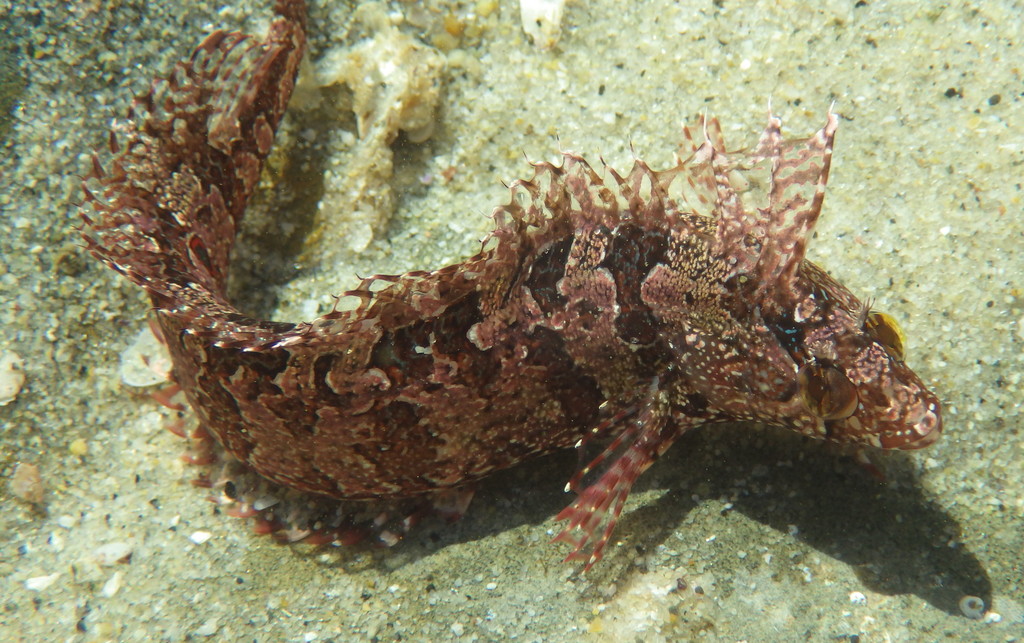
Spotted Kelpfish
Gibbonsia elegans
Gibbonsia elegans, the spotted kelpfish (called sargacero or sargacero manchado in Mexico), is a species of clinid native to subtropical waters of the Pacific Ocean from central California, U.S. to southern Baja California, Mexico. It prefers subtidal rocky habitats with seaweed down to a depth of about 56 metres (184 ft). This species can reach a maximum length of 16 centimetres (6.3 in). This species feeds on benthic crustaceans (amphipods, isopods, crabs), gastropods, and polychaete worms. The genus Gibbonsia is named after William P. Gibbons who was a naturalist in the California Academy of Science. The spotted kelpfish occurs in three different color morphs (red, green, and brown), depending on which plants occur in an individual's habitat. Males and females do not show sexual dimorphism.
From the article Gibbonsia elegans on Wikipedia (CC BY-SA), quoted section by section
Description
Gibbonsia elegans is a relatively small, mottled fish with a slender body and triangular head. It has a compressed, almost angulliform body type. The maximum length the spotted kelpfish has been found to reach is 120 mm. It is unknown whether the spotted kelpfish presents a toxic hazard to humans. Gibbonsia elegans has a terminal mouth with conical teeth on the upper and lower mandibles (meaning that its mouth ends at the point of its snout, neither angled up or down, and it teeth are sharp and narrow), as well as in the center of the roof of its mouth. The spotted kelpfish has a fleshy flap of skin above its eye, and a smaller one in front of its eye. Spotted kelpfish can have up to three spots, called ocelli, on the body. Generally, they have two ocelli; one above the pectoral fin and one positioned further posteriorally. The spotted kelpfish's dorsal fin follows the entire length of the fish's body, from the level of its gill cover to the beginning of the caudal fin. The anterior end of the dorsal fin often sports 3-5 spiny rays. The caudal fin of Gibbonsia elegans is relatively small and has a rounded end. Like the dorsal fin, the anal fin of the spotted kelpfish is long, stretching from the caudal fin to further than halfway up the fish's abdomen. …
Range & habitat
The spotted kelpfish is found in the shallow, rocky, coastal waters of southern California (including Baja) and requires aquatic vegetation in its habitat.It is sometimes found in calm bays but is most common along stretches of open coast.Some common plants found in the spotted kelpfish's habitat are green surfgrass, brown algae, and red algae. The spotted kelpfish inhabits depths ranging from the lower intertidal level (from 0 to 1.2 meters below mean sea level) to about 30m. As mentioned previously, kelpfish are found in various color morphs that match their plant habitat. In that effort, they are found in red, green or brown forms. They are capable of changing their color over a period of time (within several weeks). According to a 1988 study by Stepien et al., color changes in kelpfish are determined solely by the color of their habitat and not by their diet. Color changes are also dependent on season. In the study, more red Gibbonsia elegans were found in the winter, when red algae were dominant. In the spring and summer, the green and brown morphs were more prevalent. Male and female Gibbonsia elegans are commonly found in different vertical distributions. Females are more frequently found in shallow habitats whereas males are found more commonly at greater depths. A 1990 study performed by Holbrook et al. …
Wikipedia: “Habitat and distribution”
What it does
The spotted kelpfish feeds largely on epiphytic crustaceans, such as gammarid amphipods and flabilliferan isopods. Examples include the hump-backed shrimp, Spirontocaris paludicola, and S. picta. Spirontocaris picta was found to be the significant portion of Gibbonsia elegans' stomach content in one study. These crustaceans are found on the same plants that Gibbonsia elegans live on, including brown and red algae. The epiphytic crustaceans also match the color of their plant habitat. In addition to crustaceans, polychaete worms and microgastropods have been found in abundance in the stomach contents of spotted kelpfish.
Wikipedia: “Diet”
At the table
The spotted kelpfish has been deemed economically insignificant to humans except for its contribution to the diet of certain game fishes. One source claims that the spotted kelpfish is occasionally caught by fishers using small hooks in rocky or kelp areas of the California coast, but that the fish is too small to be of value for food use.
Wikipedia: “Human Uses”
Where it lives
Recorded sightings
—
geo-referenced records in GBIF, from museums, herbaria and field observers.
Drag the globe to turn it. Dots are where records exist, not a range map; darker means more records.
In the stacks
Searching the stacks…
Every page naming Gibbonsia elegans in the Biodiversity Heritage Library →
This page is assembled live from iNaturalist, GBIF, Wikipedia, the Source Library and the Internet Archive. It is not yet part of the hand-edited codex. iNaturalist taxon 117548.