- Plants
- ›Vascular Plants
- ›flowering plants
- ›Dicots
- ›magnolias, nutmegs, and allies
- ›magnolia family
- ›Magnolioideae
- ›Magnolia
- ›Tulipastrum
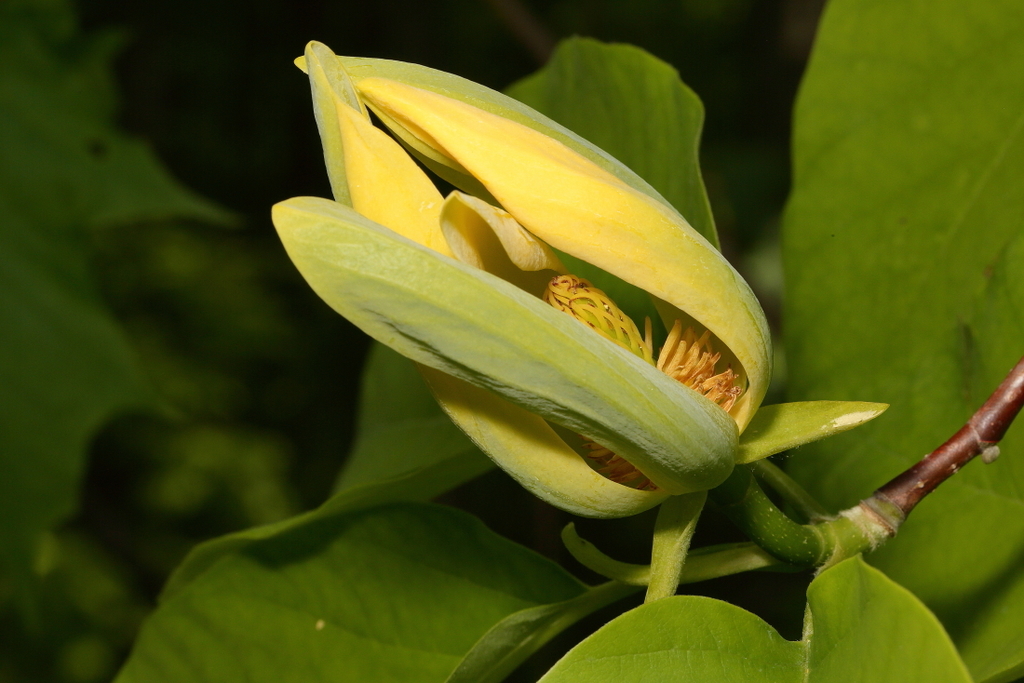
Cucumber-tree
Magnolia acuminata
Magnolia acuminata, commonly called the cucumber tree (often spelled as a single word "cucumbertree"), cucumber magnolia or blue magnolia, is one of the largest magnolias, and one of the cold-hardiest. It is a large forest tree of the Eastern United States and Southern Ontario in Canada. It is a tree that tends to occur singly as scattered specimens, rather than in groves.
The cucumber tree is native primarily within the Appalachian belt, including the Allegheny Plateau and Cumberland Plateau, up to western Pennsylvania and New York. There are also numerous disconnected outlying populations through much of the southeastern U.S., and a few small populations in Southern Ontario. In Canada, the cucumber tree is listed as an endangered species and is protected under the Canadian Species at Risk Act. In 1993 the North American Native Plant Society purchased Shining Tree Woods to preserve a stand of Magnolia acuminata, which is also known as "The Shining Tree".
From the article Magnolia acuminata on Wikipedia (CC BY-SA), quoted section by section
At the table
Cucumber trees are excellent shade trees for parks and gardens, though they are not recommended for use as street trees. In cultivation, they typically only grow 15–20 m (49–66 ft) tall, although they reach over 30 m (98 ft) in ideal forest situations. They can become quite massive: the United States national (and presumed world) champion in Stark County, Ohio measures eight feet (2.4 m) in diameter and 96 ft (29 m) tall. They grow best in deep, moist, well-drained soils that are slightly acidic although they are tolerant of alkaline soils. They are tricky to transplant due to their coarse, fleshy root system and should be planted shallow and moved in early spring with a good soil ball. In the timber trade, the wood of this tree is interchangeable with that of the related tuliptree (Liriodendron tulipifera). Magnolia acuminata has been used in hybridizing new varieties that share its yellow flower color and cold hardiness. It additionally has been marked as a pollinator plant, supporting and attracting bees and butterflies. It is a host plant for butterflies, providing food during their larval stage.
Wikipedia: “Uses and cultivation”
Where it lives
Recorded sightings
—
geo-referenced records in GBIF, from museums, herbaria and field observers.
Drag the globe to turn it. Dots are where records exist, not a range map; darker means more records.
In the stacks
Searching the stacks…
Every page naming Magnolia acuminata in the Biodiversity Heritage Library →
This page is assembled live from iNaturalist, GBIF, Wikipedia, the Source Library and the Internet Archive. It is not yet part of the hand-edited codex. iNaturalist taxon 117426.