- Animals
- ›Arthropods
- ›Hexapods
- ›Insects
- ›Winged and Once-winged Insects
- ›Butterflies and Moths
- ›Butterflies
- ›Gossamer-winged Butterflies
- ›Hairstreaks
- ›Eumaeini
- ›Callophryidina
- ›Callophrys
- ›Greenie
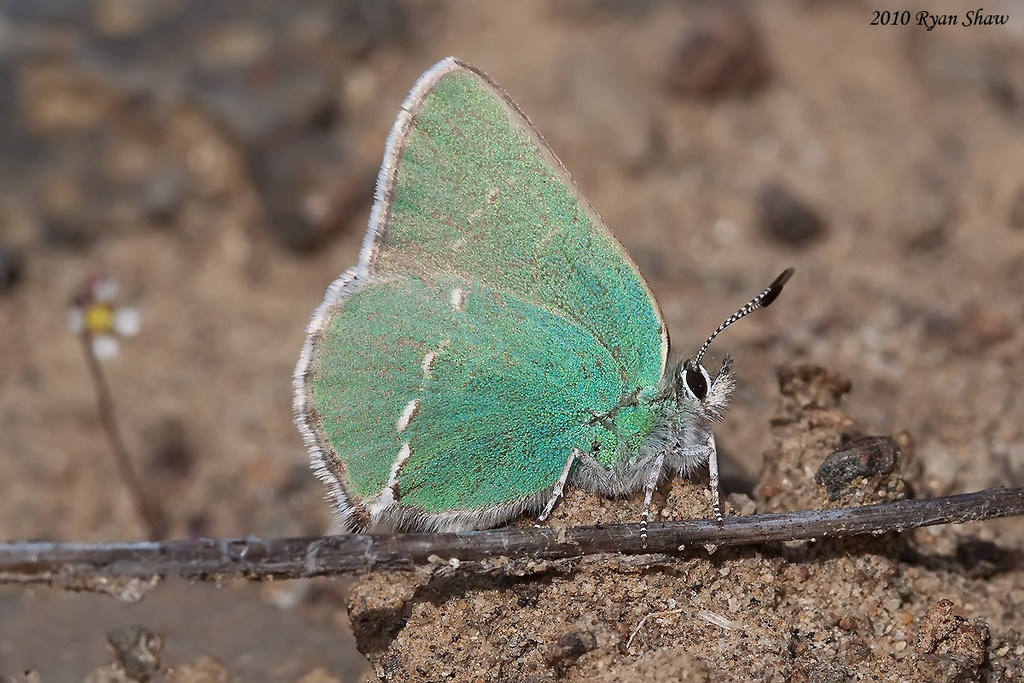
Sheridan's Hairstreak
Callophrys sheridanii
Callophrys sheridanii, the Sheridan's hairstreak and Sheridan's green hairstreak, is a butterfly in the family Lycaenidae. It is found in North America along the south coast of British Columbia and parts of Nevada, Arizona, Saskatchewan, North Dakota, and New Mexico. In 2009, this species was adopted as the U.S. state butterfly for Wyoming.
From the article Callophrys sheridanii on Wikipedia (CC BY-SA), quoted section by section
Description
This small, tail-less butterfly has a wingspan of 20–24 millimetres (0.8–0.9 in). The upperside is dark gray brown, with underside color ranging from a bright green to dark gray green. The lower part of the forewing is gray. Callophrys sheridanii has a white postmedian line of dots that may be straight or bulged out, and even reduced or absent. It is named for its characteristic straight, white line crossing the underside of both wings, although this may be less distinct in specimens from southern British Columbia.
Range & habitat
Although uncommon in Canada, this species is found from southern Alberta east to British Columbia. From British Columbia, the range extends south through Eastern Washington down to the Sierra Nevada of California. From Alberta, the species extends southward through the Rocky Mountains down to New Mexico.
Wikipedia: “Distribution”
In human culture
Females have one brood between April and May. They lay eggs singly on various species of wild buckwheat leaves. The eggs are flattened and hemispherical in shape, and very pale green in color. The larvae range from a green to pink color and feed on buckwheat. The caterpillars are a light green to pink color, and are covered with bunches of short stiff pines. They have two rows of white spots running down the back. They eat the leaves, but some prefer to eat the flowers and young fruits. Chrysalids then hibernate. In Washington, the caterpillars feed on sulphur umbrella plants (Eriogonum umbellatum). In adulthood, males perch looking for female mates in depressions or gulch bottoms. The adults drink flower nectar. They take flight between March and June, with specimens from British Columbia flying from mid-April to late May, while specimens in Alberta flying mid-May until late June.
Wikipedia: “Life history”
Listen
Looking for field recordings…
Where it lives
Recorded sightings
—
geo-referenced records in GBIF, from museums, herbaria and field observers.
Drag the globe to turn it. Dots are where records exist, not a range map; darker means more records.
In the stacks
Searching the stacks…
Every page naming Callophrys sheridanii in the Biodiversity Heritage Library →
This page is assembled live from iNaturalist, GBIF, Wikipedia, the Source Library and the Internet Archive. It is not yet part of the hand-edited codex. iNaturalist taxon 117339.