On eBird ↗
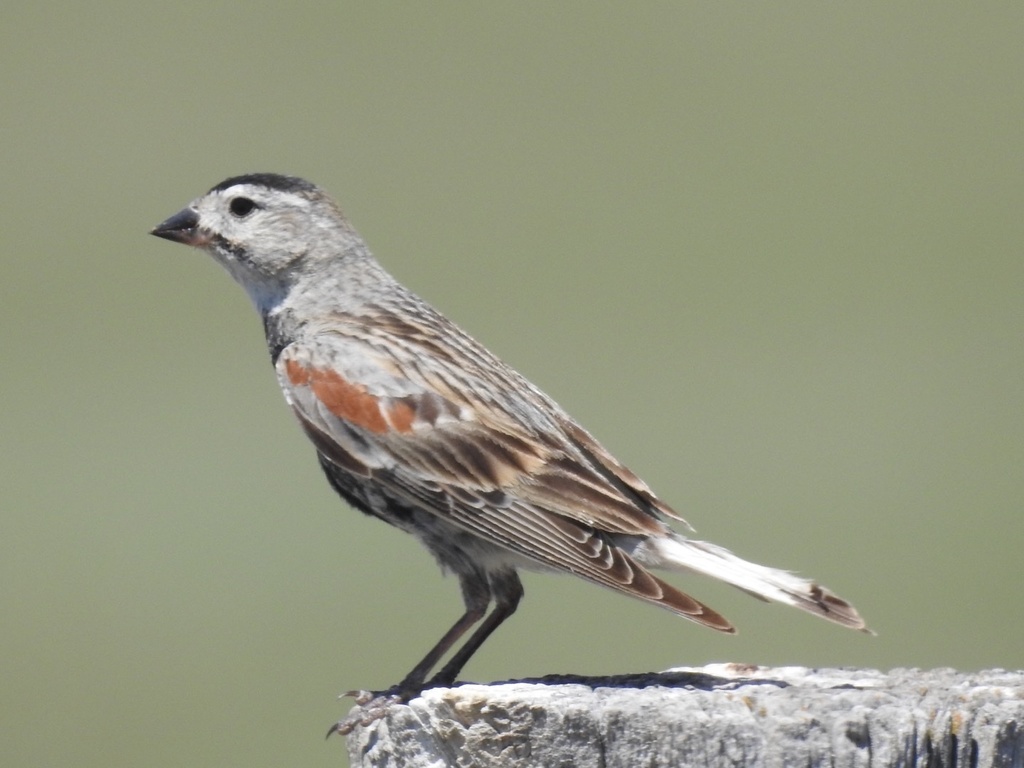
Thick-billed Longspur
Live sightings near you, the range map, bar charts of when it is seen, and Macaulay Library photos and recordings.
Thick-billed Longspur
Rhynchophanes mccownii
The thick-billed longspur, also known as McCown's longspur (Rhynchophanes mccownii), is a small ground-feeding bird in the family Calcariidae, which also contains the other longspurs and snow buntings. It is found in North America and is the only species in the genus Rhynchophanes.
From the article Thick-billed longspur on Wikipedia (CC BY-SA), quoted section by section
Description
The thick-billed longspur is about 15 cm (5.9 in) long, has a wingspan of 28 cm (11 in) and weighs around 25 g (0.88 oz). It has a large cone-shaped bill, a streaked back, a rust-coloured shoulder and a white tail with a dark tip. In breeding plumage, the male has a white throat and underparts, a grey face and nape and a black crown. Breeding females are largely gray, with a pale bill and rusty tinged median coverts and scapulars. Non-breeding males are similar to females but with crowns spotted rather than streaked, and more chestnut on their median coverts and scapulars. Juveniles are seen briefly in late summer and are more uniformly sandy, with a streaked upper breast and white belly.
Range & habitat
Thick-billed longspurs breed in the northwestern Great Plains states and southern Prairie Provinces. They prefer the sparsely vegetated habitat of the semi-arid shortgrass steppes, which provide a mix of perennial shortgrasses and cacti. The breeding range of thick-billed longspurs has drastically reduced; historically, it stretched farther south into Oklahoma, and east into Minnesota and Manitoba. Their non-breeding range stretches from south Oklahoma into Texas and Northern Mexico. Here, they prefer open habitats with sparse vegetation such as shortgrass prairie, plowed fields, grazed pastures and dried lake beds.
Wikipedia: “Distribution and habitat”
What it does
The male produces a distinctive tinkling song, often in flight. The calls include a dry rattle. Nests are constructed in a shallow depression on the ground, and incubate the eggs for about 12 days. Both parents feed the young, and fledglings leave the nest about 10 days after hatching, before they can properly fly. Outside the breeding season, thick-billed longspurs occur in flocks, sometimes with other species like Lapland longspur and horned lark. The diet consists of seeds and insects.
Wikipedia: “Behavior”
Listen
Looking for field recordings…
Where it lives
Recorded sightings
—
geo-referenced records in GBIF, from museums, herbaria and field observers.
Drag the globe to turn it. Dots are where records exist, not a range map; darker means more records.
In the stacks
Searching the stacks…
Every page naming Rhynchophanes mccownii in the Biodiversity Heritage Library →
This page is assembled live from iNaturalist, GBIF, Wikipedia, the Source Library and the Internet Archive. It is not yet part of the hand-edited codex. iNaturalist taxon 117223.