On eBird ↗
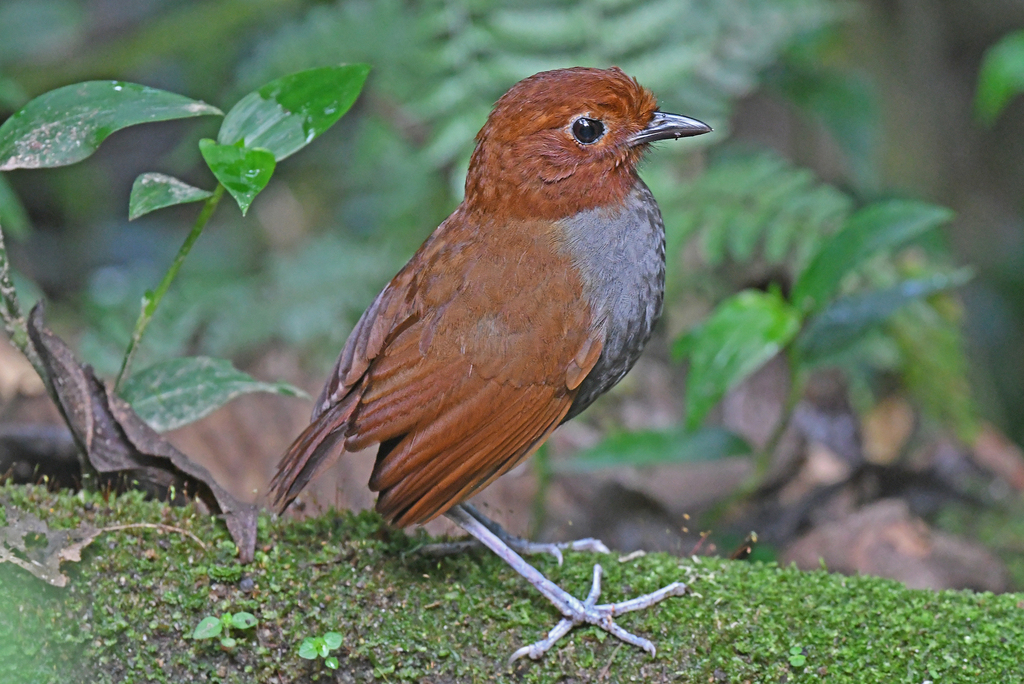
Bicolored Antpitta
Live sightings near you, the range map, bar charts of when it is seen, and Macaulay Library photos and recordings.
Bicolored Antpitta
Grallaria rufocinerea
The bicolored antpitta (Grallaria rufocinerea) is a species of bird in the Grallariidae family. It is found in Colombia and Ecuador. Its natural habitat is subtropical or tropical moist montane forests. It is threatened by habitat loss.
From the article Bicolored antpitta on Wikipedia (CC BY-SA), quoted section by section
Description
Grallaria antpittas are a "wonderful group of plump and round antbirds whose feathers are often fluffed up...they have stout bills [and] very short tails". The bicolored antpitta is 15 to 18 cm (5.9 to 7.1 in) long; one individual weighed 44.8 g (1.6 oz). The sexes have the same plumage. Adults have a mostly rufous-brown or ferruginous red head, throat, upperparts, wings, and tail, though the throat is slightly more rufous than the rest and has some grayish mottling. Their underparts are mostly gray to sooty gray with a whitish central belly and whitish edges on the breast, side, and flank feathers. Both sexes have a dark brown iris, a black bill, and gray to brownish gray legs and feet.
Range & habitat
The bicolored antpitta was long thought to be endemic to Colombia but in 1999 its range was discovered to extend slightly into extreme northern Ecuador's Sucumbíos Province. In Colombia the species has a disjunct distribution in the country's Central Andes. One population is found from southern Antioquia Department south into northern Tolima Department. The other is found from western Huila Department south into Ecuador. It is found in the temperate zone, where it primarily inhabits the floor and understory of humid montane cloudforest as high as treeline. It also occurs on the forest edges and in secondary forest. In elevation it ranges between 2,000 and 3,100 m (6,600 and 10,200 ft) in Colombia and is known only at about 2,250 m (7,400 ft) in Ecuador.
Wikipedia: “Distribution and habitat”
What it does
The bicolored antpitta is one of several antpittas that regularly come to feeding stations set up to view them. There they are fed earthworms, which are thought to also be a large part of their natural diet. In the wild they also feed on arthropods. Their foraging behavior is not known in detail though they are assumed to be essentially terrestrial like others of the genus. They have been observed following swarms of army ants to capture prey disturbed by them, and are thought to follow large mammals such as tapirs for the same reason.
Wikipedia: “Feeding”
Listen
Looking for field recordings…
Where it lives
Recorded sightings
—
geo-referenced records in GBIF, from museums, herbaria and field observers.
Drag the globe to turn it. Dots are where records exist, not a range map; darker means more records.
In the stacks
Searching the stacks…
Every page naming Grallaria rufocinerea in the Biodiversity Heritage Library →
This page is assembled live from iNaturalist, GBIF, Wikipedia, the Source Library and the Internet Archive. It is not yet part of the hand-edited codex. iNaturalist taxon 117202.