On eBird ↗
Five-colored Barbet
Live sightings near you, the range map, bar charts of when it is seen, and Macaulay Library photos and recordings.
Five-colored Barbet
Capito quinticolor
The five-colored barbet (Capito quinticolor) is a species of bird in the Capitonidae family. It is endemic to humid forest in the Chocó of south-western Colombia and far north-western Ecuador. It is threatened by habitat loss.
From the article Five-colored barbet on Wikipedia (CC BY-SA), quoted section by section
Description
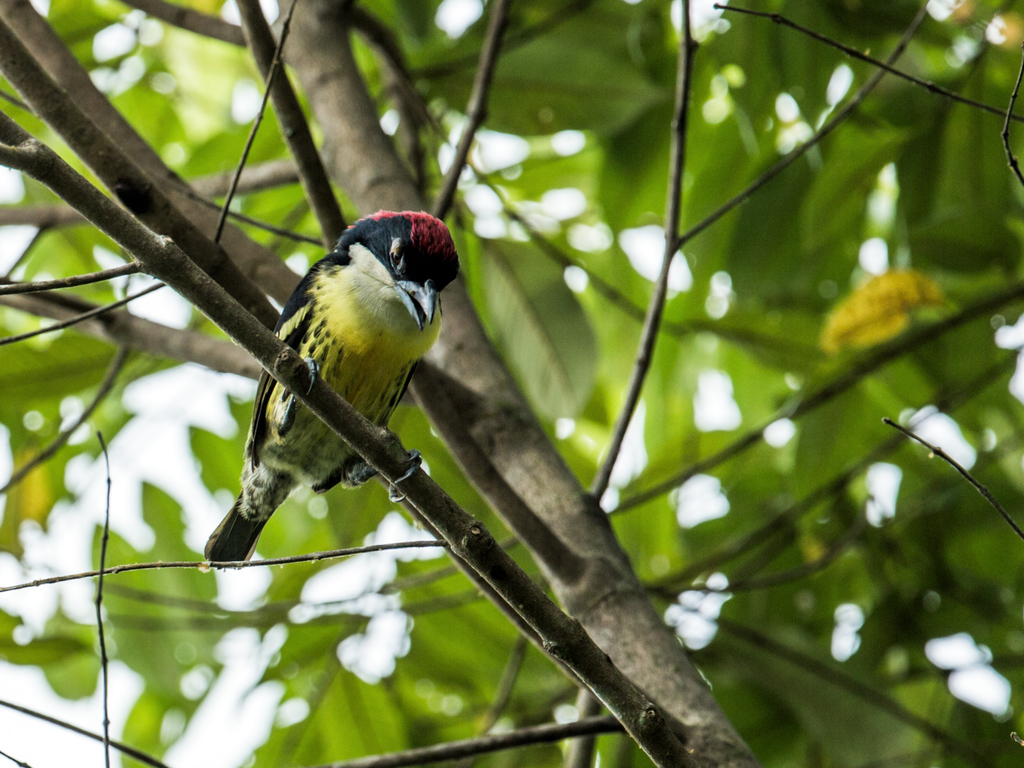
The five-colored barbet is 17 to 18 cm (6.7 to 7.1 in) long and weighs 54 to 69 g (1.9 to 2.4 oz). The male is mostly black above with a yellow "V" on the mantle. It has a red crown and nape and yellow wingbars. Its throat and breast are yellow brightening to gold or orange on the belly; the flanks have black spots. The female is also black above but heavily streaked with gold. Its throat, breast, and belly are colored like the male's but have black spots throughout.
Range & habitat
The five-colored barbet is found from central Chocó Department in western Colombia south into Ecuador's most northwesterly province, Esmeraldas. It inhabits wet primary and mature secondary forest and their edges and disturbed areas. In elevation it usually ranges from near sea level to 350 m (1,150 ft) but locally can be found up to approximately 600 m (2,000 ft).
Wikipedia: “Distribution and habitat”
What it does
The five-colored barbet's diet is primarily fruit but it also takes insects. It forages from mid-level to the canopy in the forest interior; in the forest edges it also feeds in the understory. It sometimes joins mixed-species foraging flocks.
Wikipedia: “Feeding”
Listen
Looking for field recordings…
Where it lives
Recorded sightings
—
geo-referenced records in GBIF, from museums, herbaria and field observers.
Drag the globe to turn it. Dots are where records exist, not a range map; darker means more records.
In the stacks
Searching the stacks…
Every page naming Capito quinticolor in the Biodiversity Heritage Library →
This page is assembled live from iNaturalist, GBIF, Wikipedia, the Source Library and the Internet Archive. It is not yet part of the hand-edited codex. iNaturalist taxon 117194.