On eBird ↗
Salmon-crested Cockatoo
Live sightings near you, the range map, bar charts of when it is seen, and Macaulay Library photos and recordings.
Salmon-crested Cockatoo
Cacatua moluccensis
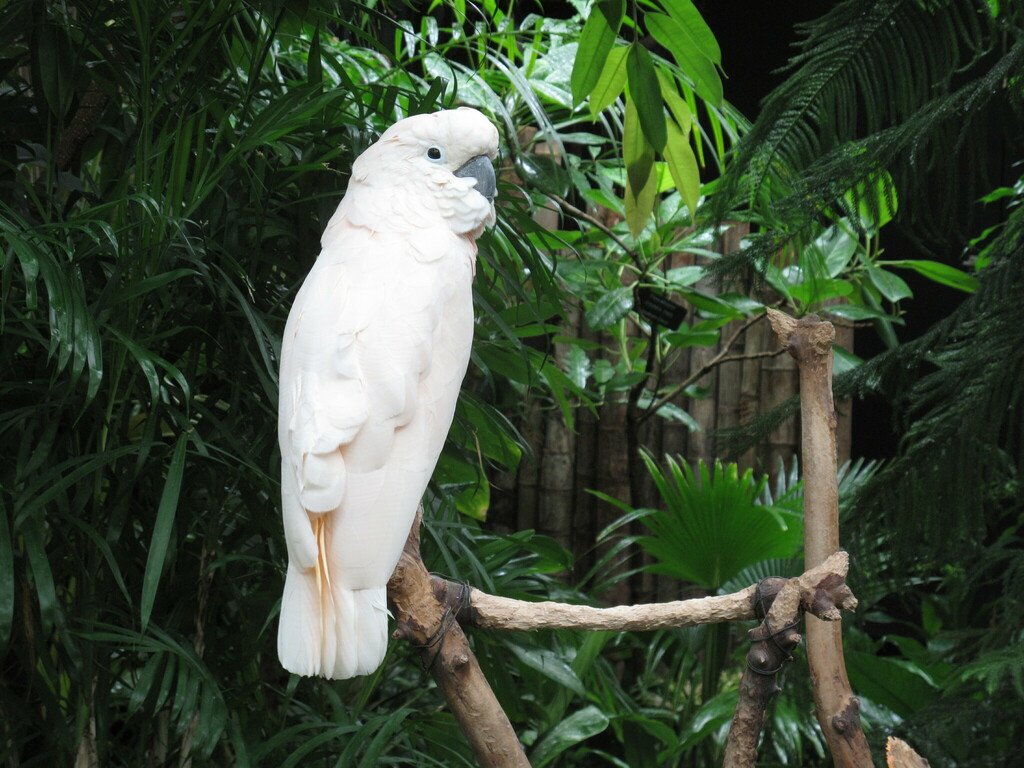
The salmon-crested cockatoo (Cacatua moluccensis), also known as the Moluccan cockatoo, is a cockatoo endemic to the Seram archipelago in eastern Indonesia. At a height of up to 46–52 cm (1.51–1.71 ft) and weight of up to 850 g (1.87 lb), it is among the largest of the white cockatoos. The female is slightly smaller than the male on average. It has white-pink feathers with a definite peachy glow, a slight yellow on the underwing and underside of the tail feathers and a large retractable recumbent crest, which it raises when threatened, revealing hitherto concealed bright red-orange plumes to frighten potential attackers. It may also be raised in excitement or in other "emotional" displays. Some describe the crest as "flamingo-colored". It also has one of the louder calls in the parrot world and in captivity is a capable mimic.
In the wild, the salmon-crested cockatoo inhabits lowland forests below 1,000 metres or 3,300 feet. Its diet consists mainly of seeds, nuts, and fruit, as well as coconuts. Some additional evidence shows that they eat insects off the ground, and pet Moluccan cockatoos have tested positive for anemia if their diets do not include enough protein.
From the article Salmon-crested cockatoo on Wikipedia (CC BY-SA), quoted section by section
Range & habitat
The salmon-crested cockatoo is endemic to the Seram archipelago in eastern Indonesia, and has been introduced to the Hawai'ian island of Oahu, where a small population has become established. Although they have been observed in the wild in Puerto Rico, they are probably the result of escaped pets, and no reproduction has been recorded.
Wikipedia: “Distribution and habitat”
In human culture
The salmon-crested cockatoo is widely considered to be one of the most demanding parrots to keep as a pet due to their high intelligence, large size, potential noise level (some of the loudest birds in the world, with calls up to 129 decibels), and need to chew. They require a very large and very sturdy cage or aviary. Salmon-crested cockatoos are highly social, and pets can be extremely cuddly, affectionate, and gentle birds. This can lead to problems if a young cockatoo is spoiled with a great deal of attention and cuddling when young and does not get the opportunity to learn to play with toys, forage, or otherwise entertain itself. Salmon-crested cockatoos require a great deal of attention and activity to remain healthy and well-adjusted. Attention and training from human caregivers is important in keeping them occupied, as are chewable toys and foraging toys that require them to work for their food. As with most large cockatoos, the salmon-crested cockatoo may develop health and behavioural problems such as feather-plucking and aggression if not provided with the appropriate environment, attention, and enrichment opportunities. In captivity, the salmon-crested cockatoo has been known to live for an extremely long time, with a captive individual mentioned in a 2011 paper having lived to the age of 92 years.
Wikipedia: “Aviculture”
Listen
Looking for field recordings…
Where it lives
Recorded sightings
—
geo-referenced records in GBIF, from museums, herbaria and field observers.
Drag the globe to turn it. Dots are where records exist, not a range map; darker means more records.
In the old herbals & bestiaries

In the stacks
Searching the stacks…
Every page naming Cacatua moluccensis in the Biodiversity Heritage Library →
This page is assembled live from iNaturalist, GBIF, Wikipedia, the Source Library and the Internet Archive. It is not yet part of the hand-edited codex. iNaturalist taxon 117192.