On eBird ↗
White Cockatoo
Live sightings near you, the range map, bar charts of when it is seen, and Macaulay Library photos and recordings.
White Cockatoo
Cacatua alba
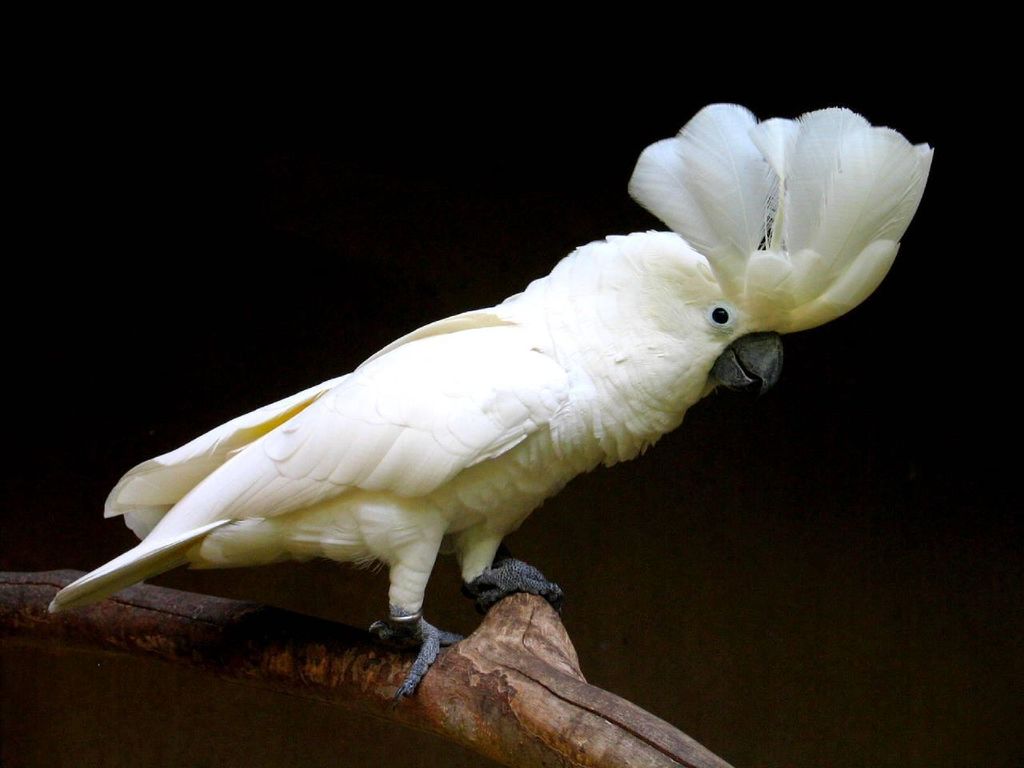
The white cockatoo (Cacatua alba), also known as the umbrella cockatoo, is a medium-sized all-white cockatoo endemic to tropical rainforest on islands of Indonesia. When surprised, it extends a large and striking head crest, which has a semicircular shape (similar to an umbrella, hence the alternative name). The wings and tail have a pale yellow or lemon color which is exposed when they fly. It is similar to other species of white cockatoo such as yellow-crested cockatoo, sulphur-crested cockatoo, and salmon-crested cockatoo, all of which have yellow, orange or pink crest feathers instead of white.
From the article White cockatoo on Wikipedia (CC BY-SA), quoted section by section
Description
The white cockatoo is around 46 cm (18 in) long, and weighs about 400 g (14 oz) for small females and up to 800 g (28 oz) for big males. The male white cockatoo usually has a broader head and a bigger beak than the female. They have brown or black eyes and a dark grey beak. When mature some female white cockatoos can have reddish/brown irises, while the irises of the adult male are dark brown or black. The feathers of the white cockatoo are mostly white. However, both upper and lower surfaces of the inner half of the trailing edge of the large wing feathers are a yellow color. The yellow color on the underside of the wings is most notable because the yellow portion of the upper surface of the feather is covered by the white of the feather immediately medial (nearer to the body) and above. Similarly, areas of larger tail feathers that are covered by other tail feathers – and the innermost covered areas of the larger crest feathers – are yellow. Short white feathers grow from and closely cover the upper legs. …
Range & habitat
Cacatua alba is endemic to lowland tropical rainforest on the Moluccan islands of Halmahera, Bacan, Ternate, Tidore, Kasiruta and Mandioli (Bacan group) in North Maluku, Indonesia. Records from Obi and Bisa (Obi group) are thought to be introductions, while a local introduced population breeds on Taiwan. It occurs in primary, logged, and secondary forests below 900m. It also occurs in mangroves and plantations including coconut and agricultural land. It remains locally common: in 1991–1992, the population was estimated at 42,545–183,129 birds (Lambert 1993), although this may be an underestimate as it was largely based on surveys from Bacan and not Halmahera where the species may have been more common. Recent observations indicate that rapid declines are on-going, and are predicted to increase in the future (Vetter 2009). CITES data show significant harvest rates for the cage bird trade during the early 1990s. Annual harvests have declined in actual terms and as a proportion of the remaining population in recent years, but illegal trade continues and is likely to have been underestimated (S. Metz in litt. 2013)
Wikipedia: “Distribution and habitat”
What it does
In the wild, white cockatoos feed on berries, seeds, nuts, fruit and roots. When nesting, they include insects and insect larvae. In their natural habitat, umbrella cockatoos typically feed on various seeds, nuts and fruits, such as papaya, durian, langsat and rambutan. As they also feed on corn growing in fields, they do considerable damage and are therefore considered crop pests by farmers. (BirdLife International, 2001) They also eat large insects, such as crickets (order Orthoptera) and small lizards such as skinks. Captive birds are usually provided a parrot mix containing various seeds, nuts and dried fruits and vegetables. Additionally, they need to be offered many fresh vegetables, fruits and branches (with leaves) for chewing and entertainment.
Wikipedia: “Feeding”
In human culture
They were quite popular in China during the Tang dynasty, a fact which in turn influenced the depictions of Guan Yin with a white parrot. The Fourth Crusade was also sealed between Holy Roman Emperor Frederick II and the Sultan of Babylon in 1229 with a gift of a white cockatoo.
Wikipedia: “History”
Listen
Looking for field recordings…
Where it lives
Recorded sightings
—
geo-referenced records in GBIF, from museums, herbaria and field observers.
Drag the globe to turn it. Dots are where records exist, not a range map; darker means more records.
In the old herbals & bestiaries

In the stacks
Searching the stacks…
Every page naming Cacatua alba in the Biodiversity Heritage Library →
This page is assembled live from iNaturalist, GBIF, Wikipedia, the Source Library and the Internet Archive. It is not yet part of the hand-edited codex. iNaturalist taxon 117191.