On eBird ↗
Toucan Barbet
Live sightings near you, the range map, bar charts of when it is seen, and Macaulay Library photos and recordings.
Toucan Barbet
Semnornis ramphastinus
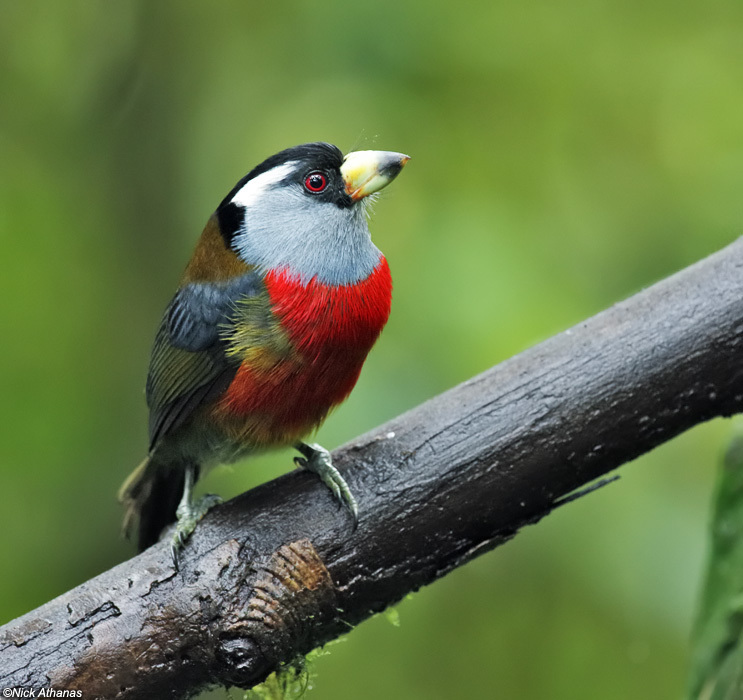
The toucan barbet (Semnornis ramphastinus) is a barbet native to western Ecuador and Colombia. Along with the prong-billed barbet, it forms the family Semnornithidae, and is closely related to the toucans. It is a medium-sized barbet with a robust yellow bill. It has striking plumage, having a black head with grey throat and nape, red breast and upper belly, yellow lower belly and grey wings and tail.
The toucan barbet is native to humid montane forests, where it occupies all levels of the canopy and is found in both primary and secondary forests, as well as forest edges. It is social, living in small family groups which work together to defend their territories and raise the chicks communally. It feeds on fruit and a range of animal prey, with insects being an important part of the diet of chicks. It sometimes joins mixed-species feeding flocks. Chicks are raised in cavities dug into large, usually dead trees.
From the article Toucan barbet on Wikipedia (CC BY-SA), quoted section by section
Description
The toucan barbet is a medium-sized robust barbet, of 19 to 21 cm (7.5–8.3 in) long and weighing 80–115 g (2.8–4.1 oz). The beak is robust with a yellow maxilla and a light green mandible, both with dark ends. It is pronged at the end, though the prongs are not noticeable in the field. The plumage is colourful and includes a black crown, "mask", and thin cervical collar. The species has long occipital feathers and a conspicuous white stripe behind the eyes, which has a bright red-colored iris. The nape of the neck is golden-brown and becomes yellow towards the rump. The throat, upper breast, and sides of the nape are grayish-blue. The lower breast and middle belly are bright red, while the lower belly is yellowish green. The wings and tail are grey. The subspecies S. r. caucae is very similar to the nominate race, but has less extensive red on the breast. Both sexes are almost identical except for the female's plumage being slightly less bright, and the female lacks the tuft on the black plumage of the nape. Immature birds are duller than adults, and do not develop prongs until they are 4 months old.
Range & habitat
The species is native to the humid forests of the western Andes, from the Andean slopes of northwest Ecuador to southwest Colombia, at altitudes of 1,400–2,400 m (4,600–7,900 ft). It uses all forest strata, showing some preference for the upper canopy of the forest (11–20 m (36–66 ft)) and the subcanopy (6–10 m (20–33 ft)). The species also uses secondary forest and forest-edge habitats. Evidence suggests that these birds are very specific in choosing trees for nesting. It usually prefers old trees in the family Lauraceae. As nesting trees of sufficient diameter are not very common in these forests, habitat loss through logging is impacting the species.
Wikipedia: “Habitat and distribution”
What it does
The toucan barbet is usually found in pairs or small groups perched silently on long horizontal branches, making them hard to find unless active or singing. The flight is characterized by being hurried and noisy. It usually lives in small groups of three to six individuals. The species is territorial, with territories ranging between 4–10.6 ha (9.9–26.2 acres), with an average of 5.8 ha (14 acres). Most of the territory consists of mature forest, although the species can adapt to live in forests with small areas of secondary forest or pastures. Toucan barbet groups show a marked territorial behavior towards other groups or species, which is usually made clear by the loud duets of breeding pairs, and it is actively protected by the breeding pair by chasing of intruders. The family group's helpers assist in this, especially near the nest. In the absence of interference, these groups can occupy a particular territory for a year or longer.
Calls and displays. Toucan barbet calls are unmistakable, composed of loud shrieks that travel long distances. It is usually sung in duet by the breeding pair, simultaneously or in syncope by both sexes during the breeding season, usually for territorial display. The frequency of calls changes with each season, being more common at the beginning of the year and declining in frequency after April. …
Wikipedia: “Behavior and ecology”
Listen
Looking for field recordings…
Where it lives
Recorded sightings
—
geo-referenced records in GBIF, from museums, herbaria and field observers.
Drag the globe to turn it. Dots are where records exist, not a range map; darker means more records.
In the stacks
Searching the stacks…
Every page naming Semnornis ramphastinus in the Biodiversity Heritage Library →
This page is assembled live from iNaturalist, GBIF, Wikipedia, the Source Library and the Internet Archive. It is not yet part of the hand-edited codex. iNaturalist taxon 117180.