On eBird ↗
Fairy Flycatcher
Live sightings near you, the range map, bar charts of when it is seen, and Macaulay Library photos and recordings.
Fairy Flycatcher
Stenostira scita
The fairy flycatcher or fairy warbler (Stenostira scita) is a small passerine bird. Formerly placed in the Old World flycatcher family, Muscicapidae, it is now separated with some other "odd flycatchers" as the new family Stenostiridae (Beresford et al. 2005, Fuchs et al. 2006). It is the only member of the genus Stenostira.
It is an endemic resident breeder in southern Africa in Botswana, South Africa, Lesotho and Namibia, and a vagrant to Zimbabwe and Eswatini.
From the article Fairy flycatcher on Wikipedia (CC BY-SA), quoted section by section
Description
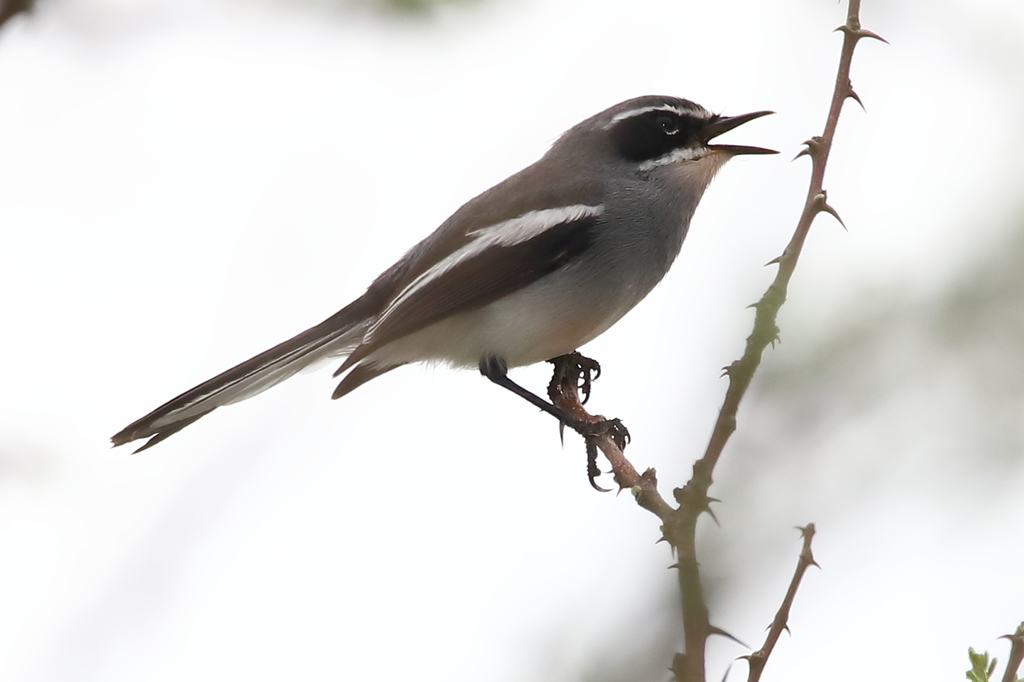
The fairy flycatcher is 11–12 cm in length. The adult is pale grey above with a black mask through the eye and a white supercilium. The wings are black with a long white stripe, and the long black tail has white sides. The throat is white, the breast is pale grey, and the belly is white with a pinkish-grey wash to its centre. The sexes are alike, but the juvenile is browner than the adult. The eye is brown and the bill and legs are black.
What it does
The fairy flycatcher is monogamous unless its mate dies, when it will seek a new partner. It builds an open cup nest from thin stems and other plant material and lined with plant down. It is placed in the branches of a tree or shrub but well concealed. The female lays two or three green eggs. This bird is usually seen alone, in pairs, or small flocks. It feeds on small insects and other invertebrates, foraging in the foliage like a warbler.
Wikipedia: “Behaviour”
Listen
Looking for field recordings…
Where it lives
Recorded sightings
—
geo-referenced records in GBIF, from museums, herbaria and field observers.
Drag the globe to turn it. Dots are where records exist, not a range map; darker means more records.
In the stacks
Searching the stacks…
Every page naming Stenostira scita in the Biodiversity Heritage Library →
This page is assembled live from iNaturalist, GBIF, Wikipedia, the Source Library and the Internet Archive. It is not yet part of the hand-edited codex. iNaturalist taxon 117118.