On eBird ↗
Prong-billed Barbet
Live sightings near you, the range map, bar charts of when it is seen, and Macaulay Library photos and recordings.
Prong-billed Barbet
Semnornis frantzii
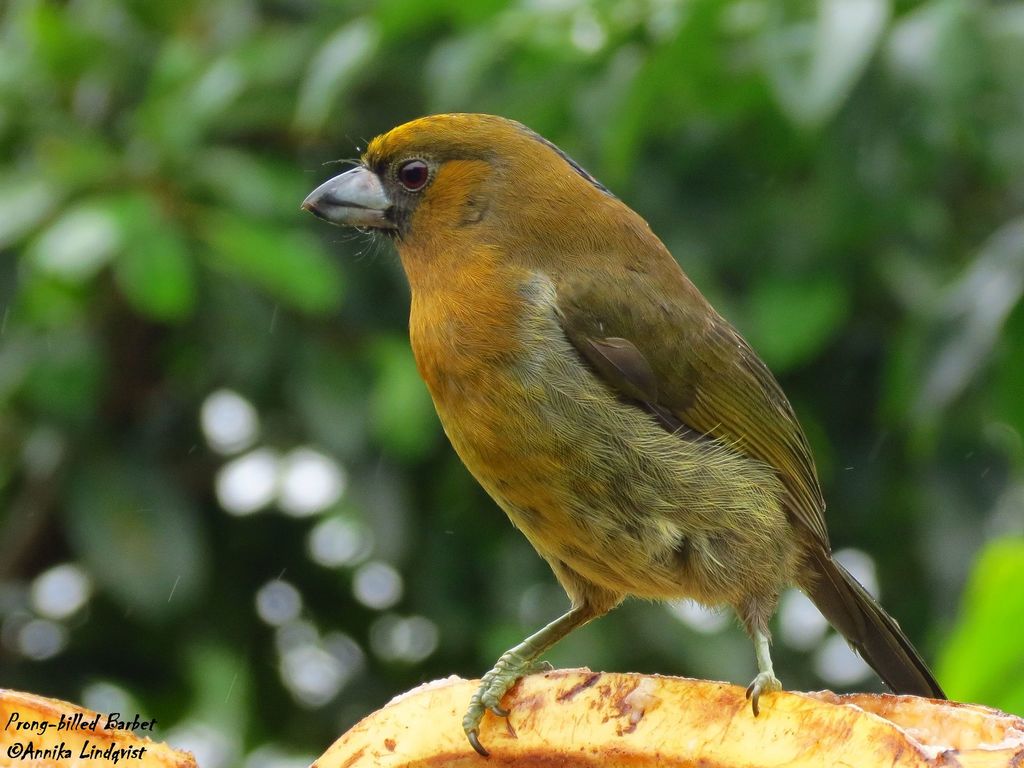
The prong-billed barbet (Semnornis frantzii) is a distinctive, relatively large-billed bird native to humid highland forest in Costa Rica and western Panama.
From the article Prong-billed barbet on Wikipedia (CC BY-SA), quoted section by section
Description
The prong-billed barbet is 17 to 18.5 cm (6.7 to 7.3 in) long and weighs about 60 to 70 g (2.1 to 2.5 oz). Its bill is silvery gray to bluish with a dark tip; a notch on the tip of the mandible provides its English name. The maxilla has a hooked tip and a notch on the side. Adults have a dull golden brown crown, brownish olive nape and upper back, and olive green lower back, rump, and uppertail coverts. Males have a glossy black tuft of feathers at the rear of the crown; females lack it. Both sexes have dull slaty black lores, cheeks, and chin. The sides of their head, their neck, and their upper breast are buffy olive that becomes yellowish on the lower breast. Their belly's center is pale yellow and their flanks dull grayish with a pale yellowish wash. Their tail is dull green and their wings dusky. Immatures are overall duller than adults and the black areas of the adult's face are grayer in immatures.
Range & habitat
The prong-billed barbet is found in the mountains from Costa Rica's Cordillera de Tilarán to western Panama's Veraguas Province. In elevation it mostly ranges between 750 and 2,450 m (2,500 and 8,000 ft) on the Caribbean side of Costa Rica, between 1,500 and 1,450 m (4,900 and 4,800 ft) on the Pacific side, and between 1,500 and 2,250 m (4,900 and 7,400 ft) in Panama. (Locally it occurs somewhat lower in both countries.) It inhabits the interior and edges of extremely humid montane evergreen forest, a landscape characterized by many epiphytes and mosses and frequent fog.
Wikipedia: “Distribution and habitat”
What it does
Prong-billed barbets usually forage in the forest canopy but sometimes do so lower at the edges. Their diet is almost entirely fruit, but young nestlings are fed insects. Small fruits are swallowed whole or only the interior may be squeezed out. Large fruits are torn apart to eat.
Wikipedia: “Feeding”
Listen
Looking for field recordings…
Where it lives
Recorded sightings
—
geo-referenced records in GBIF, from museums, herbaria and field observers.
Drag the globe to turn it. Dots are where records exist, not a range map; darker means more records.
In the stacks
Searching the stacks…
Every page naming Semnornis frantzii in the Biodiversity Heritage Library →
This page is assembled live from iNaturalist, GBIF, Wikipedia, the Source Library and the Internet Archive. It is not yet part of the hand-edited codex. iNaturalist taxon 117113.