On eBird ↗
Scaled Antpitta
Live sightings near you, the range map, bar charts of when it is seen, and Macaulay Library photos and recordings.
Scaled Antpitta
Grallaria guatimalensis
The scaled antpitta (Grallaria guatimalensis) is a species of bird in the family Grallariidae. It is found in Bolivia, Brazil, Colombia, Costa Rica, Ecuador, El Salvador, Guatemala, Guyana, Honduras, Mexico, Nicaragua, Panama, Peru, and Venezuela It has occurred as a vagrant on Trinidad. There is also a single record in Belize.
From the article Scaled antpitta on Wikipedia (CC BY-SA), quoted section by section
Description
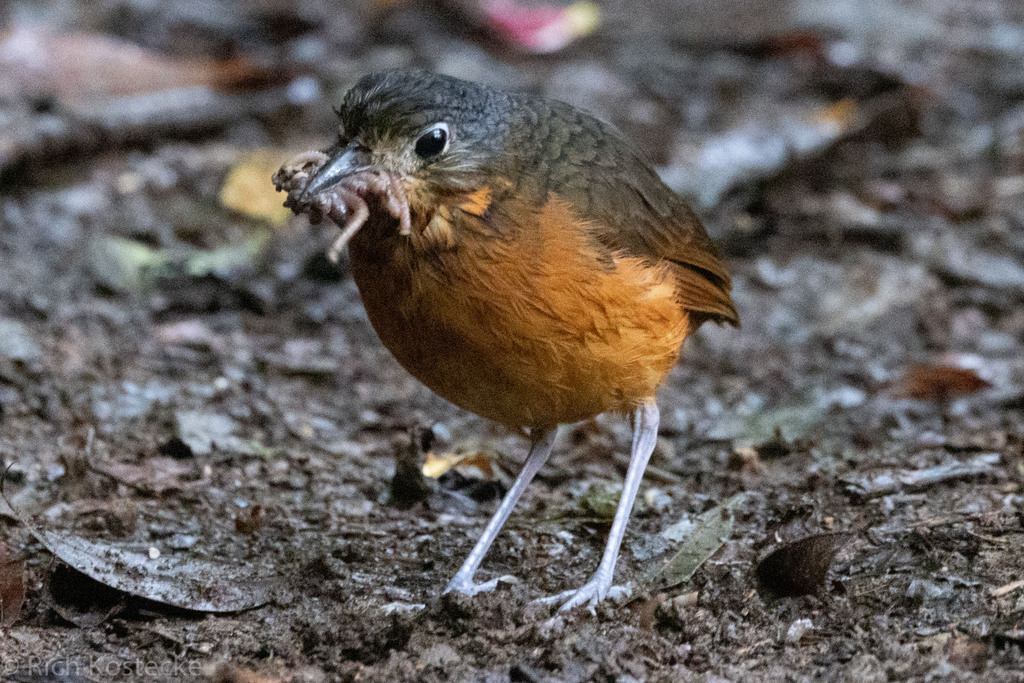
Grallaria antpittas are a "wonderful group of plump and round antbirds whose feathers are often fluffed up...they have stout bills [and] very short tails". The scaled antpitta is 15 to 19 cm (5.9 to 7.5 in) long and weighs 70 to 98 g (2.5 to 3.5 oz). The sexes have the same plumage. Adults of the nominate subspecies G. g. guatimalensis have a pale olive brownish forecrown with fine black scaling and a gray crown and nape. They have whitish or buffy lores, olive brown ear coverts with thin streaks, and blue-gray skin around their eye. Their back and wing coverts are olive brown with black feather edges that give the eponymous scaled appearance. Their flight feathers and tail are light brown. Their throat is ochraceous- or tawny-brown with thin pale streaks and wide ochraceous or buffy "moustache" streaks on its sides. They often have a black-speckled paler "necklace" below their throat. Their underparts are tawny. All subspecies have a dark brown iris, a black maxilla, a grayish mandible, and pinkish or bluish gray legs and feet. The other subspecies of the scaled antpitta differ from the nominate and each other thus:
G. g. binfordi: much paler than the nominate, with narrower scaling on the back G. g. ochraceiventris: much paler than the nominate, with narrower scaling on the back G. g. princeps: richer colors and heavier scaling on the back than the nominate G. g. …
Range & habitat
The scaled antpitta has a highly disjunct distribution. The subspecies are found thus:
G. g. binfordi: south-central Mexico in Mexico City and Mexico and Morelos states G. g. ochraceiventris: southern Mexico between Jalisco and western Hidalgo and from southern Guerrero to southern Oaxaca G. g. guatimalensis: from Veracruz and Oaxaca in eastern and southern Mexico south through Guatemala, El Salvador, and Honduras into northern Nicaragua G. g. princeps: both slopes in Costa Rica into Panama as far as Veraguas Province G. g. chocoensis: Darién Province in eastern Panama and Chocó Department in northwestern Colombia G. g. regulus: west slope of Colombia's Eastern Andes; Andes of western Venezuela between Táchira and Lara; southwestern Colombia and south through eastern and western Ecuador to central Peru, where mostly on the east slope G. g. sororia: from Peru's Department of Cuzco into central Bolivia's Santa Cruz Department G. g. carmelitae: northern Colombia; Sierra Nevada de Santa Marta and from Serranía del Perijá south into northern Boyacá Department G. g. aripoensis: Trinidad (but see below) G. g. roraimae: tepui area where southern Venezuela, central western Guyana, and northern Brazil meet; population on Margarita Island might be this subspecies A single scaled antpitta was captured in a mist net in Belize in 2024. …
Wikipedia: “Distribution and habitat”
What it does
The scaled antpitta is one of several antpittas that regularly come to feeding stations set up to allow viewing them. There they are fed earthworms and similar invertebrates, which are thought to also be a large part of their natural diet. In the wild they are known to feed on a variety of arthropods and possibly also on small vertebrates like frogs. They are highly terrestrial while foraging; they hop, pause, and dash to capture prey, sometimes flicking aside and probing leaf litter to expose it. They seldom fly beyond a short distance or higher than to a low branch. They mostly hunt at dawn and dusk. They probably attend army ant swarms to capture prey disturbed by the ants.
Wikipedia: “Feeding”
Listen
Looking for field recordings…
Where it lives
Recorded sightings
—
geo-referenced records in GBIF, from museums, herbaria and field observers.
Drag the globe to turn it. Dots are where records exist, not a range map; darker means more records.
In the stacks
Searching the stacks…
Every page naming Grallaria guatimalensis in the Biodiversity Heritage Library →
This page is assembled live from iNaturalist, GBIF, Wikipedia, the Source Library and the Internet Archive. It is not yet part of the hand-edited codex. iNaturalist taxon 116899.