On eBird ↗
Cape Rockjumper
Live sightings near you, the range map, bar charts of when it is seen, and Macaulay Library photos and recordings.
Cape Rockjumper
Chaetops frenatus
The Cape rockjumper or rufous rockjumper (Chaetops frenatus) is a medium-sized insectivorous passerine bird endemic to the mountain fynbos of southernmost South Africa.
From the article Cape rockjumper on Wikipedia (CC BY-SA), quoted section by section
Description
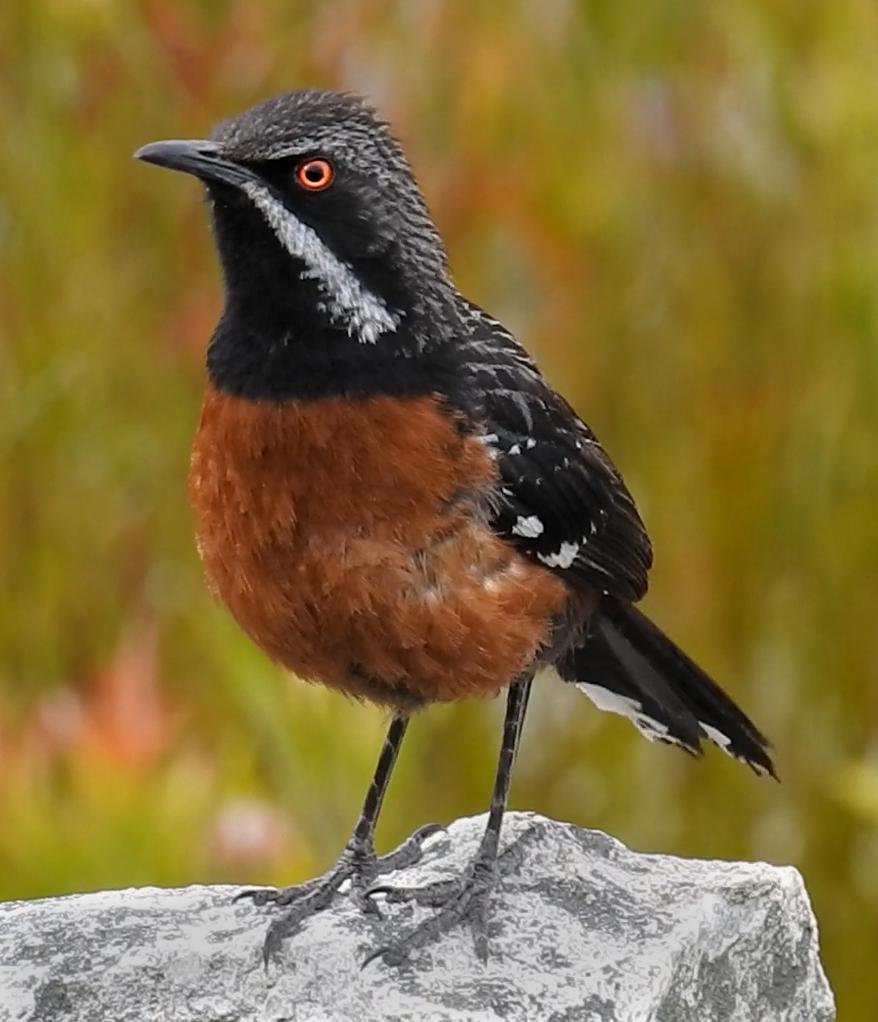
The Cape rockjumper is 23–25 cm long with a long black tail and strong legs. The male has a dark grey and black head with a thin white supercilium and a broad white moustache (malar stripe). The back and wings are dark grey, and the underparts and rump are rufous red. The female and juvenile have a paler grey head, upperparts and wings, a duller head pattern, an orange rump, and buff underparts. The call varies from 1-4 piercing whistles to a series of trills. Adults have bright red eyes, while juveniles have black eyes until mature. The closely related Drakensberg rockjumper (Chaetops aurantius) does not overlap in range. The male of that species has orange underparts, and the female and young are paler below than the Cape rockjumper.
Range & habitat
Cape rockjumpers inhabit only mountain Fynbos, specifically that dominated by low scrubby restio vegetation. They prefer steep slopes with plenty of large boulders from which they can perch to keep an eye out for predators. While there is an established population at sea level at Rooi-Els (~ 80 km east of Cape Town), this area nevertheless is made up of mountain Fynbos habitat.
Wikipedia: “Habitat”
What it does
Birds forage on rocky slopes and scree. Insects are the major part of the diet, although small vertebrates are reported to be taken by Cape rockjumpers. A range of insects are taken, including caterpillars, moths, grasshoppers, beetles and flies. In addition to insects other prey include lizards and geckos, amphibians, scorpions, annelid worms and spiders. Their wings are proportionately small and they do not fly very often, although they will often take long gliding "flights" across valleys or downslope. They spend most of their lives running and jumping among rocks and grasses while hunting arthropods, small lizards, and amphibians.
Wikipedia: “Diet”
Listen
Looking for field recordings…
Where it lives
Recorded sightings
—
geo-referenced records in GBIF, from museums, herbaria and field observers.
Drag the globe to turn it. Dots are where records exist, not a range map; darker means more records.
In the stacks
Searching the stacks…
Every page naming Chaetops frenatus in the Biodiversity Heritage Library →
This page is assembled live from iNaturalist, GBIF, Wikipedia, the Source Library and the Internet Archive. It is not yet part of the hand-edited codex. iNaturalist taxon 116869.