On eBird ↗
Black-spotted Barbet
Live sightings near you, the range map, bar charts of when it is seen, and Macaulay Library photos and recordings.
Black-spotted Barbet
Capito niger
The black-spotted barbet (Capito niger) is a species of bird in the Capitonidae family. It is found in forests in northeastern South America, ranging as far south as the Amazon River and as far west as the Branco River. Previously, it included the gilded barbet of the southern and western Amazon Basin as subspecies. As currently defined, the black-spotted barbet is monotypic.
From the article Black-spotted barbet on Wikipedia (CC BY-SA), quoted section by section
Description
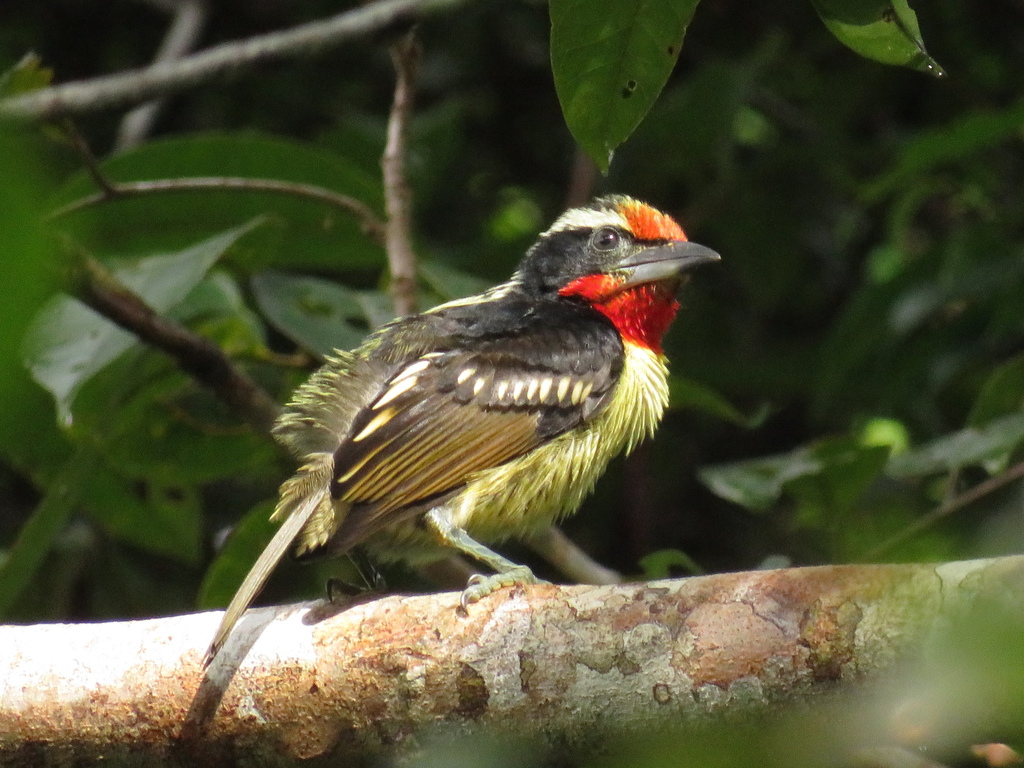
The black-spotted barbet is 16 to 19 cm (6.3 to 7.5 in) long and weighs 41 to 68 g (1.4 to 2.4 oz). It is intricately colored, with much variation in the richness of the colors. The adult male has a red forehead, a yellowish crown and nape, and a black band from the lores to the nape. The nape has dusky streaks. Its upperside is black; its mantle is outlined yellowish and it has yellowish wingbars. Its throat is red, the breast and belly yellow, and the flanks yellow with an olive tinge and black streaks. The adult female is similarly colored but more heavily marked; its upperparts have pale flecks on the black and the breast and belly are spotted or streaked. The immatures are similar to the adults but duller.
Range & habitat
The black-spotted barbet is found in the eastern parts of Venezuela's Bolívar and Delta Amacuro states, the three countries of the Guianas, and the Brazilian states of Roraima, Pará, and Amapá north of the Amazon River. It inhabits the interiors of a variety of forest types including terra firme, riparian, and várzea. It also uses the forest edges and more open terrain such as gardens and plantations. In elevation it ranges from sea level up to 200 m (660 ft) in Venezuela and as high as 800 m (2,600 ft) in the Guianas.
Wikipedia: “Distribution and habitat”
What it does
Though little is known about the black-spotted barbet's diet and foraging habits, they are assumed to be similar to those of the gilded barbet.
Wikipedia: “Feeding”
Listen
Looking for field recordings…
Where it lives
Recorded sightings
—
geo-referenced records in GBIF, from museums, herbaria and field observers.
Drag the globe to turn it. Dots are where records exist, not a range map; darker means more records.
In the stacks
Searching the stacks…
Every page naming Capito niger in the Biodiversity Heritage Library →
This page is assembled live from iNaturalist, GBIF, Wikipedia, the Source Library and the Internet Archive. It is not yet part of the hand-edited codex. iNaturalist taxon 116852.