On eBird ↗
Blyth's Reed Warbler
Live sightings near you, the range map, bar charts of when it is seen, and Macaulay Library photos and recordings.
Blyth's Reed Warbler
Acrocephalus dumetorum
Blyth's reed warbler (Acrocephalus dumetorum) is an Old World warbler in the genus Acrocephalus. It breeds in the Palearctic and easternmost Europe. It is migratory, wintering in Bangladesh, India and Sri Lanka. It is one of the most common winter warblers in those countries. It is a rare vagrant to western Europe.
From the article Blyth's reed warbler on Wikipedia (CC BY-SA), quoted section by section
Description
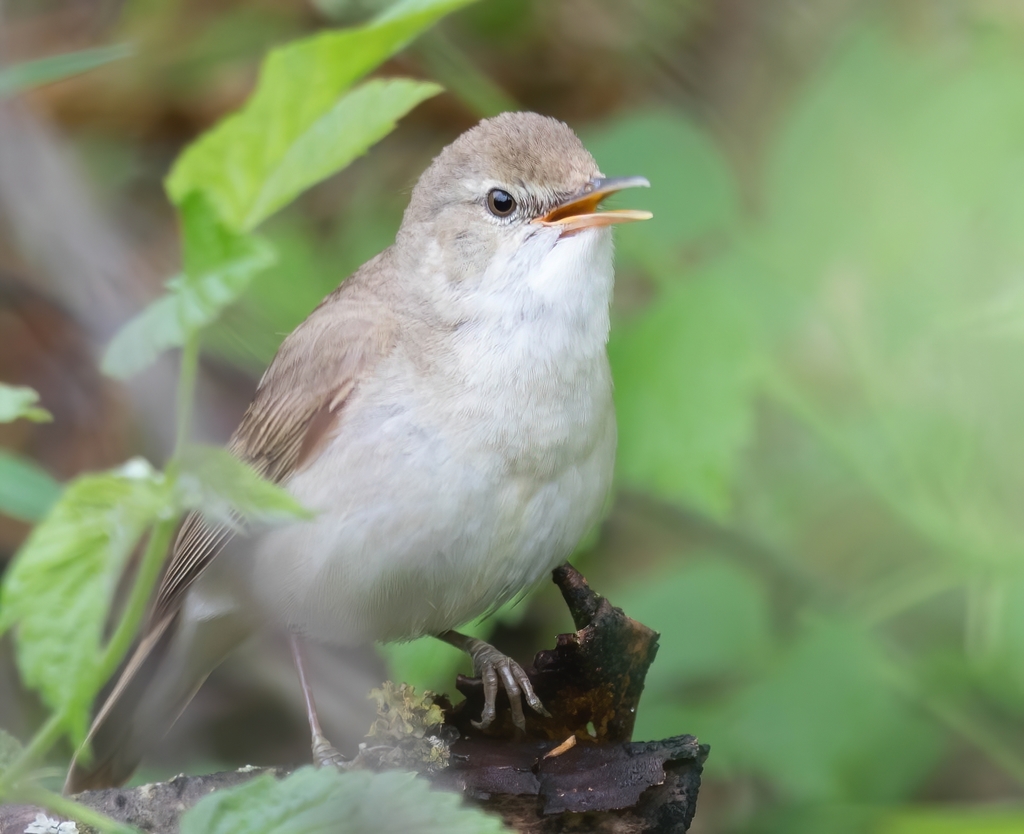
Blyth's reed warbler is between 12 and 14 cm (4.7 and 5.5 in) in length and weighs between 8 and 16 g (0.28 and 0.56 oz). It is a slim warbler with relatively short wings and a long bill. The plumage is rather plain with few distinguishing features and has been described as lacking in "warmer" tones observed in related species. The upperparts are plain olive brown, with less olive on the short, rounded wings. There is a short whitish supercilium running between the base of the bill and the eye, with a dusky stripe through the eye. The underparts are plain and off-white in colour. The rather long, thick bill is greyish brown with a pale pinkish-brown base on the lower mandible, which is the colour of the feet and legs.
Range & habitat
Blyth's reed warbler breeds from the Baltic Sea in eastern Europe almost as far as Lake Baikal in Siberia, with a southern isolated population in Central Asia. It winters in India, Sri Lanka, Nepal, Bangladesh and Myanmar. This species was a rare vagrant to western Europe, although it has been spreading and increasing in numbers in the region, and was found to have bred in the Netherlands in 2022 and in Scotland in 2024. In the breeding season, the species prefers the edges of, and clearings within, damp broadleaved woodland, as well as wooded gullies, parks and gardens, scrub and coniferous forest. In the winter, it is found in trees in both wet and dry habitats.
Wikipedia: “Distribution and habitat”
In human culture
Blyth's reed warbler is named in honour of Edward Blyth, its describer. The genus name Acrocephalus is from Ancient Greek akros, "highest", and kephale, "head". It is possible that Naumann and Naumann thought akros meant "sharp-pointed". The specific dumetorum is from Latin dumetum, "thicket".
Wikipedia: “Etymology”
Listen
Looking for field recordings…
Where it lives
Recorded sightings
—
geo-referenced records in GBIF, from museums, herbaria and field observers.
Drag the globe to turn it. Dots are where records exist, not a range map; darker means more records.
In the stacks
Searching the stacks…
Every page naming Acrocephalus dumetorum in the Biodiversity Heritage Library →
This page is assembled live from iNaturalist, GBIF, Wikipedia, the Source Library and the Internet Archive. It is not yet part of the hand-edited codex. iNaturalist taxon 116797.