- Animals
- ›Chordates
- ›Vertebrates
- ›Reptiles
- ›Snakes and Lizards
- ›Lizards
- ›Iguanas and Allies
- ›Dragons and Chameleons
- ›Dragons
- ›Flying Dragons and Allies
- ›Ceratophora
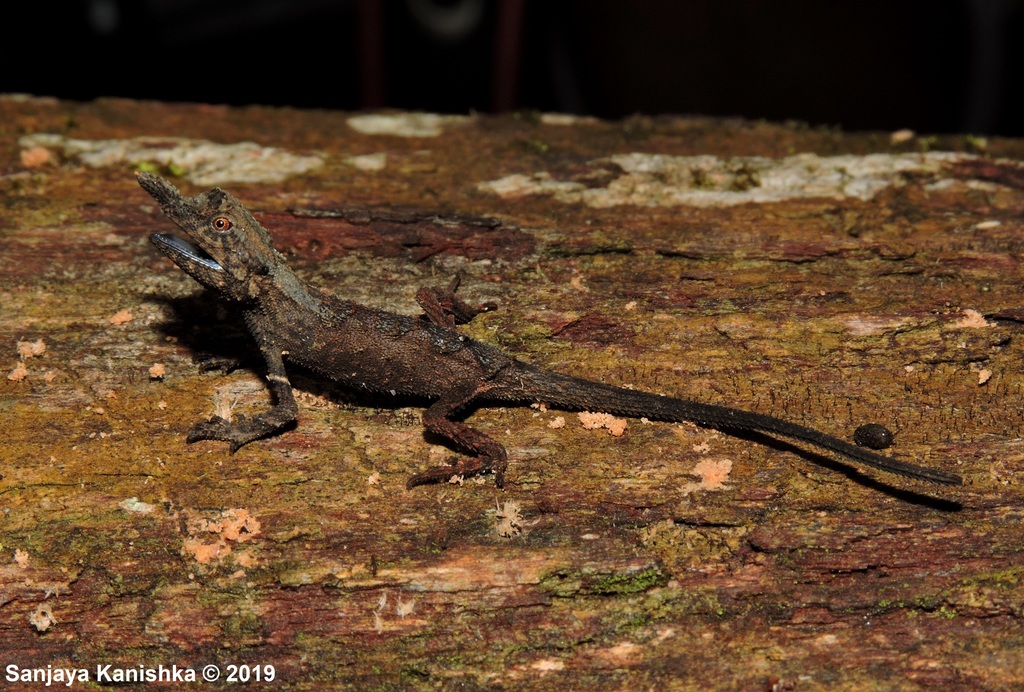
Ukuwelas' Rough-horn Lizard
Ceratophora ukuwelai
Ceratophora ukuwelai, or Ukuwelas's rough-horn lizard, is a species of agamid lizard. It was described in 2020 and is named after the herpetologist Kanishka Ukuwela. Some taxonomists have posited that Ukuwelas' rough-horn lizard might be better treated as being part of the rough-nosed horned lizard. Ukuwelas' rough-horn lizard is endemic to Salgala Forest in Kegalle District, Sri Lanka. It is found in thick leaf litter on the forest floor in dense patches of forest. The study describing the species recommended that it be classified as being critically endangered due to the species' small range, low encounter rates within its known range, and ongoing habitat loss. Habitat loss and fragmentation are the greatest threats to the species. Other threats include roadkill, thermal stress due to highway asphalt, and invasive species.
From the article Ceratophora ukuwelai on Wikipedia (CC BY-SA), quoted section by section
Description
Females have a snout–vent length of 36.4 to 37.9 mm. The upperside of the head, body and limbs are mostly grey-brown, while the tail is brown with dull serpentine markings. The chin, gular, and ventral scales are a mixture of dirty-white and red-brown. There is a white spot on the forehead, a Y-shaped brown marking on the area between the eyes, and a W-shaped pattern on the occiput. There are four grey diamond-shaped markings and black dots along the vertebrae. The labial scales are striped and there are two brown postorbital stripes past each eye. The upper side of both arms has a white ring. The back of the femur has a white line and the tibia has a white ring. The mouth is bluish-grey, the iris is copper-orange and the pupil is black. Males are slightly darker than females in colour. They also have a long complex rostral "horn" made of keeled acuminate scales.
Range & habitat
Ukuwelas' rough-horn lizard is endemic to Salgala Forest in Kegalle District, Sri Lanka. The area, located at the northern edge of the wet bioclimatic zone, comprises lowland tropical rainforest at elevations of 120–325 m. The forest is separated from other forests by the Kelani and Maha rivers, smaller streams, and human agricultural cultivation. The species is known from four localities within Salgala forest and, like other Ceratophora lizards, seems to be a rather rare species. The species is found in thick leaf litter on the forest floor in dense patches of forest. Its microhabitat is poorly lit, with a light intensity of 455–687 Lux, moist, shaded, and warm, with an average temperature of 27.7–28.2 °C. It occurs alongside several other agamids, including the common green forest lizard, oriental garden lizard, brown-patched kangaroo lizard, and Sri Lankan agama.
Wikipedia: “Distribution and habitat”
Where it lives
Recorded sightings
—
geo-referenced records in GBIF, from museums, herbaria and field observers.
Drag the globe to turn it. Dots are where records exist, not a range map; darker means more records.
In the stacks
Searching the stacks…
Every page naming Ceratophora ukuwelai in the Biodiversity Heritage Library →
This page is assembled live from iNaturalist, GBIF, Wikipedia, the Source Library and the Internet Archive. It is not yet part of the hand-edited codex. iNaturalist taxon 1161466.