- Animals
- ›Chordates
- ›Vertebrates
- ›Birds
- ›Perching Birds
- ›Ovenbirds and Woodcreepers
- ›Typical Ovenbirds
- ›Pseudocolaptes
On eBird ↗
Streaked Tuftedcheek
Live sightings near you, the range map, bar charts of when it is seen, and Macaulay Library photos and recordings.
Streaked Tuftedcheek
Pseudocolaptes boissonneautii
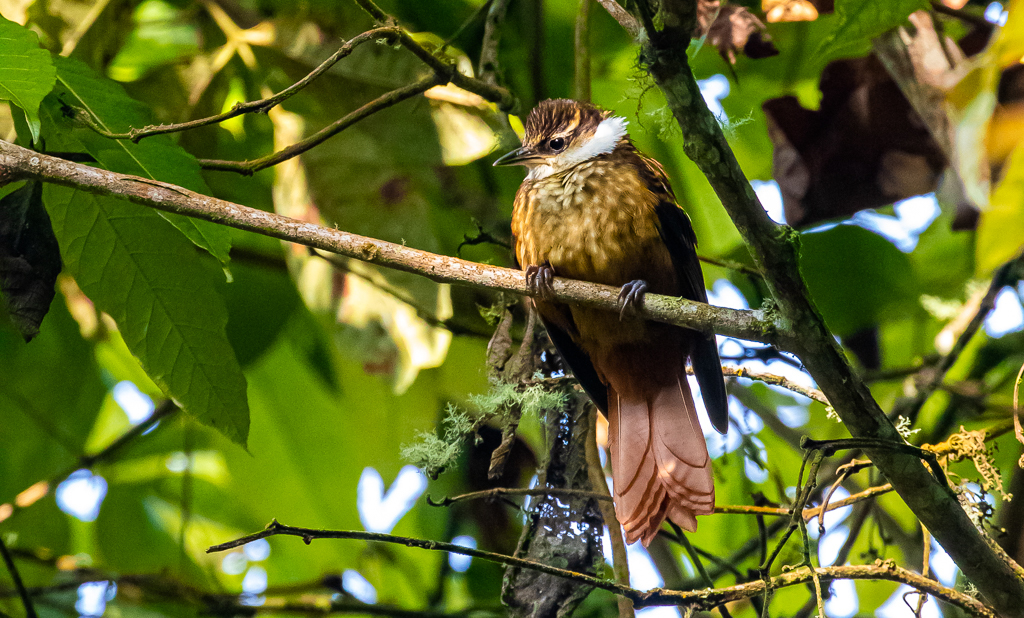
The streaked tuftedcheek (Pseudocolaptes boissonneautii) is a passerine bird in the ovenbird family, which breeds in the tropical New World in the coastal mountains of Venezuela, and the Andes from Venezuela to Bolivia. It is sometimes considered conspecific with the buffy tuftedcheek, P. lawrencii of Central America, Colombia and Ecuador.
From the article Streaked tuftedcheek on Wikipedia (CC BY-SA), quoted section by section
Description
The streaked tuftedcheek is 20 to 22 cm (7.9 to 8.7 in) long and weighs 37 to 62 g (1.3 to 2.2 oz). It is a rather large and strongly patterned ovenbird. The sexes' plumages are alike but the female of most subspecies has a significantly longer bill than the male. The species' most distinctive feature is its namesake tuft of almost pure white feathers that flare on the side of the neck. Adults of the nominate subspecies P. b. boissonneautii have a buff-whitish supercilium, blackish brown lores and ear coverts, and white cheeks. Their crown is blackish brown with many thin buff streaks, their hindneck and upper back similar with wider pale buff streaks, and the rest of their back rufescent brown. Their rump and uppertail coverts are bright chestnut rufous and their tail bright rufous. Their wings are blackish brown with pale rufous edges and tips on the coverts. Their secondaries have rufous edges at their base and their tertials are mostly rufous. Their throat is white, their breast a pale golden buff with dark brown feather edges that give a scaly look, and the rest of their underparts unmarked rufous that darkens to the undertail coverts. Their iris is brown to dark brown, their maxilla black, their mandible grayish white to silvery with a blackish upper third, and their legs and feet gray to slate. …
Range & habitat
The subspecies of the streaked tuftedcheek are found thus:
P. b. striaticeps: the Venezuelan Coastal Range P. b. meridae: the Serranía del Perijá and Andes that straddle the Colombia/Venezuela border P. b. boissonneautii: Colombia's Western and Southern Andes and the southern part of the Eastern Andes P. b. oberholseri: southern Colombia to southern Ecuador P. b. intermedianus: western slope of the Andes in northwestern Peru P. b. medianus: Andes of northern Peru P. b. auritus: eastern slope of the Andes of central Peru P. b. carabayae: eastern slope of the Andes from southern Peru south into central Bolivia The streaked tuftedcheek inhabits the interior and edges of humid montane evergreen forest and elfin forest. In elevation it mostly ranges from 1,700 to 3,200 m (5,600 to 10,500 ft) but is also found as low as 1,450 m (4,800 ft) and as high as 3,500 m (11,500 ft).
Wikipedia: “Distribution and habitat”
What it does
The streaked tuftedcheek's diet has not been studied in detail but is known to include arthropods and small amphibians. It forages singly or in pairs and frequently joins mixed species feeding flocks. It forages by clambering along branches from the forest's mid level to the canopy, and does most of its foraging in epiphytes. It also seeks prey in mosses and among clumps of dead leaves.
Wikipedia: “Feeding”
Listen
Looking for field recordings…
Where it lives
Recorded sightings
—
geo-referenced records in GBIF, from museums, herbaria and field observers.
Drag the globe to turn it. Dots are where records exist, not a range map; darker means more records.
In the stacks
This page is assembled live from iNaturalist, GBIF, Wikipedia, the Source Library and the Internet Archive. It is not yet part of the hand-edited codex. iNaturalist taxon 11603.