- Animals
- ›Chordates
- ›Vertebrates
- ›Birds
- ›Perching Birds
- ›Ovenbirds and Woodcreepers
- ›Woodcreepers
- ›Lepidocolaptes
On eBird ↗
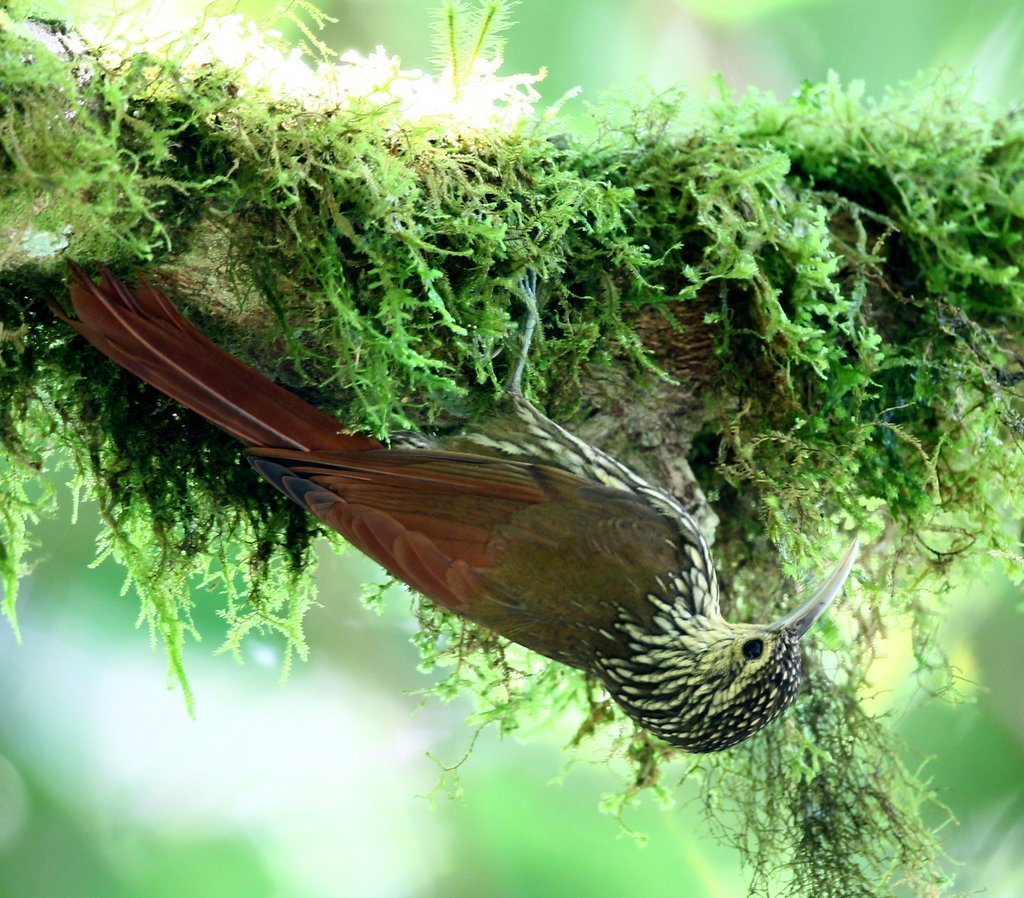
Spot-crowned Woodcreeper
Live sightings near you, the range map, bar charts of when it is seen, and Macaulay Library photos and recordings.
Spot-crowned Woodcreeper
Lepidocolaptes affinis
The spot-crowned woodcreeper (Lepidocolaptes affinis), is a passerine bird in the subfamily Dendrocolaptinae of the ovenbird family Furnariidae. it is found in Middle America from Mexico to Panama.
From the article Spot-crowned woodcreeper on Wikipedia (CC BY-SA), quoted section by section
Description
The spot-crowned woodcreeper is 19 to 22 cm (7.5 to 8.7 in) long and weighs 28 to 38 g (0.99 to 1.3 oz). It is a slim, medium-sized woodcreeper with a slim, moderately decurved bill. The sexes have the same plumage. Adults of the nominate subspecies L. a. affinis have a dusky face and sides of the neck with a black malar stripe. Their crown and nape are dark brown with conspicuous buffy spots or diamonds that sometimes extend as thin streaks onto the upper back. Their back and wing coverts are plain brown, their rump rufous-cinnamon, and their wings and tail rufous-chestnut. Their flight feathers have brown edges and the primaries have dusky tips. Their underparts are olive-brown with wide black-edged buffy streaks beginning on the lowest part of the throat that fade on the flanks and undertail coverts. Their underwing coverts are ochraceous buff. Their iris is dark brown and their legs and feet lead-gray to dull green. Their bill is bluish pink, pale gray, yellowish, or dark brown; its base is often darker and the tip a pale silvery horn. Juveniles are darker overall than adults, with less conspicuous spots on the crown, less distinct borders on the underside streaks, and a shorter and darker bill. Subspecies L. a. lignicida is similar to the nominate but much paler overall. L. a. …
Range & habitat
The spot-crowned woodcreeper's distribution is not continuous. Subspecies L. a. lignicida is the northernmost; it is found in the northeastern Mexican states of Nuevo León, Tamaulipas, and San Luis Potosí. The nominate L. a. affinis is found from southern Mexico south through Guatemala, Honduras, and El Salvador into Nicaragua. It does not occur in Belize. L. a. neglectus is found in Costa Rica and western Panama. The spot-crowned woodcreeper inhabits both humid and dry forests, mostly in the highlands. These include humid evergreen montane forest and cloudforest as well as drier deciduous, oak, pine, and pine-oak woodlands. It is found in the interior of primary forest but is thought to be more common at its edges and in mature secondary forest. It also occurs in plantations and in clearings and pastures with trees. In elevation it mostly ranges between 1,000 and 3,500 m (3,300 and 11,500 ft) but is found as low as 400 m (1,300 ft) in the non-breeding season. In Costa Rica it rarely occurs below 1,500 m (4,900 ft).
Wikipedia: “Distribution and habitat”
What it does
The spot-crowned woodcreeper's diet is almost entirely arthropods; beetles and their egg cases appear to be a major component. It typically forages singly or in pairs and regularly joins mixed-species feeding flocks. It sometimes follows army ant swarms. It hitches up trunks and branches, often in a spiral, typically from the forest's midlevel to the subcanopy. It captures much prey from epiphytes; it also takes prey by gleaning from surfaces and by probing bark crevices and moss. It sometimes flakes off bark to expose prey.
Wikipedia: “Feeding”
Listen
Looking for field recordings…
Where it lives
Recorded sightings
—
geo-referenced records in GBIF, from museums, herbaria and field observers.
Drag the globe to turn it. Dots are where records exist, not a range map; darker means more records.
In the stacks
Searching the stacks…
Every page naming Lepidocolaptes affinis in the Biodiversity Heritage Library →
This page is assembled live from iNaturalist, GBIF, Wikipedia, the Source Library and the Internet Archive. It is not yet part of the hand-edited codex. iNaturalist taxon 11562.